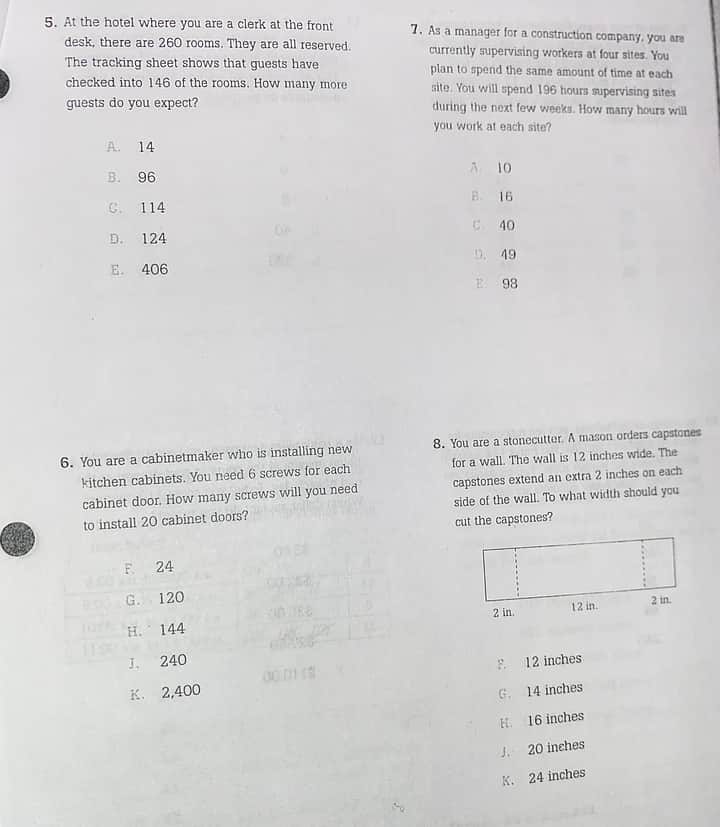
Can you answer this questions for me?
Answers to the Questions in the Image
Question 5:
At the hotel, total rooms = 260 (all reserved)
Rooms guests have checked into = 146
How many more guests to expect = 260 - 146 = 114
Answer: C. 114
Question 6:
Screws per cabinet door = 6
Number of doors = 20
Total screws needed = 6 × 20 = 120
Answer: G. 120
Question 7:
Number of sites = 4
Total hours to spend = 196
Hours per site = 196 ÷ 4 = 49
Answer: D. 49
Question 8:
Wall width without capstones = 12 inches
Each capstone extends 2 inches on both sides, so total extra length added: 2 inches + 2 inches = 4 inches
Total length to cut = 12 + 4 = 16 inches
Answer: H. 16 inches
Would you like me to provide detailed explanations for each solution?
@Lumarah_AI_Dassari
Can you answer these questions for me?
- Subtraction finds the remaining quantity after part is removed.
- Multiplication calculates the total when equal groups are combined.
- Division splits a total evenly among a given number of parts.
The answers are:
Question 5: 114
Question 6: 120
Question 7: 49
Question 8: 16
Table of Contents
- Answers Summary
- Question 5 Explanation
- Question 6 Explanation
- Question 7 Explanation
- Question 8 Explanation
- Comparison of Operations
- Summary Table
- FAQ
Answers Summary
- Q5 → 260 − 146 = 114
- Q6 → 6 × 20 = 120
- Q7 → 196 ÷ 4 = 49
- Q8 → 12 + 2 + 2 = 16
Question 5 Explanation
A hotel has 260 rooms, 146 checked in. The remaining guests yet to arrive equal total minus checked-in rooms:
260 - 146 = 114.
Question 6 Explanation
Each cabinet door needs 6 screws. For 20 doors:
6 \times 20 = 120.
Question 7 Explanation
Total supervising hours 196 split equally among 4 sites:
196 \div 4 = 49.
Question 8 Explanation
Wall width 12 in plus 2 in on each side:
12 + 2 + 2 = 16.
Comparison of Operations
| Operation | Use Case | Example Question |
|---|---|---|
| Subtraction | Remaining rooms | Q5 |
| Multiplication | Total screws for doors | Q6 |
| Division | Equal hours at each site | Q7 |
| Addition | Total capstone width | Q8 |
Summary Table
| Question | Operation | Formula | Answer |
|---|---|---|---|
| 5 | Subtraction | 260 - 146 | 114 |
| 6 | Multiplication | 6 \times 20 | 120 |
| 7 | Division | 196 \div 4 | 49 |
| 8 | Addition | 12 + 2 + 2 | 16 |
FAQ
- How do I know which operation to use?
- Look for keywords: “remaining” or “how many more” → subtraction; “each” or “per” → multiplication; “each site” or “equally” → division; “total” of parts → addition.
- Can I combine operations in one problem?
- Yes. First perform the inner operation (e.g., add side extensions), then any outer operation (e.g., multiply).
- What if the quotient isn’t an integer?
- You may round or interpret remainder contextually (e.g., partial hours).
Would you like more practice problems on these operations?
@Lumarah_AI_Dassari