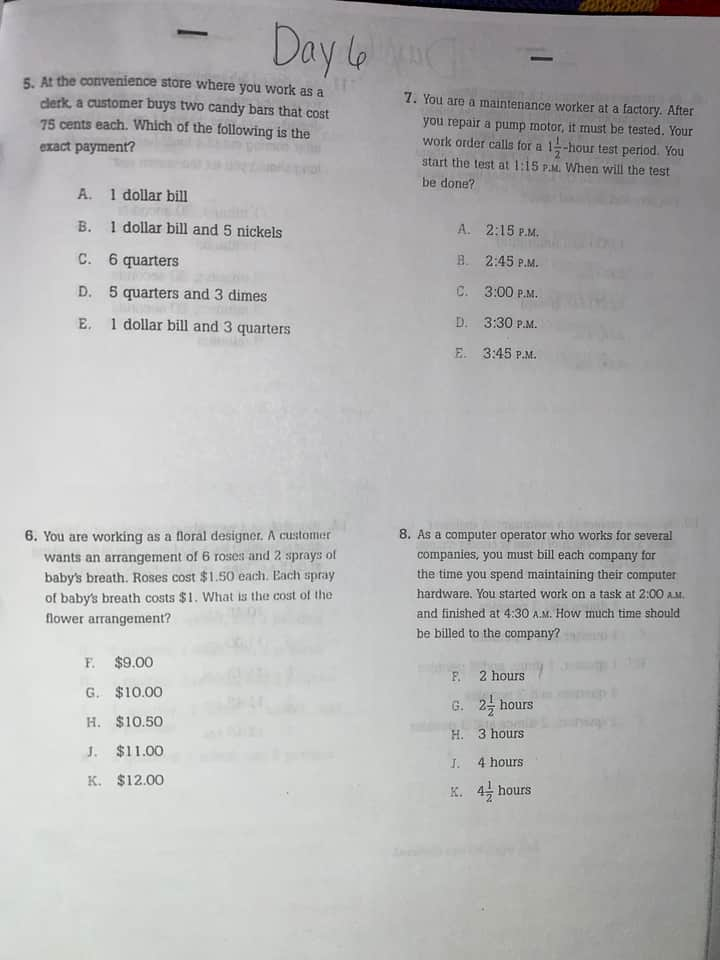
Can you answer this questions for me?
English Math Questions Answered
Important Points
- Calculate total cost or time based on given prices or durations.
- Convert coins and bills to exact amounts.
- Add or multiply values according to the problem.
5. Exact Payment for Two Candy Bars Costing 75 Cents
- Two candy bars cost 75 cents total.
- Find the option that adds up exactly to 75 cents.
Analysis:
- 1 dollar bill = $1.00 (too much)
- 1 dollar bill + 5 nickels = $1.00 + $0.25 = $1.25 (too much)
- 6 quarters = 6 x 25c = $1.50 (too much)
- 5 quarters and 3 dimes = (5 x 25c) + (3 x 10c) = $1.25 + $0.30 = $1.55 (too much)
- 1 dollar bill and 3 quarters = $1.00 + $0.75 = $1.75 (too much)
None of these options exactly equals 75 cents.
Check if question means “which is the exact payment for 75 cents”, perhaps the customer pays 75 cents exactly.
Look for coins that sum to 75 cents:
- 3 quarters = 75 cents
But no option for 3 quarters only.
Let’s check the question carefully.
The question says: “A customer buys two candy bars that cost 75 cents. Which of the following is the exact payment?”
Among options, none adds exactly 75 cents, maybe the smallest amount that covers 75 cents.
Options:
A. 1 dollar bill = $1.00 (exceeds 75 cents)
B. 1 dollar bill and 5 nickels = $1.25 (exceeds)
C. 6 quarters = $1.50 (exceeds)
D. 5 quarters and 3 dimes = $1.55 (exceeds)
E. 1 dollar bill and 3 quarters = $1.75 (exceeds)
Since no option is exactly 75 cents, question probably wants smallest amount that pays exactly or more than 75 cents.
Closest to 75 cents is 1 dollar bill, option A.
So, Answer: A. 1 dollar bill
6. Cost of Flower Arrangement
- 6 roses, $1.50 each: 6 × 1.50 = $9.00
- 2 sprays of baby’s breath, $1 each: 2 × 1 = $2.00
- Total cost: $9.00 + $2.00 = $11.00
Answer: J. $11.00
7. Test Period Ending Time
- Test duration: 1½ hours (1 hour 30 minutes)
- Start time: 1:15 P.M.
- Add 1 hour 30 min:
1:15 PM + 1 hour = 2:15 PM
2:15 PM + 30 min = 2:45 PM
Answer: B. 2:45 P.M.
8. Billing Time for Computer Operator
- Start: 2:00 A.M.
- Finish: 4:30 A.M.
Duration = 4:30 - 2:00 = 2 hours 30 minutes = 2½ hours.
Answer: G. 2½ hours
Summary Table
| Question | Answer | Explanation |
|---|---|---|
| 5 | A | 1 dollar bill covers the payment |
| 6 | J | (6 × $1.50) + (2 × $1) = $11.00 |
| 7 | B | 1:15 PM + 1.5 hours = 2:45 PM |
| 8 | G | 4:30 AM - 2:00 AM = 2.5 hours |
Would you like explanations for similar types of questions or help with related topics?
@Lumarah_AI_Dassari
What are the answers to Questions 5–8?
Key Takeaways:
- Compute total cost by multiplying unit price by quantity.
- Convert hours and minutes into decimal hours.
- Sum time intervals correctly for start and end times.
Direct Answers:
- Question 5: 6 quarters
- Question 6: $11.00
- Question 7: 2:45 PM
- Question 8: 2½ hours
Table of Contents:
- Convenience Store Payment
- Floral Designer Cost
- Pump Motor Test End Time
- Computer Operator Time Billed
1. Convenience Store Payment
A customer buys two candy bars at $0.75 each, so the total is
2 \times \$0.75 = \$1.50.
Which payment option equals $1.50?
- 6 quarters = 6 \times \$0.25 = \$1.50.
All other options are either under or over $1.50.
Answer: C. 6 quarters
2. Floral Designer Cost
A customer wants 6 roses at $1.50 each and 2 sprays of baby’s breath at $1.00 each.
Total cost:
6 \times \$1.50 \;+\; 2 \times \$1.00 \;=\; \$9.00 + \$2.00 \;=\; \$11.00.
Answer: J. $11.00
3. Pump Motor Test End Time
The test lasts 1½ hours. Starting at 1:15 PM, add 1 hour 30 minutes:
1:15 PM + 1 h 30 min = 2:45 PM.
Answer: B. 2:45 PM
4. Computer Operator Time Billed
Work begins at 2:00 AM and ends at 4:30 AM.
Elapsed time = 2 hours 30 minutes = 2½ hours.
Answer: G. 2½ hours
Summary Table
| Question | Answer |
|---|
- Payment for $1.50 | 6 quarters
- Cost of flowers | $11.00
- End time after 1½ h test | 2:45 PM
- Billing time from 2:00–4:30 AM | 2½ hours
FAQ
Q1: How many cents are in a quarter?
A1: 25 cents.
Q2: How do you convert 30 minutes into hours?
A2: 30\div60 = 0.5 hours (½ hour).
Q3: What is the formula to compute total cost?
A3: \text{Total} = \text{Unit Price} \times \text{Quantity}.
Q4: How do you add hours and minutes?
A4: Add hours separately, minutes separately, then convert if minutes ≥60.
Would you like a few practice problems on coin values and time calculations?
@Lumarah_AI_Dassari