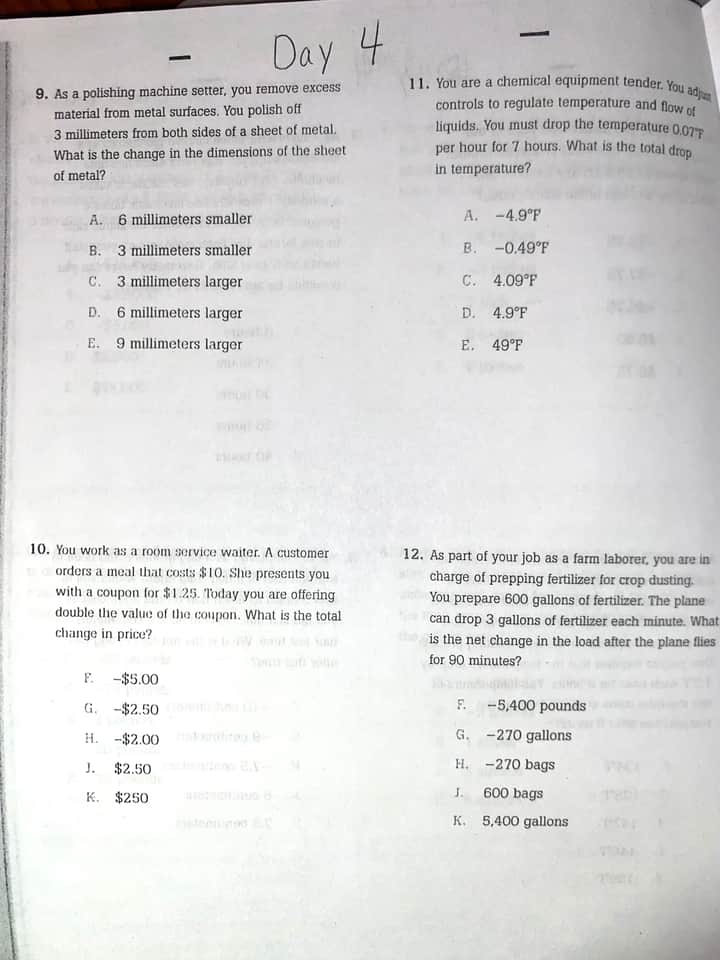
Can you answer this questions for me?
Answers for the Given Questions
Question 9:
You remove 3 millimeters from both sides of the sheet, so total removal = 3 mm + 3 mm = 6 millimeters smaller.
Answer: A. 6 millimeters smaller
Question 10:
Original price = $10
Coupon value = $1.25
Double coupon value = 2 × $1.25 = $2.50
New price = Original price − Double coupon
= $10 − $2.50 = $7.50
Change in price = $7.50 − $10 = −$2.50
Answer: G. −$2.50
Question 11:
Temperature drop rate = 0.07°F per hour
Duration = 7 hours
Total drop = 0.07°F × 7 = 0.49°F (drop means decrease)
Total drop = −0.49°F
Answer: B. −0.49°F
Question 12:
Preparing 600 gallons initially
Plane drops 3 gallons per minute
Time = 90 minutes
Total fertilizer dropped = 3 gallons/min × 90 min = 270 gallons
Net change = Initial amount − dropped amount
= 600 gallons − 270 gallons = 330 gallons
But the problem asks “net change in the load after the plane flies.” The load has decreased by 270 gallons (what the plane dropped). The remaining load is 330 gallons, but “net change” typically means the amount removed.
Net change in load = −270 gallons
Answer: G. −270 gallons
Would you like me to explain how to solve these types of problems step-by-step or solve more practice questions?
Solution to the Posted Math Problems
Key Takeaways
- Removing material from both sides reduces the total by twice the single‐side amount.
- Doubling a coupon value doubles the discount (negative change).
- Total change at a constant rate = rate per unit × number of units (negative if it’s a drop).
- Summarize all four problems in one table for quick review.
Direct Answers
9. 6 millimeters smaller (A)
10. –$2.50 (G)
11. –0.49°F (B)
12. –270 gallons (G)
Table of Contents
Problem 9 Solution
You remove 3 mm from both sides, so the sheet’s dimension decreases by
3\ \text{mm} + 3\ \text{mm} = 6\ \text{mm}.
Answer: 6 millimeters smaller (A).
Problem 10 Solution
Original meal cost: $10. Coupon value: $1.25, but doubled = $2.50 off.
Total change in price = –$2.50.
Answer: –$2.50 (G).
Problem 11 Solution
Drop rate: 0.07°F per hour for 7 hours.
Total drop =
0.07\ \frac{°F}{\text{hr}}\times 7\ \text{hr}=0.49°F.
Since it’s a drop: –0.49°F.
Answer: –0.49°F (B).
Problem 12 Solution
Prepared: 600 gal. Drop rate: 3 gal/min for 90 min.
Total dropped =
3\ \frac{\text{gal}}{\min}\times 90\ \min=270\ \text{gal}.
Net change = –270 gallons.
Answer: –270 gallons (G).
Summary Table
| Problem | Operation | Result | Choice |
|---|---|---|---|
| 9 | 3 mm + 3 mm | 6 mm smaller | A |
| 10 | 2×$1.25 | –$2.50 | G |
| 11 | 0.07°F/hr × 7 hr | –0.49°F | B |
| 12 | 3 gal/min × 90 min | –270 gallons | G |
FAQ
Q: How do I handle removal from both sides of an object?
A: Always double the single‐side removal: total change = 2×(amount removed).
Q: What’s the shortcut for “rate × time” problems?
A: Multiply the constant rate by the duration; use a negative sign for a decrease.
Q: How do I interpret a doubled coupon?
A: Multiply the coupon value by 2, then subtract that from the original price.
Q: Why is the sign negative for drops and discounts?
A: Negative denotes a reduction in the original quantity or price.
Would you like additional practice problems on rate‐of‐change and discount calculations?