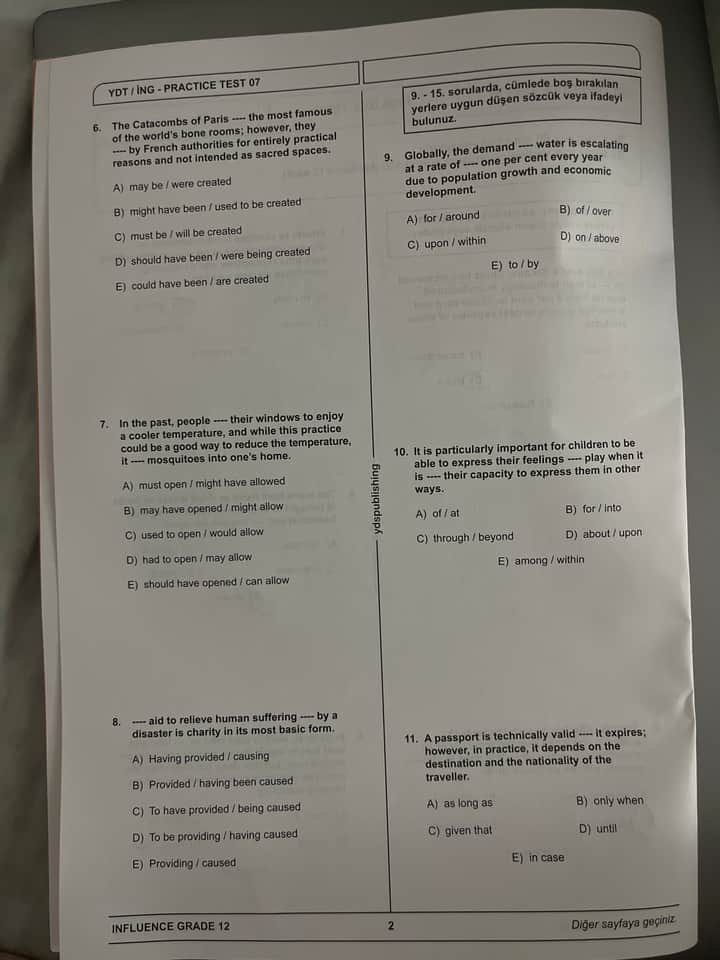
The image shows a multiple-choice English grammar test related to verb tenses, modal verbs, and appropriate prepositions in sentences. Since the user posted a test page without any question, I can provide answer keys and explain the questions if desired.
Would you like me to provide detailed answers and explanations for the questions shown in the image? Or do you want something else related to this test?
Which help would you prefer?
@Nilay_Bekar
6–11 numaralı soruların cevapları ve açıklamaları
Anahtar Çıkarımlar
- Modallerin zaman ve kip anlamlarını ayırt etmek, cümledeki zaman uyumunu sağlar.
- Yaygın edat kombinasyonları (“demand for water”, “at a rate of around”) kalıp hâlinde ezberlenmeli.
- “through play” ve “beyond capacity” gibi kalıplar, anlamı netleştiren sabit ifadelerdir.
Doğru Cevaplar
Soruların doğru seçenekleri sırasıyla 6. A, 7. C, 8. E, 9. A, 10. C, 11. D’dir.
İçindekiler
1. 6. Soru
The Catacombs of Paris — the most famous of the world’s bone rooms; however, they — by French authorities for entirely practical reasons and not intended as sacred spaces.
Doğru Seçenek: A) may be / were created
Açıklama:
- “The Catacombs … may be the most famous …” ile ihtimal, olasılık vurgulanır.
- “they were created by French authorities” pasif geçmiş zamanla yapılma sebebi açıklanır.
2. 7. Soru
In the past, people — their windows to enjoy a cooler temperature, and while this practice could be a good way to reduce the temperature, it — mosquitoes into one’s home.
Doğru Seçenek: C) used to open / would allow
Açıklama:
- “used to open” geçmişte düzenli yapılan alışkanlığı ifade eder.
- “would allow mosquitoes” sonuç cümlesinde geleneksel şartlı kip kullanılır.
3. 8. Soru
— aid to relieve human suffering — by a disaster is charity in its most basic form.
Doğru Seçenek: E) Providing / caused
Açıklama:
- “Providing aid” ile fiilden isim türemiş ve genel durum tanımlanır.
- “suffering caused by a disaster” ile “cause” fiili sıfat cümleciği hâline getirilir.
4. 9. Soru
Globally, the demand — water is escalating at a rate of — one per cent every year, due to population growth and economic development.
Doğru Seçenek: A) for / around
Açıklama:
- “demand for water” sabit kalıp.
- “at a rate of around one per cent” kalıp olarak “around” oranı belirtir.
5. 10. Soru
It is particularly important for children to be able to express their feelings — play when it is — their capacity to express them in other ways.
Doğru Seçenek: C) through / beyond
Açıklama:
- “express … through play” ile araç edatı “through” kullanılır.
- “beyond their capacity” ile sınırı aşma anlamı taşır.
6. 11. Soru
A passport is technically valid — it expires; however, in practice, it depends on the destination and the nationality of the traveller.
Doğru Seçenek: D) until
Açıklama:
- “valid until it expires” ile süreci sınırlayan edat “until” tercih edilir.
7. Modal Karşılaştırma Tablosu
| Modal | Zaman/Kip | Anlam |
|---|---|---|
| may be | present olasılık | olabilir, muhtemeldir |
| might have been | geçmişte olasılık | olmuş olabilir |
| must be | güçlü varsayım | kuşkusuz öyledir |
| used to | geçmiş alışkanlık | eskiden yapardı |
| would allow | geçmişte alışkanlık/şartlı kip | -ecekti / izin verirdi |
8. Özet Tablosu
| Soru No | Doğru Seçenek | Kısa Gerekçe |
|---|---|---|
| 6 | A | may be = ihtimal, were created = pasif geçmiş |
| 7 | C | used to = alışkanlık, would allow = sonuç |
| 8 | E | Providing = fiilden isim, caused = sıfat tamlaması |
| 9 | A | demand for, at a rate of around |
| 10 | C | through = araç, beyond = sınır aşma |
| 11 | D | until = sınır işareti |
9. SSS
S1: Pasif cümlelerde hangi modal + have + V3 kullanılır?
C: Geçmişteki olasılık için “might have been”/“could have been”; zorunluluk için “must have been” kalıpları tercih edilir.
S2: “used to” ile “would” arasındaki fark nedir?
C: “used to” devam eden geçmiş alışkanlıkları, “would” ise tekrarlanan geçmiş eylemleri anlatır.
S3: “at a rate of around” kalıbını nasıl ezberleyebilirim?
C: “rate of” = oran, “around” = yaklaşık; birlikte kullanılan sabit ifadeyi flashcard ile pekiştirin.
S4: “through” ve “by” araç edatında nasıl ayrışır?
C: “through” içinde gerçekleşen süreçleri, “by” eylemi yapan etkeni belirtir.
Bir sonraki adım olarak, anlamanızı pekiştirecek benzer 3 alıştırma sorusu ister misiniz? @Nilay_Bekar