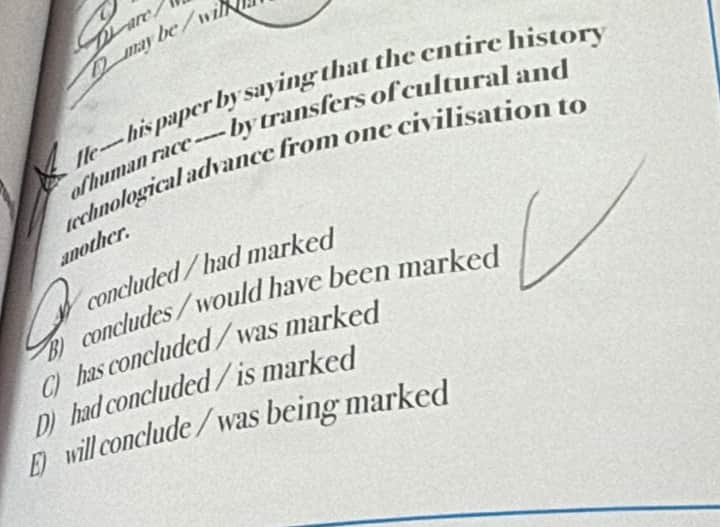
Why is the answer C in the given fill-in-the-blank question?
Önemli Noktalar
- The sentence structure requires correct tense agreement between the two parts of the sentence.
- The first blank needs a present perfect tense (has concluded) to imply a completed action with present relevance.
- The second blank needs simple past passive tense (was marked) to describe a past event.
- Answer C, “has concluded / was marked”, correctly fits this tense relationship.
The sentence likely deals with an event or fact that is completed with ongoing relevance (“has concluded”) and a past action that definitely happened (“was marked”). Other options either mismatch tenses, use incorrect forms, or convey illogical time relationships.
İçindekiler
- Tense Explanation for the First Blank
- Tense Explanation for the Second Blank
- Why Other Options Are Incorrect
- Özet Tablo
- Sık Sorulan Sorular
Tense Explanation for the First Blank
The phrase before the first blank suggests a completed action with present consequences. The present perfect tense (“has concluded”) signals that the act of concluding happened recently or has importance now.
Examples of Present Perfect Use:
- “He has finished the project.” (Completed recently or relevant now)
- “She has read the book.” (Experience up to now)
In contrast, past simple or past perfect tenses often do not fit well if the sentence context emphasizes present relevance.
Pro Tip: Use present perfect when past action affects the present moment in time.
Tense Explanation for the Second Blank
The second blank describes an action that was done to the subject — this calls for the simple past passive tense (“was marked”). Past passive is used to report completed actions done to the subject at a specific time in the past.
Examples:
- “The test was marked yesterday.”
- “The results were announced last week.”
This tense fits with the first part (“has concluded”) because the marking event occurred in the past as a completed fact.
Warning: Using present or future forms here would create a time-consistency error.
Why Other Options Are Incorrect
| Option | Why Incorrect |
|---|---|
| A) concluded / had marked | “concluded” is past simple, but the sentence needs present perfect; “had marked” is past perfect which also mismatches timing |
| B) concludes / would have been marked | “concludes” is present simple, which is unusual for completed actions here; “would have been marked” is conditional perfect passive, implying uncertainty |
| D) had concluded / is marked | Past perfect is too early for the first blank; “is marked” is present passive, inconsistent with past narrative |
| E) will conclude / was being marked | Future tense does not fit context for first blank; past continuous passive tense for second blank is not suitable for a completed action |
Only C aligns correct tense pairing for a complete and logical sentence.
Özet Tablo
| Aspect | Explanation | Correct in Option C |
|---|---|---|
| First blank tense | Present perfect (completed & relevant now) | has concluded |
| Second blank tense | Simple past passive (completed past action) | was marked |
| Time consistency | Matches logical chronological order | Yes |
| Sentence meaning clarity | Clearly shows event concluded, and marking occurred | Yes |
Sık Sorulan Sorular
1. Why is “has concluded” preferred over “concluded”?
“Has concluded” (present perfect) shows completed action with current relevance, fitting this sentence’s meaning better than simple past “concluded,” which states past action without present connection.
2. Can “was marked” be replaced by “is marked”?
No, “is marked” suggests a habitual or present ongoing action, which clashes with the past event marked by the first verb’s tense and context.
3. Why not use future tense like “will conclude”?
The context does not refer to future events but a completed history or fact, so future tense creates a time inconsistency.
Sonraki Adımlar
Would you like me to analyze more examples of present perfect vs past simple tense usage in exam questions?
Why is answer C correct?
- Present Perfect is required in the first blank to show the paper’s completion with relevance to the present context.
- Simple Past Passive is used in the second blank to describe a completed historical characteristic.
- Other tense combinations either misplace time reference or misuse voice/mood.
Table of Contents
1. Deep Dive Explanation
The sentence reads:
“He ____ his paper by saying that the entire history of human race ____ by transfers of cultural and technological advance from one civilisation to another.”
-
First blank
- Completed action still relevant now → Present Perfect (has concluded).
- He has concluded his paper … emphasizes that the ending is fresh and ties into the present discussion.
-
Second blank
- Describes a past characteristic of history → Simple Past Passive (was marked).
- … history was marked by transfers … states a fact about history as a completed period.
Other options fail because:
- Simple past (concluded) loses present relevance.
- Past perfect (had concluded) implies a later past action to compare against.
- Incorrect mix of voices/moods or unnatural time reference.
2. Comparative Tenses Table
| Tense | Form | Use | Example |
|---|---|---|---|
| Present Perfect | has/have + past participle | Completed action with ongoing relevance to the present | has concluded |
| Simple Past Passive | was/were + past participle | Completed action in the past, focus on the action itself | was marked |
| Past Perfect | had + past participle | Action completed before another past action | had concluded |
3. Summary Table
| Blank Position | Chosen Form | Reason |
|---|---|---|
| First | has concluded (Present Perfect) | Highlights a recently completed action still relevant now |
| Second | was marked (Simple Past Passive) | States a past characteristic of “the entire history” |
FAQ
Q1: When should I use present perfect instead of simple past?
A1: Use present perfect for past actions that have current relevance or no specific time is mentioned.
Q2: Why not use past perfect (“had concluded”) in the first blank?
A2: Past perfect compares two past events; here there’s no later past action—only relevance to the present.
Q3: Could “concluded” (simple past) work in the first blank?
A3: Grammatically possible, but it removes the nuance of “recently finished and relevant now” that the exam tests.
Q4: Why is the second clause passive?
A4: The focus is on history being “marked,” not on who marked it—typical when describing broad historical trends.
Would you like more practice exercises on perfect tenses and passive constructions?
@Yrn000