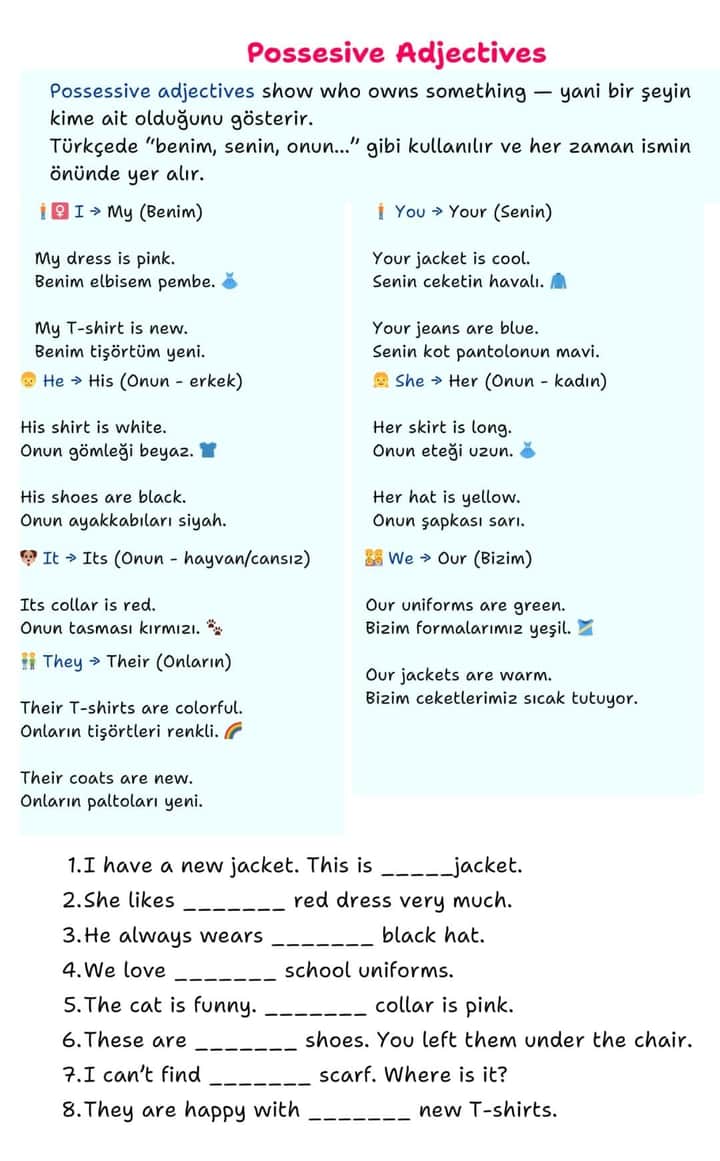
Possessive Adjectives: Boşlukları Doldurma Cevapları
Önemli Noktalar
- Possessive adjectives, bir şeye aitliği belirtir ve İngilizcede isimden önce gelir.
- My, your, his, her, its, our, their en yaygın kullanılan sahiplik sıfatlarıdır.
- Türkçedeki benim, senin, onun, bizim, onların gibi karşılıklar vardır.
- İngilizcede kişi zamirlerine göre değişir ve nesne ya da canlı olup olmaması önemlidir (örneğin its hayvan/cansız nesne içindir).
Bu etkinlikte boşluklara doğru possessive adjectives yerleştirilmelidir. Aşağıda her cümlenin doğru cevabı verilmiştir.
İçindekiler
- Cümleler ve Doğru Possessive Adjective Seçenekleri
- Possessive Adjectives Kısaca Özet Tablo
- Sık Sorulan Sorular
Cümleler ve Doğru Possessive Adjective Seçenekleri
- I have a new jacket. This is my jacket.
- She likes her red dress very much.
- He always wears his black hat.
- We love our school uniforms.
- The cat is funny. Its collar is pink.
- These are their shoes. You left them under the chair.
- I can’t find my scarf. Where is it?
- They are happy with their new T-shirts.
Pro Tip: Possessive adjectives kişinin sahipliğini belirtirken, isimden önce gelir ve kişi zamiriyle (person) tam uyum içinde olmalıdır.
Possessive Adjectives Kısaca Özet Tablo
| Kişi | Possessive Adjective | Türkçe Karşılığı |
|---|---|---|
| I | My | Benim |
| You | Your | Senin/Sizin |
| He | His | Onun (erkek) |
| She | Her | Onun (kadın) |
| It | Its | Onun (cansız/hayvan) |
| We | Our | Bizim |
| They | Their | Onların |
Sık Sorulan Sorular
1. Possessive adjective ile possessive pronoun arasındaki fark nedir?
Possessive adjective (sahiplik sıfatı), sahiplik gösterir ve isimden önce gelir: “my book”, “her car”. Possessive pronoun ise ismin yerine geçer ve tek başına kullanılır: “mine”, “hers”.
2. “Its” neden genellikle hayvanlar veya cansızlar için kullanılır?
İngilizcede kişi ve nesnelerin sahiplik ifadeleri farklıdır. İnsanlar için “his” veya “her” kullanılırken, hayvanlar ve cansız nesneler için “its” tercih edilir. Bu, dilin gramer kuralıdır.
3. Birden fazla kişiye ait durumlarda hangi possessive adjective kullanılır?
Bir grubun sahip olduğu bir şeyi ifade etmek için “our” (bizim) ya da “their” (onların) kullanılır: “our house”, “their school”.
4. Possessive adjective’lar cümle içinde nasıl yer alır?
Possessive adjective, her zaman sahip olunan ismin önünde yer alır ve ismi belirtir: “Her dress is red.”
5. “Your” hem tekil hem de çoğul mü?
Evet, “your” hem tekil “senin” hem de çoğul “sizin” anlamındadır, bağlama göre değişir.
Sonraki Adımlar
Possessive adjectives konusunda alıştırma yapmayı ister misiniz? Size cümle tamamlama ya da çeviri soruları hazırlayabilirim. Ayrıca, possessive pronouns ile karşılaştırmalı açıklama yapmam faydalı olur mu?
Fill in the blanks with the correct possessive adjectives.
- Possessive adjectives indicate ownership and always precede the noun they modify.
- The seven English possessive adjectives are my, your, his, her, its, our, their.
- They differ from possessive pronouns (mine, yours, etc.) in that they cannot stand alone.
Direct Answer:
Possessive adjectives in English come before a noun to show to whom something belongs. In the sentences below, the correct forms are:
| № | Sentence | Answer |
|---|---|---|
| 1 | I have a new jacket. This is _____ jacket. | my |
| 2 | She likes ______ red dress very much. | her |
| 3 | He always wears ______ black hat. | his |
| 4 | We love ______ school uniforms. | our |
| 5 | The cat is funny. ______ collar is pink. | its |
| 6 | These are ______ shoes. You left them under the chair. | your |
| 7 | I can’t find ______ scarf. Where is it? | my |
| 8 | They are happy with ______ new T-shirts. | their |
Table of Contents
1. Answers
As shown above, the filled-in possessive adjectives are my, her, his, our, its, your, my, their respectively.
2. Comparison: Possessive Adjectives vs Possessive Pronouns
| Subject Pronoun | Possessive Adjective | Possessive Pronoun |
|---|---|---|
| I | my | mine |
| you | your | yours |
| he | his | his |
| she | her | hers |
| it | its | — |
| we | our | ours |
| they | their | theirs |
3. Summary Table
| Possessive Adjective | Usage Example |
|---|---|
| my | my book, my car |
| your | your house, your idea |
| his | his shirt, his opinion |
| her | her dress, her choice |
| its | its tail, its color |
| our | our school, our project |
| their | their plans, their uniforms |
4. FAQ
Q1: When do we use its versus it’s?
A1: its is the possessive adjective for “it.” it’s is a contraction of “it is” or “it has.”
Q2: Can we ever omit the possessive adjective before the noun?
A2: No. Omitting it changes the meaning; you’d need a possessive pronoun instead (e.g., “This book is mine,” not “This book is my”).
Q3: How do I decide between your and their?
A3: Use your when speaking directly to “you” (singular or plural). Use their when referring to “they” (third-person plural).
Would you like me to create additional practice exercises to reinforce these possessive adjectives? @Faruk6