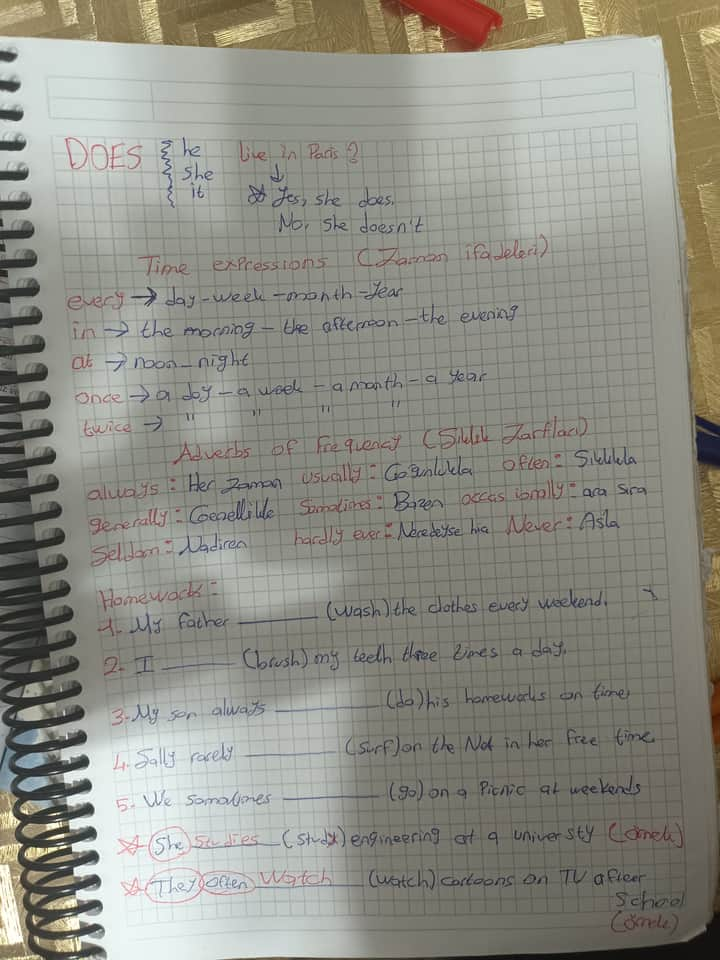
What is the correct form of the verbs in the following sentences?
Table of Contents
- Overview of Present Simple Tense
- Conjugation Rules for He/She/It
- Position of Adverbs of Frequency
- Homework Sentences and Detailed Solutions
- Summary Table of Answers
- Key Takeaways
1. Overview of Present Simple Tense
The Present Simple tense is used to talk about:
- Habits and routines
- Permanent facts
- General truths
- Scheduled events (timetables)
Form:
Subject + base verb (for I/you/we/they)
Subject + verb +s/es (for he/she/it)
Examples:
- I walk to school every day.
- She writes emails in the morning.
2. Conjugation Rules for He/She/It
When the subject is he, she, or it, add –s (or –es) to the base form:
| Rule | When to add |
|---|---|
| Most verbs | + s → work → works |
| Verbs ending in –o, –ch, –sh, –ss, –x, –z | + es → go → goes, watch → watches |
| Verbs ending in consonant + y | change y → i + es → study → studies |
| Verbs ending in vowel + y | + s → play → plays |
3. Position of Adverbs of Frequency
Adverbs of frequency (always, usually, often, sometimes, rarely, never) generally go before the main verb but after “to be”:
- Before main verb:
Subject + always + verb → She always arrives on time. - After “to be”:
Subject + am/is/are + always → He is always punctual.
Common adverbs in order of frequency:
always > usually > generally > often > sometimes > seldom/rarely > hardly ever > never
4. Homework Sentences and Detailed Solutions
Below are the five sentences you need to complete. We will apply the conjugation rules and adverb placement as explained above.
-
My father _______ (wash) the clothes every weekend.
- Subject: My father → he → third person singular
- Verb: wash → washes
- Completed: My father washes the clothes every weekend.
-
I _______ (brush) my teeth three times a day.
- Subject: I → first person → base form
- Verb: brush → brush
- Time expression “three times a day” does not affect verb form.
- Completed: I brush my teeth three times a day.
-
My son always _______ (do) his homework on time.
- Subject: My son → he → third person singular
- Adverb: always → before the verb
- Verb: do → does
- Completed: My son always does his homework on time.
-
Sally rarely _______ (surf) on the Net in her free time.
- Subject: Sally → she → third person singular
- Adverb: rarely → before the verb
- Verb: surf → surfs
- Completed: Sally rarely surfs on the Net in her free time.
-
We sometimes _______ (go) on a picnic at weekends.
- Subject: we → base form
- Adverb: sometimes → before the verb
- Verb: go → go
- Completed: We sometimes go on a picnic at weekends.
5. Summary Table of Answers
| # | Sentence Beginning | Correct Form |
|---|---|---|
| 1 | My father | washes the clothes every weekend. |
| 2 | I | brush my teeth three times a day. |
| 3 | My son always | does his homework on time. |
| 4 | Sally rarely | surfs on the Net in her free time. |
| 5 | We sometimes | go on a picnic at weekends. |
| 6* | She | studies engineering at a University. (given as correct) |
| 7* | They often | watch cartoons on TV after school. (given as correct) |
* Sentences 6 and 7 were already marked correct in your notes.
6. Key Takeaways
- Third person singular subjects (he/she/it) take –s or –es in the Present Simple.
- Adverbs of frequency typically sit before the main verb but after “to be.”
- Time expressions (every day, three times a day) do not change the verb form.
- Consistency in placement of adverbs keeps your sentences clear and correct.
By following these rules, you’ll master routine statements in English quickly.
Resimdeki boşlukları Present Simple ile doldur
Cevap:
- My father washes the clothes every weekend.
- I brush my teeth three times a day.
- My son always does his homework on time. (Not: homeworks — “homework” uncountable.)
- Sally rarely surfs on the Net in her free time.
- We sometimes go on a picnic at weekends.
- She studies engineering at a university.
- They often watch cartoons on TV after school.
Kısa açıklama ve kurallar (örneklerle):
- Üçüncü tekil şahıslarda (he / she / it) fiile -s / -es takısı gelir: He work → He works.
- Olumsuzlarda üçüncü tekilde doesn’t + base form kullanılır: She doesn’t study.
- Sıklık zarfları (always, usually, often, sometimes, rarely, never) normalde özne ile ana fiil arasına gelir: I always get up early. Ancak fiil “be” ise sıklık zarfı be’den sonra gelir: She is always late.
- “Homework” tekil / sayılmayan isim olduğuna dikkat: doğru kullanım his homework.
Özet tablo (kısa):
| Cümle No | Özne | Doğru fiil formu |
|---|---|---|
| 1 | My father | washes |
| 2 | I | brush |
| 3 | My son | does (his homework) |
| 4 | Sally | surfs |
| 5 | We | go |
| 6 | She | studies |
| 7 | They | watch |
İstersen cümleleri Türkçeye çevirip neden o formun kullanıldığını da adım adım açıklayayım. @Usmail