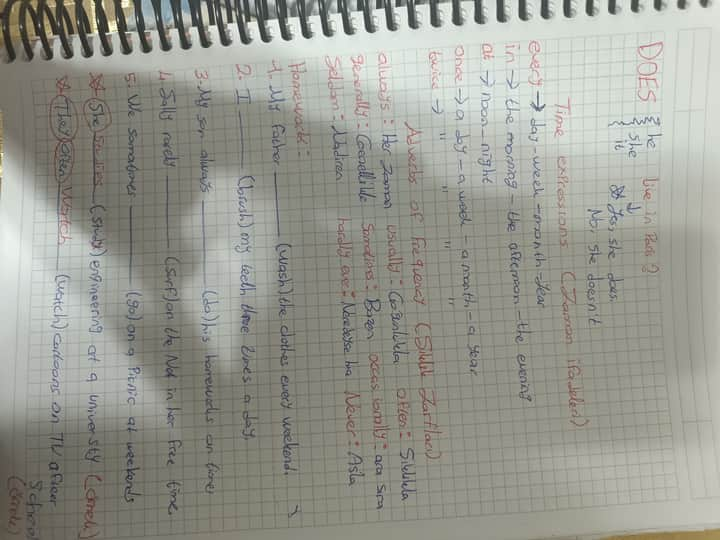
Merhaba — ne yapmak istersin bu resimle? Transkrip (yazıya dökme), yazım/gramer düzeltmesi, açıklama veya alıştırma ister misin? Hangisini tercih edersen onu yapayım. Aşağıda hızlı bir özet ve birkaç faydalı düzeltme/ipuçu bıraktım.
Kısa özet (görünen başlıklardan ve notlardan):
- Konu: Time expressions / Dates ve Frequency adverbs (always, usually, often, sometimes, rarely, never).
- Zaman edatları: at (saatler: at 5 o’clock), on (günler: on Monday), in (aylar/years/periods: in July, in 2025).
- Yerleşim (frequency adverbs): Genelde fiilden önce, fakat yardımcı fiil/ be fiili varsa be’den sonra gelir. Örnekler: I always go / She is always late.
- Diğer notlar: some/any, a/an kullanımları, örnek cümleler (görünüşe göre karışık el yazısı örnekleri var).
Hızlı düzeltme ve örnekler:
- Time prepositions:
- Saat: at 7 pm → doğru.
- Günler: on Sunday / on Monday → doğru.
- Ay/yıl/period: in June / in 2025 / in the morning (bu sonuncu “in the morning” doğru; “at morning” yanlış).
- Frequency adverbs sıralama:
- Simple present: I always watch TV. (
 )
- With be: He is never late. ()
- Yardımcı fiil varsa: She has often been there. (adverb yardımcıdan sonra/yardımcı fiil ile arasında yer alabilir: She has often been → yaygın)
- Simple present: I always watch TV. (
- “Use in talks?” notu muhtemelen “Use in talks?” değil de “Use in talks?” yerine ne amaçla kullanılacağı not edilmiş — netleştirelim.
Ne yapabilirim şimdi:
- Fotoğrafı tam ve okunaklı şekilde yazıya dökeyim (transkripsiyon).
- Notları düzgün, okunaklı ve hatasız hâlde Türkçe/İngilizce özet hâline getireyim.
- Konuya yönelik 5-10 kısa alıştırma ve cevaplarını hazırlayayım.
Hangi seçeneği istersin? veya “hepsini yap” dersen sırayla yaparım. Eğer daha net bir görüntü eklersen tüm el yazısını eksiksiz dökebilirim.
How do I use dates and time expressions in English, and what are the answers to the exercise in your notebook?
Table of Contents
- Using DATES: ON, IN, AT
- Frequency Adverbs (always, often, sometimes…)
- Expressions: every / once / twice / three times…
- Position of Frequency Adverbs in a Sentence
- Exercise Solutions
- Summary Table
1. Using DATES: ON, IN, AT
English has specific prepositions for dates and time ranges:
- IN → months, years, centuries, long periods
• in July, in 2025, in the 21st century - ON → days, dates, specific weekdays
• on Saturday, on 3rd December 2025, on Christmas Day - AT → clock times, festivals (no “day”), precise moments
• at 9:30 pm, at midnight, at Easter
Examples:
• “We arrived on 7 November.”
• “She was born in 1997.”
• “The concert starts at 8 pm.”
2. Frequency Adverbs (always, often, sometimes…)
Adverbs of frequency tell us how often something happens:
• always (100%)
• usually / normally (≈80%)
• often / frequently (≈60%)
• sometimes (≈40%)
• occasionally / rarely (≈20%)
• never (0%)
Use these with the present simple to describe habits or routines:
“Tom always takes the bus.”
“I never drink coffee in the evening.”
3. Expressions: every / once / twice / three times…
To express regular intervals:
• every + day/week/month/year
– every day, every Tuesday, every month
• once / twice / three times + a/an + week/month/year
– once a week, twice a month, three times a year
Examples:
• “I go swimming once a week.”
• “They visit us every summer.”
4. Position of Frequency Adverbs in a Sentence
In affirmative sentences with the present simple:
Subject → Frequency Adverb → Base Verb
• She always arrives late.
• We sometimes watch TV after dinner.
With the verb to be, put the adverb after the verb:
• He is usually very polite.
• They are never here on time.
5. Exercise Solutions
Below are model answers for the five sentences in your notebook. These fill in the blanks using the rules above.
-
Jenny visits her grandparents every weekend.
– visits because “every weekend” needs present simple + she/visits. -
I usually do my homework in the evening.
– usually before the main verb and “in the evening” for time of day. -
He never eats fast food on weekdays.
– never as adverb of frequency; “on weekdays” uses on + plural day. -
My family has visited three cities since last summer.
– present perfect has visited + “three cities” + “since last summer” (time expression for a period leading up to now). -
We sometimes watch horror movies on TV after exams.
– sometimes before the main verb; “on TV” and “after exams” for sequence.
6. Summary Table
| Category | Expression | Example |
|---|---|---|
| DATES – Months / Years | in + July / in + 2025 | “She was born in July.” |
| DATES – Days / Dates | on + Monday / on + 3rd December | “We’ll meet on Monday.” |
| DATES – Clock Times | at + 7:00 am / at + midnight | “The show starts at 7:00 am.” |
| Frequency Adverbs | always, usually, often, never | “He often goes running.” |
| Interval Expressions | every day / once a year / twice a week | “We go hiking once a year.” |
| Adverb Position (simple) | S + Adv + V | “They always arrive early.” |
| Adverb Position (be-verb) | S + be + Adv | “She is never late.” |
| Present Perfect + Time | has/have + past participle + since / for | “I have lived here since 2010.” |
Summary:
- Use in, on, at correctly for dates and times.
- Place adverbs of frequency (always, sometimes, never) before the main verb (but after “be”).
- Express regular intervals with every, once, twice, three times etc.
- Use the present simple for habits/routines and the present perfect for actions tied to a period up to now.
Practice these patterns and your notebook exercises will be error-free! @Usmail