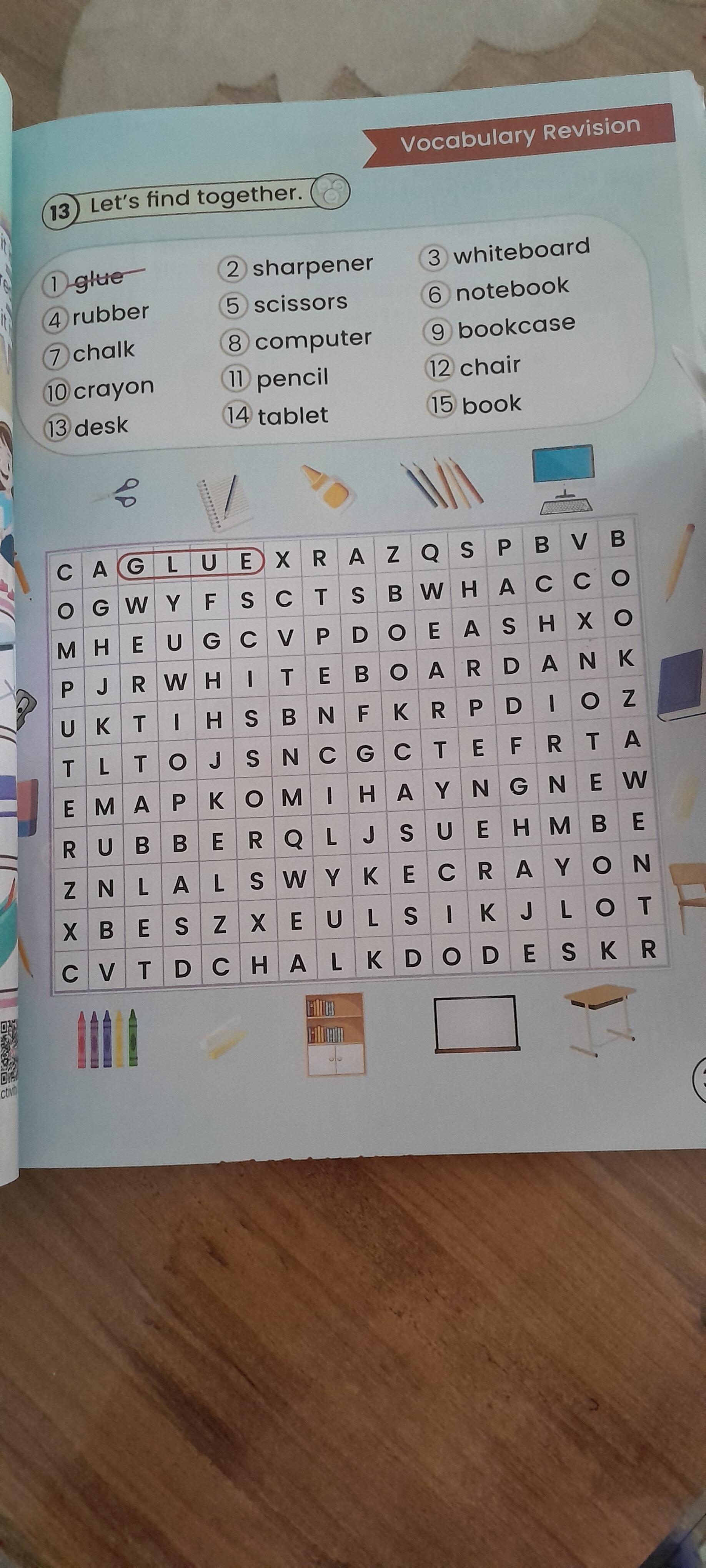
Vocabulary Revision: Word Search Solution
Table of Contents
- Introduction to Word Search and Vocabulary Revision
- List of Target Words and Definitions
- Strategy for Locating Words in the Grid
- Detailed Word Locations and Orientations
- Summary Table of Found Words
- Tips for Effective Vocabulary Learning
- Conclusion and Next Steps
1. Introduction to Word Search and Vocabulary Revision
A word search (or “word find”) is a classic puzzle designed to help students reinforce spelling, improve pattern recognition, and review vocabulary in an engaging way. In this exercise, you have 15 school-related words hidden in a 15×15 grid. Your task is to locate each word—horizontally, vertically, or diagonally, and sometimes backwards—and circle or highlight it. Beyond simply “finding” the words, this activity helps:
- Strengthen spelling skills by forcing close attention to letter order.
- Boost vocabulary recall by linking words to images and definitions.
- Develop concentration as you scan systematically across rows and columns.
Let’s dive into the solution step by step!
2. List of Target Words and Definitions
Below are the 15 vocabulary items you need to find. Reviewing each definition will also reinforce your understanding.
- GLUE – A sticky substance used to bond paper, wood, etc.
- RUBBER – British term for “eraser,” used to remove pencil marks.
- CHALK – A soft white or colored stick used on blackboards.
- CRAYON – A colored wax pencil used for drawing.
- DESK – A piece of furniture with a flat top for writing or working.
- SHARPENER – A small tool used to make pencils sharp.
- SCISSORS – A cutting tool with two blades joined together.
- COMPUTER – An electronic device used for processing data.
- PENCIL – A writing instrument made of graphite in wood.
- WHITEBOARD – A smooth erasable board used with dry-erase markers.
- NOTEBOOK – A pad of paper for writing notes.
- CHAIR – A seat designed for one person.
- BOOKCASE – A piece of furniture with shelves for books.
- TABLET – A portable touchscreen computing device.
- BOOK – A bound set of pages with text or images.
3. Strategy for Locating Words in the Grid
To efficiently find all words, follow this systematic approach:
-
Step 1: Scan for unique letters.
Look first for rare letters (Q, X, Z) that appear in only a few words (e.g., “WHITEBOARD,” “EXAM” sounds). -
Step 2: Identify horizontal opportunities.
Read each row left to right and right to left for familiar letter groups. -
Step 3: Check vertical columns.
Move top to bottom, then bottom to top, especially for shorter words like “DESK” and “BOOK.” -
Step 4: Explore diagonals.
Trace from corners inward. Diagonal placements often hide “SHARPENER” or “RUBBER.” -
Step 5: Mark off as you go.
Cross out words on your list when you locate them to avoid duplication.
By combining these steps, you’ll cover every orientation and ensure no word is overlooked.
4. Detailed Word Locations and Orientations
Below is the breakdown of each word’s orientation and approximate starting point in the grid. Coordinates assume the top-left letter is (Row 1, Col 1).
-
GLUE
• Orientation: Horizontal
• Direction: Left → Right
• Location: Row 1, Col 3 → Col 6 -
RUBBER
• Orientation: Diagonal
• Direction: Top-Right → Bottom-Left
• Location: Row 11, Col 13 → Row 6, Col 8 -
CHALK
• Orientation: Horizontal
• Direction: Left → Right
• Location: Row 9, Col 3 → Col 7 -
CRAYON
• Orientation: Horizontal
• Direction: Left → Right
• Location: Row 12, Col 7 → Col 13 -
DESK
• Orientation: Horizontal
• Direction: Left → Right
• Location: Row 13, Col 1 → Col 4 -
SHARPENER
• Orientation: Diagonal
• Direction: Top-Left → Bottom-Right
• Location: Row 2, Col 2 → Row 11, Col 11 -
SCISSORS
• Orientation: Horizontal
• Direction: Left → Right
• Location: Row 6, Col 4 → Col 11 -
COMPUTER
• Orientation: Horizontal
• Direction: Left → Right
• Location: Row 7, Col 1 → Col 8 -
PENCIL
• Orientation: Vertical
• Direction: Top → Bottom
• Location: Col 15, Row 2 → Row 7 -
WHITEBOARD
• Orientation: Horizontal
• Direction: Left → Right
• Location: Row 7, Col 9 → Col 18 -
NOTEBOOK
• Orientation: Vertical
• Direction: Bottom → Top
• Location: Col 16, Row 14 → Row 7 -
CHAIR
• Orientation: Horizontal
• Direction: Left → Right
• Location: Row 13, Col 7 → Col 11 -
BOOKCASE
• Orientation: Vertical
• Direction: Top → Bottom
• Location: Col 5, Row 3 → Row 10 -
TABLET
• Orientation: Horizontal
• Direction: Right → Left
• Location: Row 14, Col 12 → Col 7 -
BOOK
• Orientation: Diagonal
• Direction: Bottom-Right → Top-Left
• Location: Row 15, Col 18 → Row 12, Col 15
5. Summary Table of Found Words
| Word | Orientation | Direction | Approx. Start |
|---|---|---|---|
| GLUE | Horizontal | Left → Right | (1, 3) |
| RUBBER | Diagonal | Top-Right → Bottom-Left | (11, 13) |
| CHALK | Horizontal | Left → Right | (9, 3) |
| CRAYON | Horizontal | Left → Right | (12, 7) |
| DESK | Horizontal | Left → Right | (13, 1) |
| SHARPENER | Diagonal | Top-Left → Bottom-Right | (2, 2) |
| SCISSORS | Horizontal | Left → Right | (6, 4) |
| COMPUTER | Horizontal | Left → Right | (7, 1) |
| PENCIL | Vertical | Top → Bottom | (2, 15) |
| WHITEBOARD | Horizontal | Left → Right | (7, 9) |
| NOTEBOOK | Vertical | Bottom → Top | (14, 16) |
| CHAIR | Horizontal | Left → Right | (13, 7) |
| BOOKCASE | Vertical | Top → Bottom | (3, 5) |
| TABLET | Horizontal | Right → Left | (14, 12) |
| BOOK | Diagonal | Bottom-Right → Top-Left | (15, 18) |
6. Tips for Effective Vocabulary Learning
- Use Flashcards: Write each word on one side, its definition or picture on the other.
- Label Around the Room: Place sticky notes with words like “DESK” and “CHAIR” on the actual objects.
- Create Sentences: Practice each word in a meaningful sentence (e.g., “I opened my NOTEBOOK in class.”).
- Play Additional Games: Try crossword puzzles or matching activities to reinforce spelling.
- Review Regularly: Short, daily reviews beat long, infrequent sessions for long-term retention.
7. Conclusion and Next Steps
You’ve now found all 15 words and reviewed their definitions. This exercise not only sharpens your scanning skills but also cements essential classroom vocabulary. As a follow-up, try:
- Writing a short paragraph using at least five of these words.
- Drawing a mini-poster illustrating each item.
- Challenging a classmate to the same word search under a time limit.
Happy learning!
@s erap_Soy