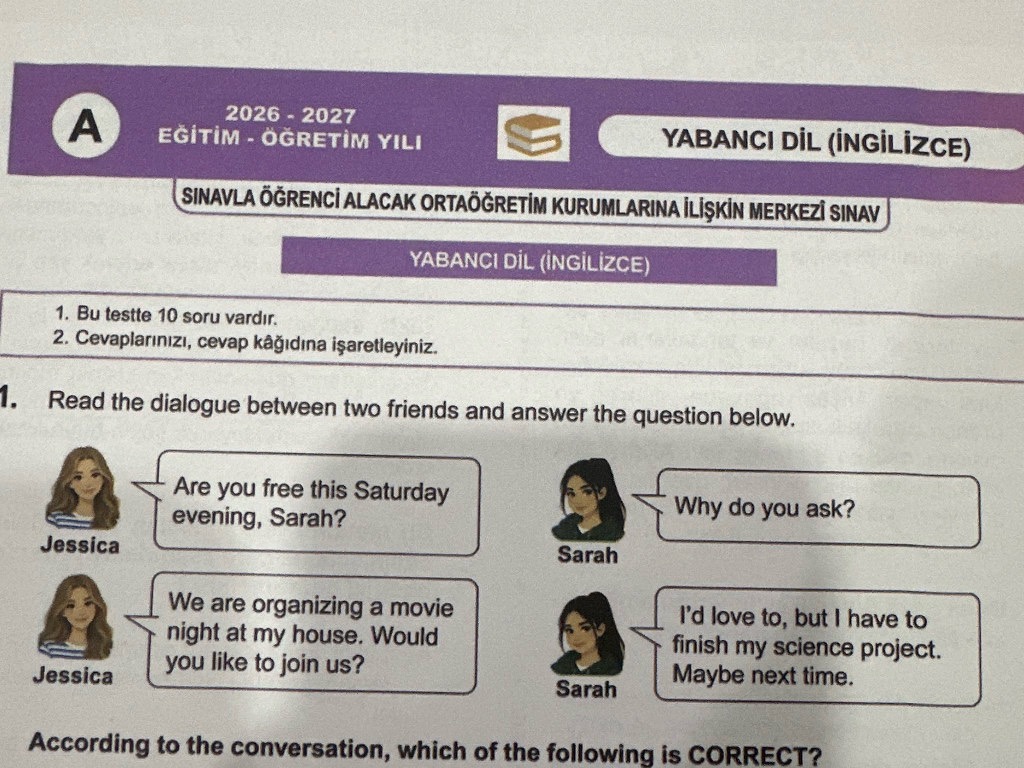
Read the dialogue between two friends and answer the question below.
Jessica: Are you free this Saturday evening, Sarah?
Sarah: Why do you ask?
Jessica: We are organizing a movie night at my house. Would you like to join us?
Sarah: I’d love to, but I have to finish my science project. Maybe next time.
According to the conversation, which of the following is CORRECT?
LGS English: Friendship — Making and Refusing Invitations with an Excuse
 KEY FORMULA / RULE: In English dialogue comprehension questions, refusing an invitation with an excuse typically follows the pattern of expressing a polite desire (
"I'd love to, but...") followed by a stated obligation or reason ("I have to finish my science project").
 SOLUTION & DIALOGUE ANALYSIS
- Jessica’s role: She makes an invitation (“Would you like to join us?”) to a movie night at her house on Saturday evening.
- Sarah’s response: She politely declines the offer by stating: “I’d love to, but I have to finish my science project. Maybe next time.”
- Core deduction: Sarah refuses (rejects) Jessica’s invitation and gives an excuse / a reason (she has to work on her science project).
 EVALUATION OF TYPICAL EXAM STATEMENTS
- Correct deductions:
- Sarah refuses / turns down the invitation because she has an excuse.
- Sarah has to study / finish her school project on Saturday.
- Jessica invites Sarah to watch a movie at her home.
- Incorrect distractors (False statements):
- Sarah accepts the invitation. \rightarrow False (She declines using “I’d love to, but…”).
- Sarah is free this Saturday evening. \rightarrow False (She is busy with her project).
- Sarah refuses the offer without making an excuse. \rightarrow False (She explicitly states her science project as the reason).
 FINAL ANSWER: The correct statement concludes that Sarah refuses the invitation and gives an excuse (or has a reason for not attending), as she must complete her science project.
 EXAM INSIGHT / PITFALL: Pay close attention to the word “but”. In LGS dialogues, “I’d love to, but…” is always a polite refusal, never an acceptance. The clause following “but” provides the student’s excuse (reason).