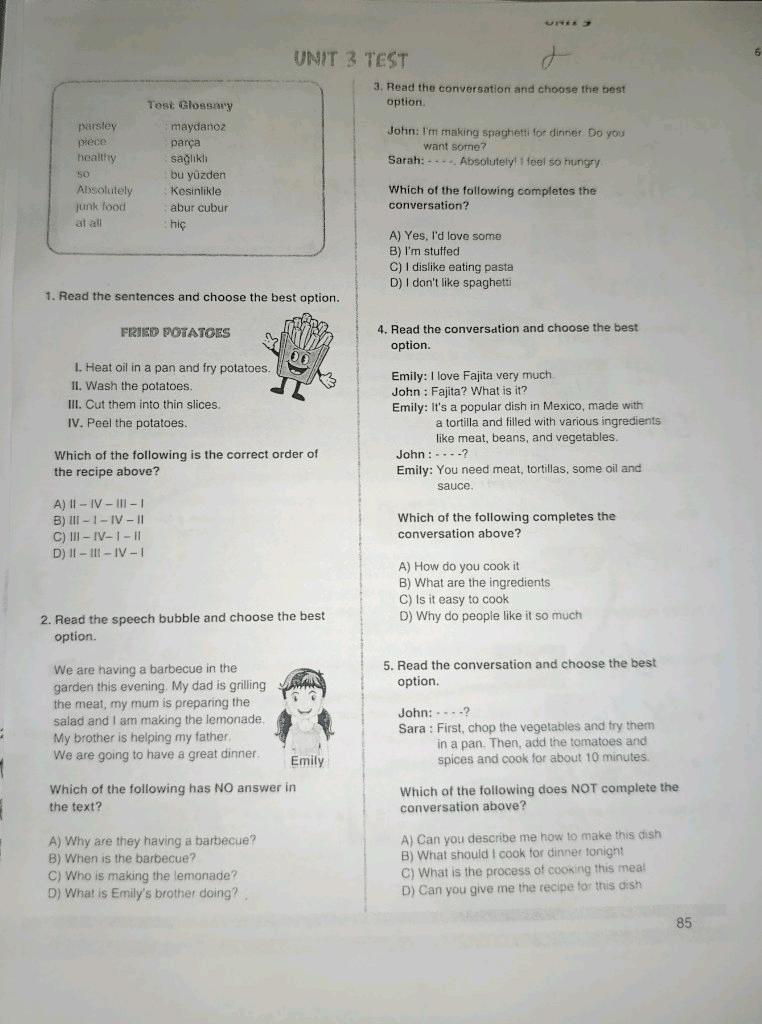
- Read the conversation and choose the best option.
John: I’m making spaghetti for dinner. Do you want some?
Sarah: ----, Absolutely! I feel so hungry.
Which of the following completes the conversation?
A) Yes, I’d love some
B) I’m stuffed
C) I dislike eating pasta
D) I don’t like spaghetti - Read the conversation and choose the best option.
Emily: I love Fajita very much.
John1 Fajita? What is it?
Emily: It’s a popular dish in Mexico, made with a tortilla and filled with various ingredients like meat, beans, and vegetables.
John1 ----?
Emily: You need meat, tortillas, some oil and sauce.
A) How do you cook it
B) What are the ingredients
C) Is it easy to cook
D) Why do people like it so much - Read the conversation and choose the best option.
John: ----?
Sara: First, chop the vegetables and fry them in a pan. Then, add the tomatoes and spices and cook for about 10 minutes.
A) Can you describe me how to make this dish
B) What should I cook for dinner tonight
C) What is the process of cooking this meal
D) Can you give me the recipe for this dish
English Unit 3: In the Kitchen — Test Questions & Explanations
 KEY FORMULA / RULE: In cooking and dialogue-based English questions, sequential recipes follow chronological transition words (first, then, next, finally), ingredient lists answer questions containing “ingredients” or “what is in it”, and accepting an offer requires an enthusiastic positive phrase matching context cues such as “I feel so hungry”.
 SOLUTION & OPTION ANALYSIS
Question 1: Recipe Sequencing (Fried Potatoes)
- Step 1: First, you clean the ingredients: II. Wash the potatoes.
- Step 2: Second, remove the skin: IV. Peel the potatoes.
- Step 3: Third, prepare the shape: III. Cut them into thin slices.
- Step 4: Finally, apply heat: I. Heat oil in a pan and fry potatoes.
- Correct Order: II – IV – III – I
 ANSWER: A) II – IV – III – I
Question 2: Text Comprehension & Wh- Questions
- A) Why are they having a barbecue? → The text states they are having a barbecue, but gives no reason or occasion (celebration, birthday, etc.).
- B) When is the barbecue? → Answered in the text: “this evening”.
- C) Who is making the lemonade? → Answered in the text: “I am making the lemonade” (Emily).
- D) What is Emily’s brother doing? → Answered in the text: “My brother is helping my father”.
ANSWER: A) Why are they having a barbecue?
Question 3: Accepting an Offer
- A) Yes, I’d love some: Correct. Sarah confirms enthusiastically with “Absolutely! I feel so hungry”, which expresses hunger and willingness to eat.
- B) I’m stuffed: Incorrect; means full, contradicting “I feel so hungry”.
- C) I dislike eating pasta: Incorrect; contradicts accepting the offer.
- D) I don’t like spaghetti: Incorrect; contradicts accepting the offer.
ANSWER: A) Yes, I’d love some
Question 4: Asking for Ingredients
- A) How do you cook it: Asks about the preparation method/steps, not the item list.
- B) What are the ingredients: Correct. Emily replies by listing the necessary food items: “meat, tortillas, some oil and sauce”.
- C) Is it easy to cook: Requires a Yes/No answer.
- D) Why do people like it so much: Asks for a reason, not ingredients.
ANSWER: B) What are the ingredients
Question 5: Identifying the Odd Question Out (Negative Stem)
- A) Can you describe me how to make this dish: Fits Sara’s step-by-step cooking description.
- B) What should I cook for dinner tonight: Does NOT fit. This asks for a menu suggestion/dish name (e.g., “You should cook pasta”), not step-by-step cooking instructions.
- C) What is the process of cooking this meal: Fits Sara’s preparation steps.
- D) Can you give me the recipe for this dish: Fits Sara’s instructions directly.
ANSWER: B) What should I cook for dinner tonight
 EXAM INSIGHT / PITFALL: Pay close attention to negative question roots such as “does NOT complete” or “has NO answer”. Always identify the key linking words: ingredient lists (meat, oil) match “ingredients”, while sequential imperatives (chop, fry, add) match “process/recipe”.