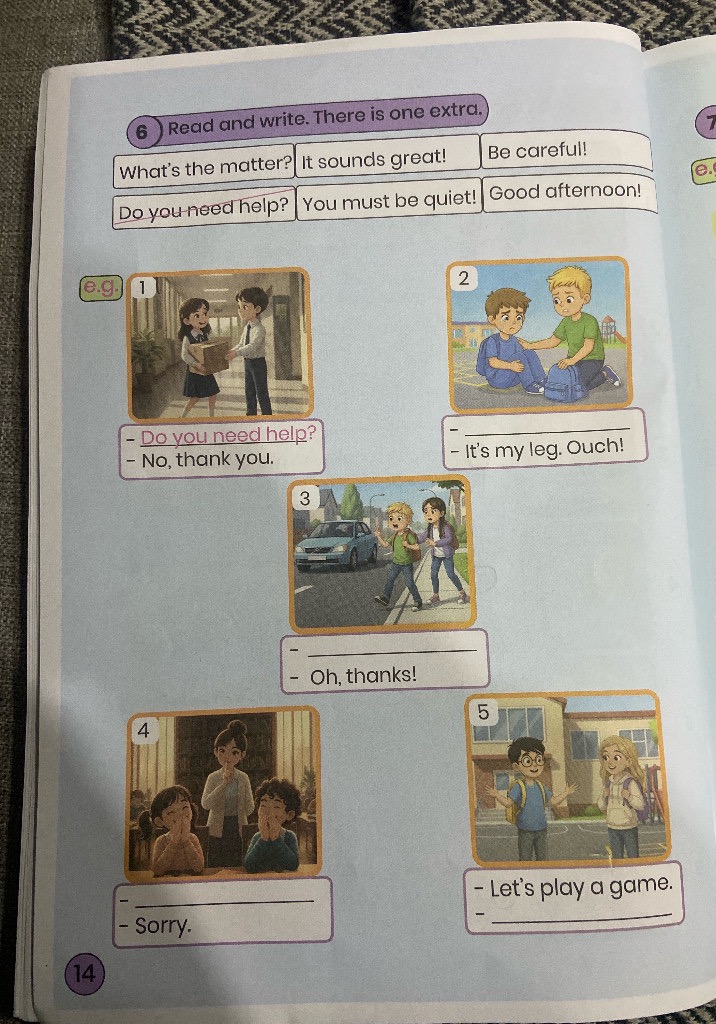
Read and write. There is one extra.
What’s the matter?
It sounds great!
Be careful!
Do you need help?
You must be quiet!
Good afternoon!
- No, thank you.
- It’s my leg. Ouch!
- Oh, thanks!
- Sorry.
- Let’s play a game.
 KEY FORMULA / RULE: In English situational dialogues, the appropriate response depends on visual clues and conversational context, matching expressions of health inquiries (“What’s the matter?”), warnings (“Be careful!”), classroom rules (“You must be quiet!”), and accepting suggestions (“It sounds great!”).
 SOLUTION STEPS
1 (Example): A boy asks a girl carrying a heavy box if she requires assistance.
2: A boy is sitting on the ground in pain holding his leg, and his friend asks what is wrong.
3: A car is approaching while the children cross the street; the girl warns the boy of danger.
4: The teacher places her finger over her lips asking for silence in the library/classroom.
5: A boy invites a friend to do an activity together (“Let’s play a game.”), and she enthusiastically accepts.
 FINAL ANSWER:
 EXAM INSIGHT / PITFALL: Always look at the responding line to determine the function of the missing sentence: an expression of pain (“Ouch!”) follows an inquiry about physical distress (“What’s the matter?”), while an expression like “Let’s…” represents an invitation best accepted with enthusiasm (“It sounds great!”).