Read and circle.
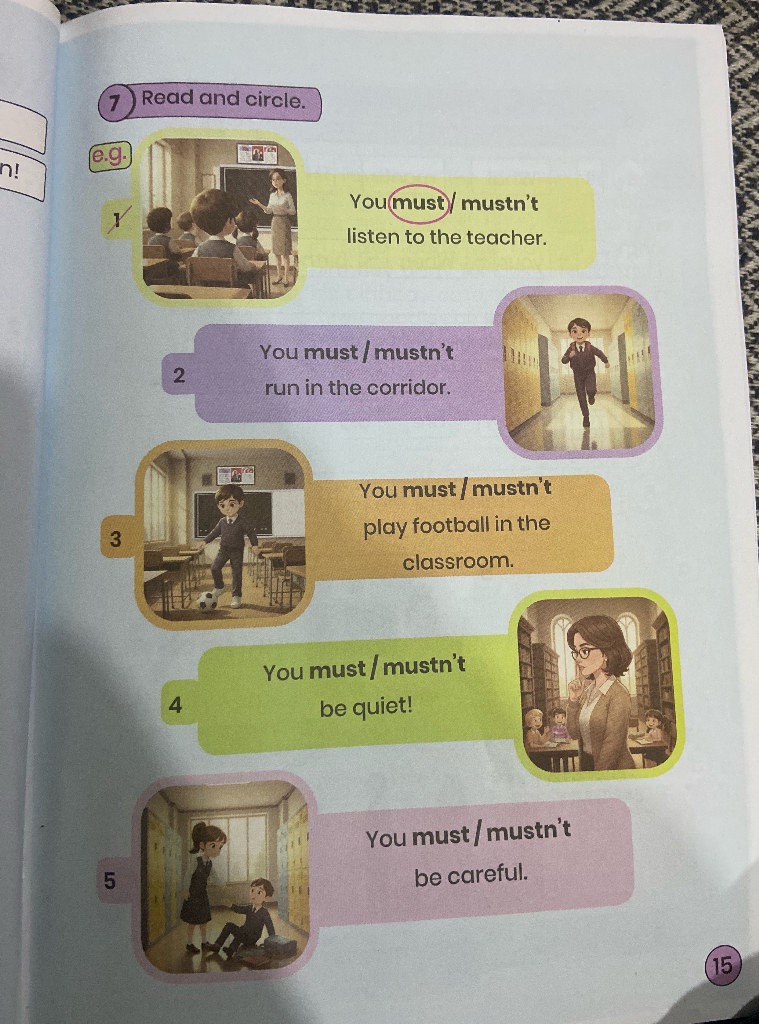
E) g. You must / mustn’t listen to the teacher.
1 You must / mustn’t listen to the teacher.
2 You must / mustn’t run in the corridor.
3 You must / mustn’t play football in the classroom.
4 You must / mustn’t be quiet!
5 You must / mustn’t be careful.
Modal Verbs: Expressing Obligation and Prohibition with Must and Mustn’t
 KEY FORMULA / RULE: Must indicates an obligation, requirement, or rule that should be followed, whereas mustn’t (must not) indicates a prohibition against an action that is not allowed or dangerous.
 SOLUTION & OPTION ANALYSIS
- 1 (Example): You must listen to the teacher. Listening to the teacher is an essential classroom obligation.
- 2: You mustn’t run in the corridor. Running in school hallways is prohibited because it poses a safety hazard.
- 3: You mustn’t play football in the classroom. Playing sports indoors can cause damage or injury, making it strictly forbidden.
- 4: You must be quiet! In the library setting shown, remaining quiet is a mandatory rule of respect.
- 5: You must be careful. Being attentive and cautious prevents accidents and falls in school areas.
 FINAL ANSWER:
- must
- mustn’t
- mustn’t
- must
- must
 EXAM INSIGHT / PITFALL: Pay close attention to whether the sentence describes a positive responsibility (must) or a safety restriction (mustn’t); negative actions that lead to danger are always paired with mustn’t.