ete
2A
Rea thepareranhs ane e the eerelees betoe
Narthe
hernnc
ebrinch and ijnds in
khnshopping in te
Eema Suny
pe u
eet This morning.
netting married
tamily and friends
Teein a beautiful wthite dresSs and
myhustand is Weiting for me downstairs
LWhat does Martha usually do on Sunday mornings?
Greg
4. What is he doing this Christrnas1
On Christnas Day w usually o fo my
feiends house and oper:ur orusents
having a great diner Christmias Dayis veny
special for us, because Ne car ornby be
toqether on this day with ryy triends
But this Christmas is different Myte
andI are in London. We re isiting our
fanily. This morning, we went to church
and now. we ane havinga barbecue in our
gorgeous qarden. It is a bit coid so we are
wearing our coats and jackets
she
hie tam and Nead Shes wwea abeub hibe eest
3 What does Greg usually do on Christmas day?
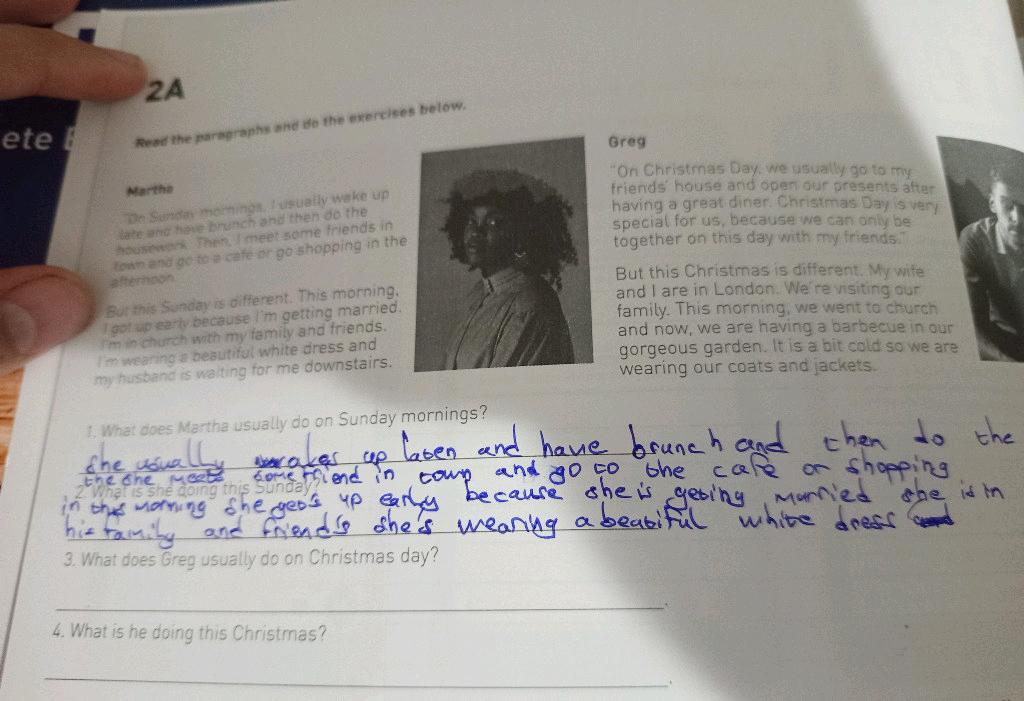
Reading Comprehension: Present Simple vs. Present Continuous
This exercise focuses on distinguishing between regular routines (Present Simple with usually) and temporary actions happening right now or changes to a routine (Present Continuous with this Sunday / this Christmas).
 STEP-BY-STEP SOLUTION:
Step 1 — Question 1: What does Martha usually do on Sunday mornings?
- Text Reference: “On Sunday mornings, I usually wake up late and have brunch and then do the housework.”
- Correct Form (Third Person Singular):\text{She usually wakes up late, has brunch, and does the housework.}
Step 2 — Question 2: What is she doing this Sunday?
- Text Reference: “This morning, I got up early because I’m getting married. I’m in church with my family and friends. I’m wearing a beautiful white dress…”
- Correct Form (Present Continuous):\text{She is getting married today. She is at church with her family and friends, wearing a white dress.}
Step 3 — Question 3: What does Greg usually do on Christmas day?
- Text Reference: “On Christmas Day, we usually go to my friends’ house and open our presents after having a great dinner.”
- Correct Form (Third Person Singular):\text{He usually goes to his friends' house, opens presents, and has a great dinner with them.}
Step 4 — Question 4: What is he doing this Christmas?
- Text Reference: “My wife and I are in London. We’re visiting our family… and now, we are having a barbecue in our gorgeous garden.”
- Correct Form (Present Continuous):\text{He is visiting family in London with his wife, and they are having a barbecue in the garden.}
━━━━━━━━━━━━━━━━━━━━━━━━━━━
 FINAL ANSWER:
- She usually wakes up late, has brunch, and does the housework.
- She is getting married today at church with her family and friends.
- He usually goes to his friends’ house to open presents and have dinner.
- He is visiting family in London and having a barbecue in the garden with his wife.
━━━━━━━━━━━━━━━━━━━━━━━━━━━
 KEY CONCEPTS:
- Present Simple (Habits & Routines): Used with time adverbs like usually, on Sundays, every year. Note the addition of -s / -es for third-person subjects (he/she wakes up, goes).
- Present Continuous (Current & Temporary Actions): Formed with be (am/is/are) + verb-ing (is getting married, are having a barbecue) to describe what is taking place at or around the present moment.
 COMMON MISTAKES:
 Incorrect Approach: Writing “He usually go to his friend house…” (forgetting the third-person -s suffix or the possessive 's).
- Correct Approach: Ensure subject-verb agreement: “He usually goes to his friends’ house…”
Would you like to practice writing two more sentences comparing your own usual weekend routine with what you are doing this weekend?