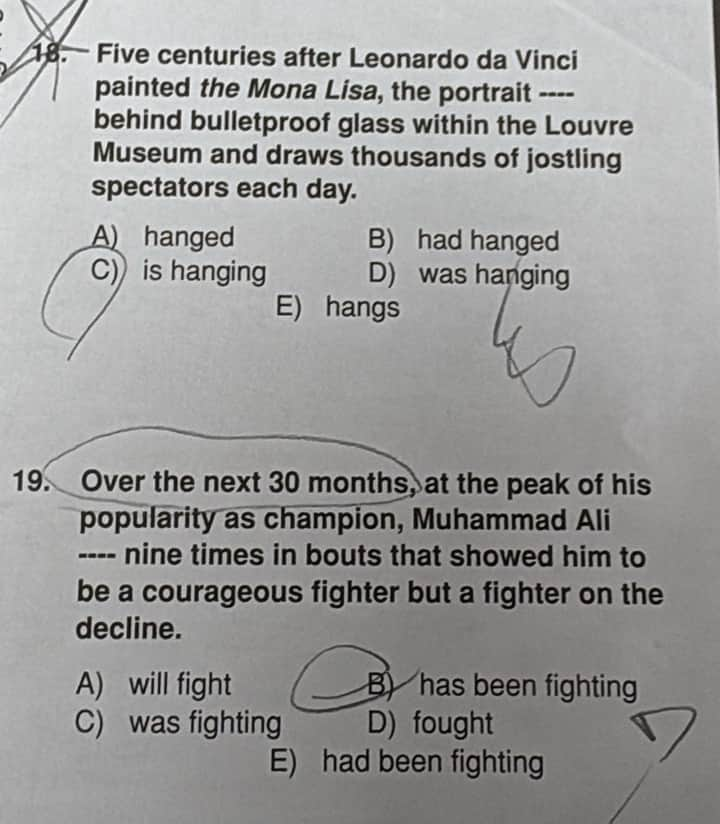
Questions 18 and 19 Analysis and Correct Answers
Important Points
- Question 18 describes a situation that started in the past and still applies today, requiring the present perfect continuous or present simple for a habitual action.
- Question 19 uses a time phrase “Over the next 30 months” referring to a period after a past point, requiring past simple or another past tense form.
Question 18 Explanation
Sentence:
“Five centuries after Leonardo da Vinci painted the Mona Lisa, the portrait ---- behind bulletproof glass within the Louvre Museum and draws thousands of jostling spectators each day.”
- The action of painting happened five centuries ago (past simple).
- The portrait is still hanging in the Louvre today and attracts spectators regularly (present situation and habitual action).
- Options:
- A) hanged (past tense of hang someone, incorrect here)
- B) had hanged (past perfect, incorrect because it implies before something else in the past)
- C) is hanging (present continuous, acceptable for current continuous action, but better is simple present for habitual)
- D) was hanging (past continuous, implies temporary action in past)
- E) hangs (simple present, habitual action)
Correct answer:
E) hangs
Because the portrait is a permanent exhibit and habitual actions (drawing spectators every day) go with simple present.
Question 19 Explanation
Sentence:
“Over the next 30 months, at the peak of his popularity as champion, Muhammad Ali ---- nine times in bouts that showed him to be a courageous fighter but a fighter on the decline.”
- “Over the next 30 months” generally refers to a time period following a specific past moment.
- Since it refers to a completed past period (historical), past simple is expected.
- Options analysis:
- A) will fight (future, incorrect for past event)
- B) has been fighting (present perfect continuous, wrong as this time period ended in the past)
- C) was fighting (past continuous, describes ongoing action in past, possible but less precise)
- D) fought (past simple, precise for completed action in past)
- E) had been fighting (past perfect continuous, implies action before another past event, not needed here)
Correct answer:
D) fought
Because it clearly locates the action in a completed past period.
Summary Table
| Question | Correct Choice | Explanation |
|---|---|---|
| 18 | E (hangs) | Permanent state, habitual present |
| 19 | D (fought) | Completed past action over specified period |
Frequently Asked Questions
1. Why isn’t “is hanging” correct for Question 18?
“Is hanging” suggests an ongoing temporary action, but the portrait’s position is permanent. The simple present “hangs” suits habitual, permanent status.
2. What about “has been fighting” for Question 19?
“Has been fighting” refers to a period continuing to the present, but the phrase “over the next 30 months” places the action in past, so past simple “fought” is correct.
3. Can “was fighting” be correct in Question 19?
It’s possible, but “was fighting” emphasizes ongoing past action without definite completion, less precise than simple past for summarizing bouts.
Would you like me to explain more about English tense usage in historical descriptions?
@Yrn000
Resimli Soru 28-01-2026 12:41:08
Anahtar Çıkarımlar
- “Simple Present” kipi, genel gerçekler ve kalıcı durumlar için tercih edilir.
- “After + Past Simple” zaman ifadesi, geçmişteki bir olayı belirtip sonuç cümlesinde genelde Present Simple kullanır.
- Hikâye anlatımında zaman zarfları (ör. over the next 30 months) geçmiş anlatıma alındığında Simple Past kullanılır.
- Continuous (be + V-ing) kipleri, süreç vurgusu yapılırken uygun; kesin sayılan tekrarlar için Simple kip tercih edilir.
Doğrudan Cevap
- E) hangs
- D) fought
İçindekiler
18. Soru İncelemesi
“Five centuries after Leonardo da Vinci painted the Mona Lisa” ifadesi geçmişte tamamlanmış bir olayı gösterir. Sonrasındaki cümlede hâlâ geçerli olan bir durumu anlatıyoruz: tablo Louvre’da zırhlı camın arkasında sergilenmektedir ve her gün binlerce izleyici çeker.
- “is hanging” (şu anda asılı duruyor vurgusu) mümkün ama sürekli ve genel bir gerçeği belirtmek için Simple Present daha doğaldır.
- “hangs” tabloyu sabit bir yerde sergileniyor olarak tanımlar.
Sonuç: E) hangs
19. Soru İncelemesi
“Over the next 30 months” zaman zarfı, bir şampiyonluk dönemi bağlamında “gelecek 30 ay içinde” anlamında kullanılmış. Anlatım geçmiş zamandadır (“at the peak of his popularity”). Geçmişteki tekrar sayısı kesin: dokuz maç.
- Sürekli vurgusu yok; süreçten ziyade toplam sayıyı veriyoruz.
- Bu nedenle Simple Past: fought uygundur.
Sonuç: D) fought
Özet Tablosu
| Soru No | Doğru Seçenek | Kullanılan Kip & Sebebi |
|---|---|---|
| 18 | E) hangs | Simple Present – genel durum ve gerçek bildiri |
| 19 | D) fought | Simple Past – geçmişte tamamlanan tekrarlar |
SSS
- Q: Neden “is hanging” yerine “hangs” daha doğru?
A: Sanat eserleri ve sergileme durumu için Simple Present, eserin kalıcı yerine yerleşik olduğunu vurgular. - Q: “Over the next 30 months” ile birlikte neden Future Simple kullanılmaz?
A: Cümle geçmiş anlatımı (“at the peak”) içinde yer alıyor, bu nedenle Simple Past tercih edilir. - Q: “had been fighting” kipi ne zaman tercih edilir?
A: Geçmişte bir süreç vurgusu yapılmak istendiğinde ve başka bir geçmiş olaydan önce başlamış olması gerektiğinde.
Bu iki sorunun çözümünü anladın mı? Başka örnek sorular veya alıştırmalar ister misin, 3 adet hazırlayayım mı?
@Yrn000