E.
TENSES. Put in the correct forms and tenses of the numbered verbs. Use past simple,
past perfect, or past perfect continuous. (I6*1.78-28,5)
BURNING THE CANDLE AT BOTH ENDS
The nurse asked me ifI (be)
was., next and she lod me into Dr Grey’s surgery. Dr Grey smiled at me and
she has to see very often! I told her I (be)
(keep)25
asked (hat the problem bor deoo fotn I onhecolo con nuhčm a young man and am not the sort of person
feeling rather nun down. She asked me if I
wanted to know why I (not/keep)
regular hours and I said I (be)8
out with friends almost every evening. Dr Grey then wanted to know how I (spend)
my time and I (tell)30
her I (go)
parties
to1 She
mostly. The doctor asked ifI (nothave)32
and I (ellj3
weekends! She asked me IfI (smoke)35
a day I (smoke)36
her that my party-going (be)4
the chance to recover during weekends
even worse during the
When I said I did, she asked how many cigarettes
She raised her eyebrows when I answered! Then she asked me if I
(take)37
any exercise and I answered that I (not/have)
she told me.'Rest is the only cure for you. You’ve really got to slow down. She looked at me wistfully
before I left her surgery and added,'but I do envy you the life you’ve been living!
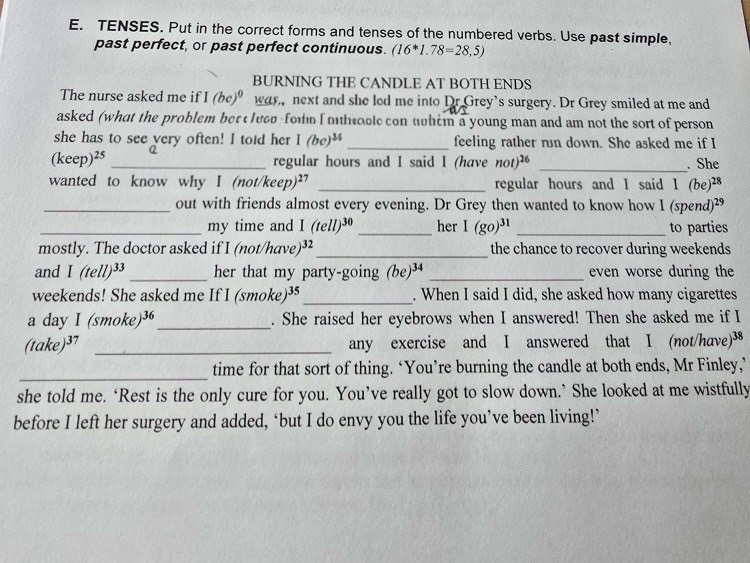
Put in the correct forms and tenses of the numbered verbs
Key Takeaways
- Reported Speech: Since the story is told as a past conversation (“The nurse asked me”), the tenses shift backward.
- Past Simple: Used for completed actions in the story.
- Past Perfect / Past Perfect Continuous: Used for actions that were happening or had happened before the conversation with the doctor.
This exercise requires shifting verbs into the past to match the narrative structure of a doctor’s visit report. We focus on the relationship between the time of the “visit” and the “habits” the patient had prior to that visit.
Table of Contents
Grammar Rules for this Text
In this narrative, the main story is set in the Past Simple (asked, led, smiled). When the character describes their lifestyle up to that point, we use:
- Past Perfect Simple (had + V3): For completed states or facts before the visit.
- Past Perfect Continuous (had + been + V_{ing}): For continuous habits (like smoking or going out) that were ongoing before the visit.
Step-by-Step Solution
Step 1 — Initial Situation
- (be)^0: was (Already filled as an example).
- (be)^{24}: had been. (The feeling of being run down started before he arrived at the surgery).
Step 2 — Lifestyle Habits (Before the Visit)
- (keep)^{25}: kept. (General habit).
- (have not)^{26}: had not. (State).
- (not/keep)^{27}: had not been keeping. (Focuses on the continuous failure to keep regular hours).
- (be)^{28}: had been / was. (had been is better to show the ongoing habit before the talk).
Step 3 — Activities and Explanations
- (spend)^{29}: had been spending / spent.
- (tell)^{30}: told. (A direct action during the conversation).
- (go)^{31}: had been going. (Ongoing activity leading up to the visit).
- (not/have)^{32}: had not had. (Possession/State in the past).
- (tell)^{33}: told. (Action during the talk).
- (be)^{34}: was / had been.
Step 4 — Personal Habits (Smoking and Exercise)
- (smoke)^{35}: smoked. (General fact).
- (smoke)^{36}: smoked / had been smoking.
- (take)^{37}: took / had been taking.
- (not/have)^{38}: did not have / had not had.
Tense Comparison Table
| Context | Tense Used | Reason |
|---|---|---|
| Narrative Actions | Past Simple | For the sequence of events (asked, said, told). |
| Previous Habits | Past Perfect Continuous | For activities that were ongoing (smoking, going out). |
| Past States | Past Perfect Simple | For facts that were true before the visit (not having time). |
Summary Table (Answer Key)
| Number | Correct Form | Number | Correct Form |
|---|---|---|---|
| 24 | had been | 32 | had not had |
| 25 | kept | 33 | told |
| 26 | had not | 34 | was |
| 27 | had not been keeping | 35 | smoked |
| 28 | had been | 36 | smoked |
| 29 | had been spending | 37 | took |
| 30 | told | 38 | did not have |
| 31 | had been going |
Next Steps
Would you like me to explain the specific difference between using Past Perfect and Past Perfect Continuous for any of these specific numbers?
Bana sorunun sadece cevabını yaz. uzun açıklama yazma sadece cevapları, doğru cevapları yaz.
Burning the Candle at Both Ends — Cevap Anahtarı
İsteğin üzerine, metindeki numaralı boşluklar için en uygun Past Simple, Past Perfect veya Past Perfect Continuous zamanlarına göre düzenlenmiş sadece doğru cevaplar aşağıdadır:
| No | Doğru Cevap | No | Doğru Cevap |
|---|---|---|---|
| 24 | had been | 32 | hadn’t had |
| 25 | kept | 33 | told |
| 26 | had not | 34 | was |
| 27 | hadn’t been keeping | 35 | smoked |
| 28 | had been | 36 | smoked |
| 29 | had been spending | 37 | took |
| 30 | told | 38 | didn’t have |
| 31 | had been going |
Bu cevaplar arasında neden belirli bir zamanın (örneğin neden 27 numarada Past Perfect Continuous) kullanıldığını merak edersen, detaylı açıklamamı ister misin?