ABC
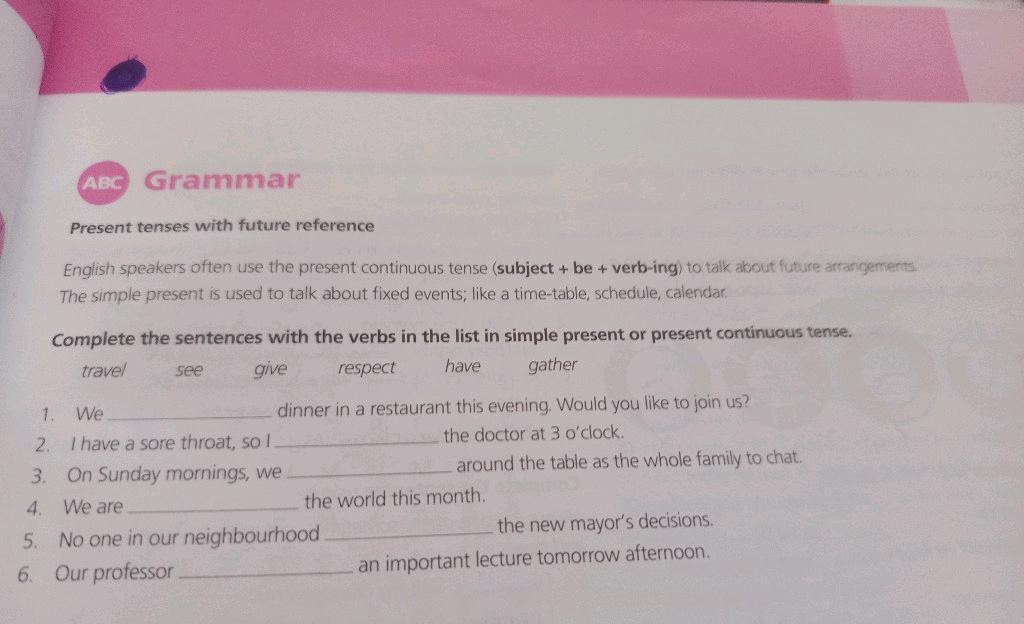
Present tenses with future reference
English speakers often use the present continuous tense (subject + be + verb-ing) to talk about future ararerent
The simple present is used to talk about fixed events; like a time-table, schedule, calendar.
Complete the sentences with the verbs in the list in simple present or present continuous tense
Grammar
trave
We
see
4. We are
grve respect
Ihave a sore throat, so I
3. On Sunday mornings, we
have
dinner in a restaurant this evening. Would you like to join us?
the doctor at 3 o’cdock
5. No one in our neighbourhood
6. Our professor
gather
the world this month.
around the table as the whole farnily to chat.
the new mayor’s decisions.
an important lecture tomorrow afternoon.
Present Tenses with Future Reference & Routines
 FORMULAS & RULES USED:
- Present Continuous for Future Arrangements: \text{Subject} + \text{am / is / are} + \text{Verb-ing}
- Used for planned personal appointments or social arrangements.
- Simple Present for Timetables & Routines: \text{Subject} + \text{Base Verb / Verb(-s/-es)}
- Used for routines, facts, opinions, or fixed official schedules/timetables.
 STEP-BY-STEP SOLUTION:
Step 1 — Sentence 1 Analysis
- Sentence: “We ________ dinner in a restaurant this evening. Would you like to join us?”
- Explanation: Having dinner at a restaurant tonight is a personal future arrangement/plan. Therefore, we use the Present Continuous form of the verb have.
\text{We } \mathbf{are\ having} \text{ dinner...}
Step 2 — Sentence 2 Analysis
- Sentence: “I have a sore throat, so I ________ the doctor at 3 o’clock.”
- Explanation: A specific appointment arranged with a doctor at an exact time (3\text{ o'clock}) requires the Present Continuous form of the verb see (which means “meeting/consulting”).
\text{...so I } \mathbf{am\ seeing} \text{ the doctor...}
Step 3 — Sentence 3 Analysis
- Sentence: “On Sunday mornings, we ________ around the table as the whole family to chat.”
- Explanation: “On Sunday mornings” indicates a repeated habitual action (routine). Routine actions require the Simple Present form of the verb gather. Since the subject is “we”, the verb remains in its base form.
\text{...we } \mathbf{gather} \text{ around the table...}
Step 4 — Sentence 4 Analysis
- Sentence: “We are ________ the world this month.”
- Explanation: The auxiliary verb “are” is already provided in the sentence. An ongoing temporary activity over this month requires the \text{-ing} form of the verb travel.
\text{We are } \mathbf{travelling} \text{ (or } \mathbf{traveling}\text{) the world...}
Step 5 — Sentence 5 Analysis
- Sentence: “No one in our neighbourhood ________ the new mayor’s decisions.”
- Explanation: Expressing an attitude, state of mind, or general truth requires the Simple Present tense of the verb respect. The indefinite pronoun “No one” is grammatically singular, so the verb takes the suffix -s.
\text{No one in our neighbourhood } \mathbf{respects} \text{ the new mayor's decisions.}
Step 6 — Sentence 6 Analysis
- Sentence: “Our professor ________ an important lecture tomorrow afternoon.”
- Explanation: Giving a lecture tomorrow afternoon can be viewed as an arranged event (is giving) or as part of a fixed academic schedule/calendar (gives). In school curricula, planned presentations are predominantly expressed using the Present Continuous for future arrangements:
\text{Our professor } \mathbf{is\ giving} \text{ (or } \mathbf{gives}\text{) an important lecture...}
━━━━━━━━━━━━━━━━━━━━━━━━━━━
 FINAL ANSWER:
- are having
- am seeing
- gather
- travelling (or traveling)
- respects
- is giving (or gives)
━━━━━━━━━━━━━━━━━━━━━━━━━━━
 KEY CONCEPTS:
- Future Arrangements vs. Timetables: Use the Present Continuous when two or more parties have agreed on a plan (e.g., meeting a doctor, having dinner). Use the Simple Present when an event is set by a fixed program or timetable (e.g., train departures, official conference schedules).
- Indefinite Pronouns: Pronouns such as no one, everyone, someone, and nobody take a third-person singular verb in the Simple Present (+s/-es).
 COMMON MISTAKES:
 Incorrect Approach: Using Simple Present for personal social arrangements (e.g., “We have dinner this evening”).
- Correct Approach: Use Present Continuous for pre-arranged personal plans (e.g., “We are having dinner this evening”).
Would you like to practice a few more sentences to master the difference between future arrangements and scheduled events?