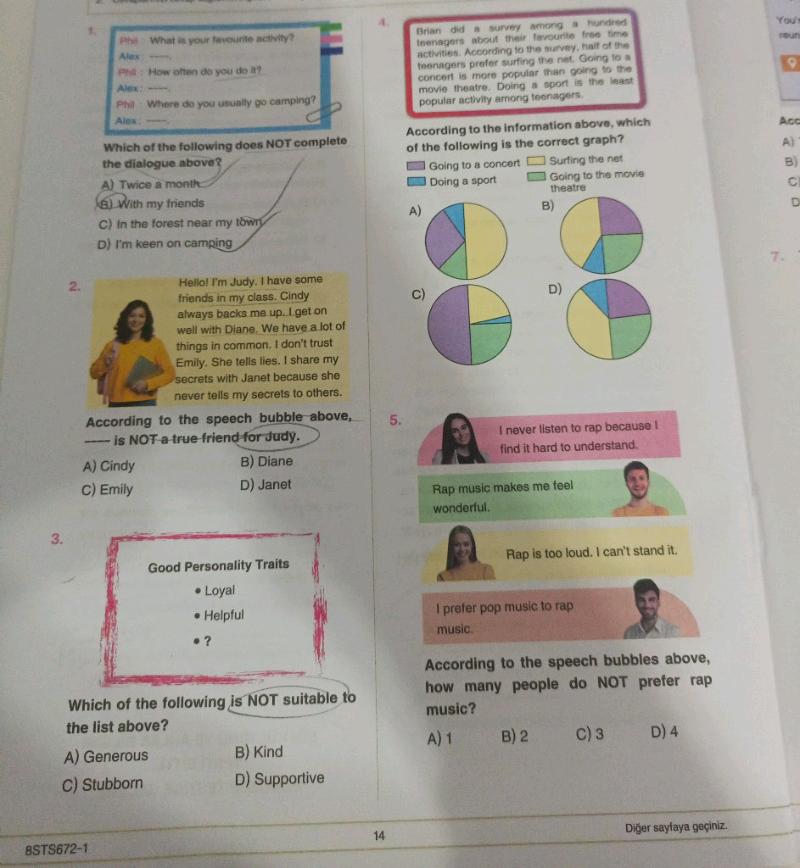
- Phil: What is your favourite activity?
Alex: —
Phil: How often do you do it?
Alex: —
Phil: Where do you usually go camping?
Which of the following does NOT complete the dialogue above?
A) Twice a month
B) With my friends
C) In the forest near my town
D) I’m keen on camping - Hello! I’m Judy. I have some friends in my class. Cindy always backs me up. I get on well with Diane. We have a lot of things in common. I don’t trust Emily. She tells lies. I share my secrets with Janet because she never tells my secrets to others.
According to the speech bubble above, ---- is NOT a true friend for Judy.
A) Cindy
B) Diane
C) Emily
D) Janet - Good Personality Traits
• Loyal
• Helpful
•1
A) Generous
B) Kind
C) Stubborn
D) Supportive - Brian did a survey among a hundred teenagers about their favourite free time activities. According to the survey, half of the teenagers prefer surfing the net. Going to a concert is more popular than going to the movie theatre. Doing a sport is the least popular activity among teenagers.
(Going to a concert, Surfing the net, Doing a sport, Going to the movie theatre)
A) [Graph A]
B) [Graph B]
C) [Graph C]
D) [Graph D] - I never listen to rap because I find it hard to understand.
Rap music makes me feel wonderful.
Rap is too loud. I can’t stand it.
I prefer pop music to rap music.
A) 1
B) 2
C) 3
D) 4
LGS English — Reading Comprehension, Dialogues & Data Analysis
 KEY FORMULA / RULE: In English proficiency tests, answers depend on matching question words (
What, How often, Where) to their correct responses, identifying antonyms/synonyms in personality traits, and translating survey proportions accurately into pie charts.
 SOLUTION & OPTION ANALYSIS
Question 1: Dialogue Completion
- Phil: “What is your favourite activity?” \rightarrow Alex: “I’m keen on camping.” (D)
- Phil: “How often do you do it?” \rightarrow Alex: “Twice a month.” (A)
- Phil: “Where do you usually go camping?” \rightarrow Alex: “In the forest near my town.” (C)
- B) “With my friends” answers the question “Who do you go with?”, which Phil never asks.
 FINAL ANSWER (Q1): B) With my friends
Question 2: Friendship & Personal Characteristics
- A) Cindy: Always backs Judy up (a true, supportive friend).
- B) Diane: Judy gets on well with her and shares common interests (a true friend).
- C) Emily: Judy states, “I don’t trust Emily. She tells lies.” An honest person never tells lies; therefore, Emily is NOT a true friend.
- D) Janet: Keeps Judy’s secrets safe (a true, trustworthy friend).
FINAL ANSWER (Q2): C) Emily
Question 3: Positive vs. Negative Personality Traits
The list title is “Good Personality Traits” and includes positive qualities (Loyal, Helpful):
- A) Generous: Positive trait (giving/sharing).
- B) Kind: Positive trait (polite/caring).
- C) Stubborn: Negative trait meaning obstinate/unwilling to change one’s mind (inatçı). It does not belong in a list of good traits.
- D) Supportive: Positive trait (helpful/encouraging).
FINAL ANSWER (Q3): C) Stubborn
Question 4: Pie Chart Data Interpretation
The survey results state:
- Surfing the net (Yellow): Exactly half (50\%) of the circle.
- Doing a sport (Blue): The least popular activity (the smallest slice).
- Going to a concert (Purple) > Going to the movie theatre (Green): Purple must be larger than green.
- Graph B is the only chart where the yellow section represents exactly 50\% (a straight diameter dividing the circle) and the remaining half is ordered: \text{Purple (Concert)} > \text{Green (Cinema)} > \text{Blue (Sport)}.
FINAL ANSWER (Q4): B)
Question 5: Expressing Preferences & Opinions
- Person 1 (Girl): “I never listen to rap…” \rightarrow Does NOT prefer rap. (1)
- Person 2 (Boy): “Rap music makes me feel wonderful.” \rightarrow Prefers rap.
- Person 3 (Girl): “Rap is too loud. I can’t stand it.” \rightarrow Does NOT prefer rap. (2)
- Person 4 (Boy): “I prefer pop music to rap music.” \rightarrow Does NOT prefer rap. (3)
Counting those who dislike/do not prefer rap gives 1 + 1 + 1 = 3 people.
FINAL ANSWER (Q5): C) 3
 EXAM INSIGHT / PITFALL: Pay close attention to negative question stems containing NOT or antonymous trait classifications (e.g., stubborn vs. supportive), and look for exact geometric benchmarks (50\% = \text{semicircle}) when reading pie charts.