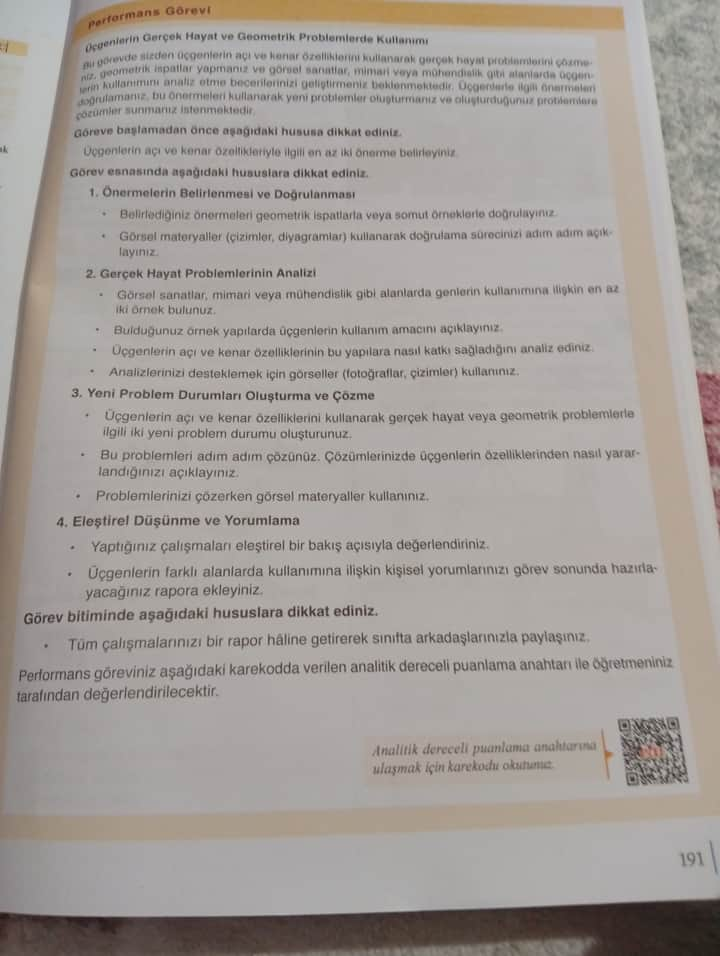
Performans Görevinin Gereksinimleri Nelerdir?
- Belirlenen önerme ve kavramları geometrik ispat veya somut örneklerle doğrulama
- Gerçek hayat ya da mühendislik uygulamalarından en az bir örnek analizi
- Üçgenlerin açı ve kenar özelliklerini kullanarak yeni problemler oluşturma ve çözme
- Çalışmanızı eleştirel bir bakış açısıyla değerlendirme ve yorumlama
Snippets: Performans görevi dört temel aşamadan oluşur ve her aşamada doğrulama, analiz, yaratma ve eleştiri becerileri öne çıkar.
İçindekiler
- Önerme Tanımlama ve Doğrulama
- Gerçek Hayat Problemlerinin Analizi
- Yeni Problem Durumları Oluşturma ve Çözme
- Eleştirel Düşünme ve Yorumlama
- Karşılaştırma Tablosu: İspat vs Somut Örnek
- Özet Tablosu
- SSS
1. Önerme Tanımlama ve Doğrulama
- Önerme: Üçgenin iç açıları toplamının 180^\circ olduğu teoremi.
- İspat:
- Paralel doğrular çizerek
- Z-tip iç açılar bağıntısını kullanarak
- Somut örnek: Bir üçgen şekli çizip açı ölçümlerini toplamak (örneğin 50^\circ+60^\circ+70^\circ=180^\circ).
2. Gerçek Hayat Problemlerinin Analizi
- Mimari: Çatı iskeletlerinde üçgen kullanımı
- Mühendislik: Kafes sistemlerinde kenar ve açı dayanım ilişkisi
- Örnek açıklaması: Bir köprü yapısındaki üçgen elemanın yük taşıma kapasitesinin a^2+b^2=c^2 bağıntısıyla nasıl test edildiği.
3. Yeni Problem Durumları Oluşturma ve Çözme
- Problem Örneği:
“Taban kenarları $5,$cm ve $12,$cm olan dik üçgende hipotenüsün uzunluğu nedir?” - Çözüm:
$$c = \sqrt{5^2 + 12^2} = 13;\text{cm}$$ - Adım adım açıklama ve görsel materyal kullanımı.
4. Eleştirel Düşünme ve Yorumlama
- Çalışmayı güçlü ve zayıf yönleriyle değerlendirme
- Farklı alanlardaki (mimari, sanat) kullanım yorumları
- Öneriler: Daha karmaşık üçgen tipleri eklenebilir (eşkenar, ikizkenar).
5. Karşılaştırma Tablosu: İspat vs Somut Örnek
| Aşama | Geometrik İspat | Somut Örnek |
|---|---|---|
| Amaç | Teorik doğrulama | Gerçek hayata bağlama |
| Araç | Paralel doğrular, iç açılar kavramı | Ölçüm cihazı, çizim |
| Sonuç | Matematiksel kesinlik | Görsel/uygulamalı anlayış |
| Kullanım Alanı | Akademik çalışma | Mimari, mühendislik |
Özet Tablosu
| Aşama No | Başlık | Anahtar Görev |
|---|---|---|
| 1 | Önerme Tanımlama ve Doğrulama | Teorik ve somut doğrulama |
| 2 | Gerçek Hayat Problemlerinin Analizi | Mimari/mühendislik örnekleri |
| 3 | Yeni Problem Durumları Oluşturma ve Çözme | Adım adım problem kurma ve çözme |
| 4 | Eleştirel Düşünme ve Yorumlama | Çalışmanın eleştirel değerlendirmesi |
SSS
- Performans görevinde kaç örnek bulmam gerekiyor?
- En az bir gerçek hayat ve bir geometrik ispat örneği yeterlidir.
- Somut örneklerde hangi araçları kullanabilirim?
- Cetvel, açıölçer, bilgisayar CAD programları gibi görsel araçlar.
- Yeni problem oluştururken dikkat edilmesi gerekenler nelerdir?
- Konuyu yansıtmalı, zorluk derecesi adım adım artmalı.
- Değerlendirme raporunu nasıl sunmalıyım?
- Yazılı belge, sunum slaytları veya poster formatında hazırlayabilirsiniz.
Bu adımlardan hangisi üzerinde daha fazla detaya ihtiyaç duyuyorsunuz?
Performance Task: Using Triangles in Real Life and Geometric Problems
Önemli Noktalar
- Triangles’ angle and side properties should be used to create real-life and geometric problems.
- Visual arts, architecture, and engineering examples help analyze triangle usage.
- Solutions should be verified step-by-step with geometric tools and represented visually.
- Critical thinking and personal reflection on triangle applications in different fields are expected.
Triangles’ properties of angles and sides must be applied to both abstract geometric and real-life problem settings, enhancing skills in creating and solving related challenges. Visual aids like drawings and diagrams are essential for explanation and verification. The entire study should culminate in a report shared with classmates.
İçindekiler
- Task Requirements Overview
- Step 1: Identifying and Verifying Properties
- Step 2: Analyzing Real Life Problems
- Step 3: Creating and Solving New Problems
- Step 4: Critical Thinking and Interpretation
- Summary Table
- Sık Sorulan Sorular
Task Requirements Overview
This task requires you to develop geometric problems involving triangles using their angle and side properties. You should also use real-world examples from fields like visual arts, architecture, or engineering to inform your analysis. Before starting, specify at least two geometric properties of triangles you will focus on. During the task, document verification processes and use various materials such as diagrams or photos to support your findings.
Pro Tip: Combining both theoretical geometry and practical real-life examples enriches your work and deepens understanding.
Step 1: Identifying and Verifying Properties
- Select at least two angular or side properties of triangles (e.g., sum of interior angles, Pythagorean theorem).
- Verify these properties with geometric tools or concrete examples.
- Use visual materials (drawings, diagrams) to explain verification processes step-by-step.
Warning: Avoid skipping the verification step—the accuracy of your conclusions depends on this careful analysis.
Step 2: Analyzing Real Life Problems
- Find at least one example in architecture, visual arts, or engineering where triangles are used.
- Explain the purpose of triangles in those contexts.
- Analyze contributions of triangle angular and side properties to these structures or works.
- Support your analysis with visual aides such as photographs or drawings.
Step 3: Creating and Solving New Problems
- Use the identified triangle properties to create a new problem related to real life or geometry.
- Solve the problem step-by-step.
- Explain how your solution benefits from the triangle properties used.
- Include visual materials to support your solution process.
Step 4: Critical Thinking and Interpretation
- Evaluate your work from a critical point of view.
- Reflect personally on the use of triangle properties in various fields.
- Add your interpretations to the report prepared at the end.
- Share your report with classmates.
Summary Table
| Step | Focus | Key Actions |
|---|---|---|
| 1 | Properties Identification | Choose and verify 2 triangle properties with tools and examples |
| 2 | Real Life Analysis | Find & explain an example from arts, architecture, or engineering |
| 3 | Problem Creation | Generate and solve a new problem with clear explanation |
| 4 | Critical Thinking | Reflect critically and add personal insights |
Sık Sorulan Sorular
1. Which triangle properties are the most important to focus on?
Commonly, the sum of interior angles (180°) and the Pythagorean theorem for right triangles are fundamental. Depending on your problem, you may also consider congruence criteria or similarity ratios.
2. How detailed should the visual materials be?
Visuals should clearly show measurements, angles, and steps in problem-solving or analysis. Clear labeling and neat diagrams enhance understanding and evaluation.
3. Can I use digital tools for diagrams?
Yes, using software for drawings or photos is encouraged as it can improve clarity and precision.
4. How do I prepare the final report?
Compile your work from each step including explanations, visual materials, and personal reflections. Organize it clearly so your classmates can follow your reasoning and findings.
5. Can I include examples from everyday life?
Absolutely. Architectural elements, art designs, engineering structures, and even natural formations involving triangles are all valid.
Sonraki Adımlar
Would you like me to help you develop a sample new geometric problem involving triangle properties with step-by-step solutions and visuals?