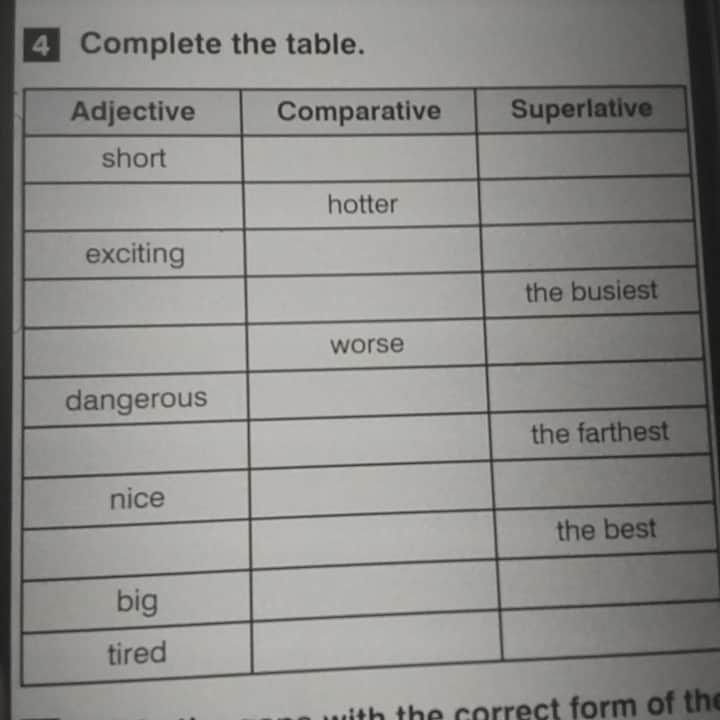
Complete the table with the correct comparative and superlative forms of the adjectives
Answer:
The table asks to fill in the missing comparative and superlative forms of the given adjectives. Here is the completed table with explanations:
| Adjective | Comparative | Superlative |
|---|---|---|
| short | shorter | shortest |
| (hot) | hotter | hottest |
| exciting | more exciting | most exciting |
| busy | busier | the busiest |
| (bad) | worse | worst |
| dangerous | more dangerous | most dangerous |
| far | farther/further | the farthest/the furthest |
| nice | nicer | the nicest |
| big | bigger | biggest |
| tired | more tired | most tired |
Explanation of forms:
- One-syllable adjectives (like short, big, nice, hot) usually form the comparative by adding -er and the superlative by adding -est.
- Adjectives ending in -y (like busy) change the y to i and add -er/-est.
- Adjectives with two or more syllables (like exciting, dangerous, tired) usually use more for comparative and most for superlative.
- Some adjectives have irregular forms (like bad → worse, worst).
- The adjective far has two acceptable comparative and superlative forms: farther/further and farthest/furthest.
- The superlative form usually takes the before it (e.g., the biggest), except when used attributively without a noun.
Completed Table for Your Question:
| Adjective | Comparative | Superlative |
|---|---|---|
| short | shorter | shortest |
| (hot) | hotter | hottest |
| exciting | more exciting | most exciting |
| busy | busier | the busiest |
| (bad) | worse | worst |
| dangerous | more dangerous | most dangerous |
| far | farther/further | the farthest/the furthest |
| nice | nicer | the nicest |
| big | bigger | biggest |
| tired | more tired | most tired |
If you want, I can also explain how to use these forms in sentences.