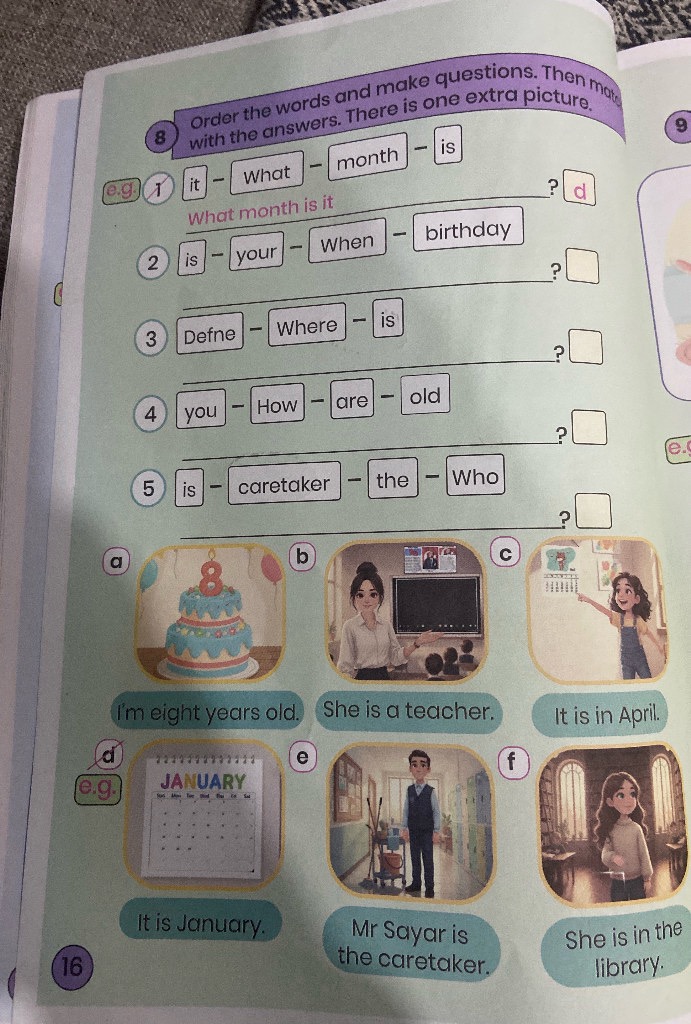
Order the words and make questions. Then match with the answers. There is one extra picture.
E) g. 1 it - What - month - is1 d
What month is it
2 is - your - When - birthday 1 [ 1
3 Defne - Where - is 1 [ 1
4 you - How - are - old 1 [ 1
5 is - caretaker - the - Who 1 [ 1
a I’m eight years old.
b She is a teacher.
c It is in April.
d It is January.
e Mr Sayar is the caretaker.
f She is in the library.
Forming Wh- Questions and Sentence Matching
 KEY FORMULA / RULE: In English, standard information questions begin with a Wh- question word (e.g., What, When, Where, Who, How), followed by the auxiliary/linking verb (am / is / are), the subject, and the rest of the sentence:
\text{Wh- Word} + \text{be (is/are)} + \text{Subject} + \dots ?
 SOLUTION STEPS
1. Example (e.g.):
- Words:
it-What-month-is - Question: What month is it?
- Answer & Match: d (“It is January.”)
2. Item 2:
- Words:
is-your-When-birthday - Question: When is your birthday?
- Answer & Match: c (“It is in April.”) — When asks for time or a date.
3. Item 3:
- Words:
Defne-Where-is - Question: Where is Defne?
- Answer & Match: f (“She is in the library.”) — Where asks for a location or place.
4. Item 4:
- Words:
you-How-are-old - Question: How old are you?
- Answer & Match: a (“I’m eight years old.”) — How old asks for age.
5. Item 5:
- Words:
is-caretaker-the-Who - Question: Who is the caretaker?
- Answer & Match: e (“Mr Sayar is the caretaker.”) — Who asks for a person’s identity.
 FINAL ANSWER:
- 1: What month is it? \rightarrow d
- 2: When is your birthday? \rightarrow c
- 3: Where is Defne? \rightarrow f
- 4: How old are you? \rightarrow a
- 5: Who is the caretaker? \rightarrow e
- (Extra Picture: b — “She is a teacher.”)
 EXAM INSIGHT / PITFALL: Be careful with compound question words: words like “What month” or “How old” function as a single unit at the beginning of the question before the verb is / are.