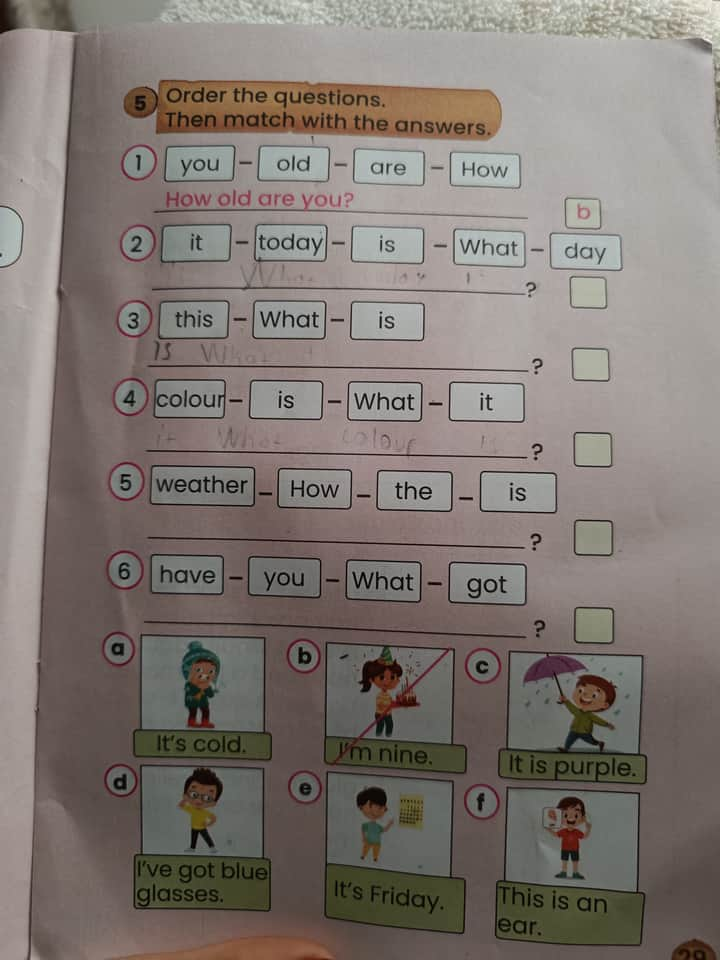
Order the questions. Then match with the answers.
Key Takeaways
- Each question must be correctly ordered with proper English question word structure.
- Match each question to the answer that fits logically.
- Pay attention to question words: How, What, Is, etc.
Direct Answer
- How old are you? — b) I’m nine.
- What day is it today? — e) It’s Friday.
- What is this? — f) This is an ear.
- What colour is it? — c) It is purple.
- How is the weather? — a) It’s cold.
- What have you got? — d) I’ve got blue glasses.
Table of Contents
Questions ordering
- Question 1: Arrange “How you old are” → “How old are you?”
- Question 2: Arrange “What day is it today?” correctly with “What day is it today?”
- Question 3: Arrange “What is this?”
- Question 4: Arrange “What colour is it?”
- Question 5: Arrange “How is the weather?”
- Question 6: Arrange “What have you got?”
Answer matching
- 1 → b) “I’m nine.” fits age question.
- 2 → e) “It’s Friday.” answers day question.
- 3 → f) “This is an ear.” answers identification question.
- 4 → c) “It is purple.” answers colour question.
- 5 → a) “It’s cold.” answers weather question.
- 6 → d) “I’ve got blue glasses.” answers possession question.
Summary Table
| Question Number | Correct Question | Correct Answer |
|---|---|---|
| 1 | How old are you? | I’m nine. |
| 2 | What day is it today? | It’s Friday. |
| 3 | What is this? | This is an ear. |
| 4 | What colour is it? | It is purple. |
| 5 | How is the weather? | It’s cold. |
| 6 | What have you got? | I’ve got blue glasses. |
FAQ
Q1: How do I form a question with “How”?
A1: Start with “How” + adjective/adverb + subject + verb. For example: “How old are you?”
Q2: What is the question word for days of the week?
A2: Use “What day is it today?” to ask about days.
Q3: How to ask about colour?
A3: Use “What colour is it?” to inquire about an object’s colour.
Q4: How to ask what someone has?
A4: Use “What have you got?” to ask about possession.
Would you like me to create similar practice exercises with answers for improving your English question skills?
Order the questions and match them with the answers
Key Takeaways
- “How” questions ask for descriptions (e.g., age, weather).
- “What + noun” questions ask for identification, day, colour, or possession.
- Each question pairs with one of the answer options a–f.
Direct Answer:
- How old are you? — b
- What day is it today? — e
- What is this? — f
- What colour is it? — c
- How is the weather? — a
- What have you got? — d
Table of Contents
- Correct Questions and Matches
- Question Structure Explanation
- Comparison: How vs What Questions
- Summary Table
- FAQ
1. Correct Questions and Matches
- 1. How old are you? — b) I’m nine.
- 2. What day is it today? — e) It’s Friday.
- 3. What is this? — f) This is an ear.
- 4. What colour is it? — c) It is purple.
- 5. How is the weather? — a) It’s cold.
- 6. What have you got? — d) I’ve got blue glasses.
2. Question Structure Explanation
- “How + adjective/adverb + subject + verb”: used for age, weather, feelings, etc.
- “What + noun + be + subject”: used for identification (this/that), day, colour, possession.
- Inversion of subject and verb (“are you”, “is it”) is mandatory in English question formation.
3. Comparison: How vs What Questions
| Feature | How Questions | What Questions |
|---|---|---|
| Question Word | How | What |
| Purpose | Describe condition/quantity | Identify object/day/colour/etc. |
| Structure Example | How old are you? | What colour is it? |
| Required Answer Type | Adjective/adverb/numerical | Noun/phrase |
4. Summary Table
| № | Question | Answer Option | Full Answer |
|---|---|---|---|
| 1 | How old are you? | b | I’m nine. |
| 2 | What day is it today? | e | It’s Friday. |
| 3 | What is this? | f | This is an ear. |
| 4 | What colour is it? | c | It is purple. |
| 5 | How is the weather? | a | It’s cold. |
| 6 | What have you got? | d | I’ve got blue glasses. |
5. FAQ
Q1: Why do we invert subject and verb in English questions?
A1: Inversion signals a question form. Without it, the sentence is a statement.
Q2: Can “How” ask about day or colour?
A2: No, “How” asks about quality or degree (How old, How tall, How fast). “What” is for identification or category.
Q3: Why “have got” instead of “have” for possession?
A3: “Have got” is a common British English form to express possession; “have” alone is also correct (“What do you have?”).
Would you like more practice exercises on forming English questions?