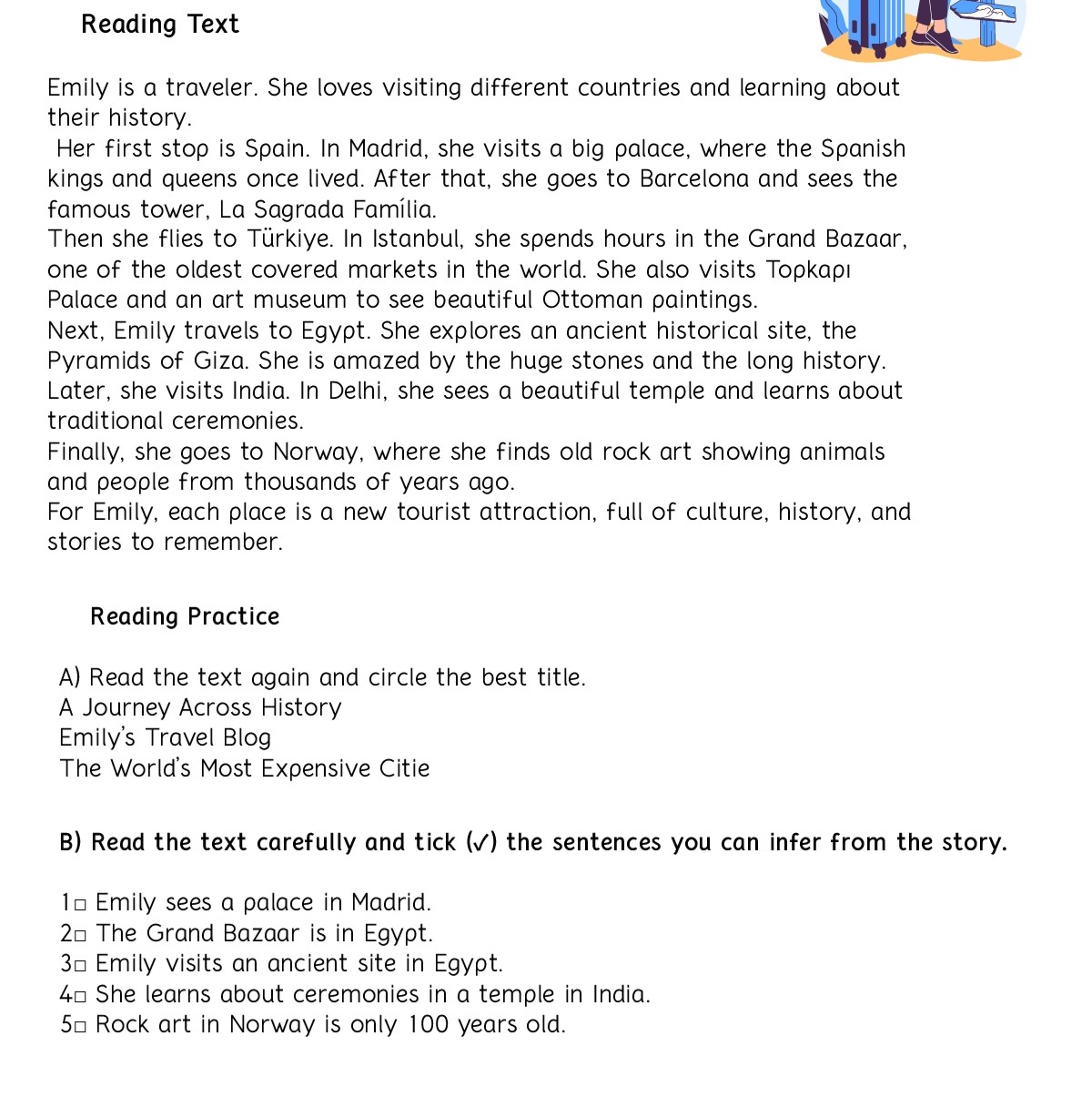
Reading Text Questions: Answers and Explanations
A) Read the text again and circle the best title.
- Best title:
Emily’s Travel Blog
Explanation:
The text describes Emily traveling to various countries and learning about their history and culture. It is a narrative of her journey and experiences, which fits well with the title “Emily’s Travel Blog.”
- “A Journey Across History” is possible but less focused on the traveler’s personal experience.
- “The World’s Most Expensive Cities” is unrelated to the content of the text.
B) Read the text carefully and tick (✓) the sentences you can infer from the story.
| Sentence | True/False (✓ or ✗) | Explanation |
|---|---|---|
| 1. Emily sees a palace in Madrid. | ✓ | The text says Emily visits a big palace in Madrid where Spanish kings lived. |
| 2. The Grand Bazaar is in Egypt. | ✗ | The Grand Bazaar is in Istanbul, Türkiye, not Egypt. |
| 3. Emily visits an ancient site in Egypt. | ✓ | She explores the Pyramids of Giza, an ancient historical site in Egypt. |
| 4. She learns about ceremonies in a temple in India. | ✓ | The text says she visits a temple in Delhi and learns about traditional ceremonies. |
| 5. Rock art in Norway is only 100 years old. | ✗ | The text says the rock art is old, showing people from thousands of years ago, so it is much older than 100 years. |
Summary Table
| Question | Answer | Explanation |
|---|---|---|
| Best Title | Emily’s Travel Blog | Reflects the traveler’s personal experiences and blog style. |
| Emily sees a palace in Madrid | ✓ | Directly stated in the text. |
| Grand Bazaar location | ✗ | Located in Istanbul, Türkiye, not Egypt. |
| Ancient site in Egypt visited | ✓ | The Pyramids of Giza mentioned explicitly. |
| Learning about Indian ceremonies | ✓ | She learns about ceremonies at a temple in India. |
| Rock art age in Norway | ✗ | Rock art is ancient, thousands of years old, not 100 years. |
Detailed Explanation
The passage gives a travelogue-style description of Emily’s visits to several countries: Spain, Türkiye, Egypt, India, and Norway. In each location, she explores historical and cultural landmarks:
- Spain: Palace in Madrid, famous tower La Sagrada Família in Barcelona.
- Türkiye: Grand Bazaar and Topkapı Palace in Istanbul.
- Egypt: Pyramids of Giza.
- India: A temple in Delhi with traditional ceremonies.
- Norway: Old rock art showing animals and ancient people, emphasizing long history.
The questions check comprehension and inference based on the text. Identifying locations, key landmarks, and the age of historical artifacts helps evaluate understanding.
If you need more help with English reading practice or travel-themed texts, feel free to ask! 
Here are the answers and a brief explanation for each part:
A) Best title
- A Journey Across History
This title fits best because the text highlights Emily’s visits to several historical sites around the world, from palaces and temples to ancient rock art.
B) Sentences you can infer ( = true, ✘ = false)
- Emily sees a palace in Madrid.
– The text says: “In Madrid, she visits a big palace…” - The Grand Bazaar is in Egypt.
✘ – The Grand Bazaar is in Istanbul, Turkey, not Egypt. - Emily visits an ancient site in Egypt.
– She explores “an ancient historical site, the Pyramids of Giza.” - She learns about ceremonies in a temple in India.
– In Delhi, “she sees a beautiful temple and learns about traditional ceremonies.” - Rock art in Norway is only 100 years old.
✘ – The rock art dates back thousands of years, not just a century.
Quick tips on how to tackle similar reading-inference tasks:
• Read the text twice—first for general meaning, then for specific details.
• Underline or note keywords (e.g., palace, ancient, learns) to match them with the statements.
• Pay attention to location words (Madrid, Istanbul, Egypt, India, Norway) when verifying each sentence.
• Remember that “infer” means you can logically conclude it from what’s written, even if the exact wording differs.