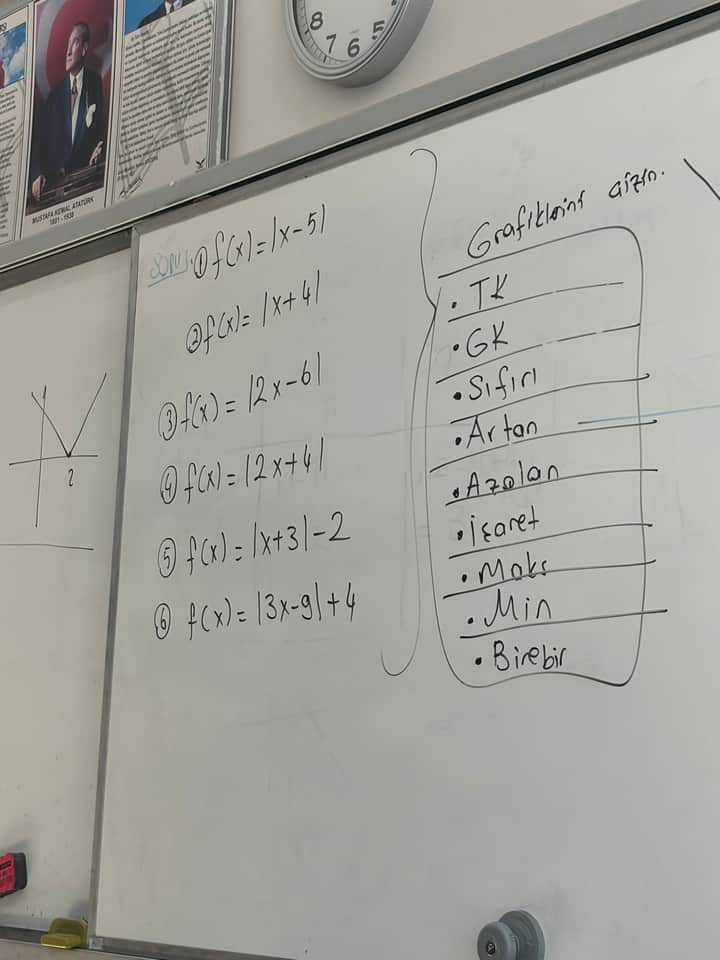
Merhaba, aşağıda tahtada verilen altı adet mutlak değer fonksiyonunun
- Tanım Kümesi (TK)
- Görüntü Kümesi (GK)
- Sıfır Noktaları
- Artan / Azalan Aralıkları
- İşaret Durumu
- Minimum / Maksimum Değerleri
- Bire-birlik Durumu
gibi tüm temel özelliklerini hem ayrıntılı açıklamalarla hem de özet bir tabloyla bulabilirsin.
1. Fonksiyonların Ayrıntılı İncelemesi
1) f(x)=|x-5|
- TK: \mathbb{R}
- GK: [0,\infty)
- Sıfır Noktası: x=5 ⇒ f(5)=0
- Azalan: (-\infty,\,5]
- Artan: [5,\,\infty)
- İşaret: f(x)>0 tüm x\neq5 için, f(5)=0
- Min: 0 (nokta: x=5)
- Max: yok (sonsuza kadar artar)
- Bire-bir: Hayır (simetrik yapısı nedeniyle)
2) f(x)=|x+4|
- TK: \mathbb{R}
- GK: [0,\infty)
- Sıfır Noktası: x=-4
- Azalan: (-\infty,-4]
- Artan: [-4,\infty)
- İşaret: f(x)>0 tüm x\neq-4 için, f(-4)=0
- Min: 0 (nokta: x=-4)
- Max: yok
- Bire-bir: Hayır
3) f(x)=|2x-6| = 2\,|x-3|
- TK: \mathbb{R}
- GK: [0,\infty)
- Sıfır Noktası: 2x-6=0\;\Rightarrow\;x=3
- Azalan: (-\infty,3]
- Artan: [3,\infty)
- İşaret: f(x)>0 için x\neq3, f(3)=0
- Min: 0 (nokta: x=3)
- Max: yok
- Bire-bir: Hayır
4) f(x)=|2x+4| = 2\,|x+2|
- TK: \mathbb{R}
- GK: [0,\infty)
- Sıfır Noktası: 2x+4=0\;\Rightarrow\;x=-2
- Azalan: (-\infty,-2]
- Artan: [-2,\infty)
- İşaret: f(x)>0 tüm x\neq-2, f(-2)=0
- Min: 0 (nokta: x=-2)
- Max: yok
- Bire-bir: Hayır
5) f(x)=|x+3|\;-2
- TK: \mathbb{R}
- GK: [-2,\infty)
- Sıfır Noktaları: |x+3|-2=0\;\Rightarrow\;|x+3|=2\;\Rightarrow\;x=-5,\,-1
- Azalan: (-\infty,-3]
- Artan: [-3,\infty)
- İşaret:
- f(x)<0 için -5<x<-1 (çünkü -2<f(x)<0),
- f(x)=0 için x=-5,-1,
- f(x)>0 diğer tüm $x$’ler.
- Min: -2 (nokta: x=-3)
- Max: yok
- Bire-bir: Hayır
6) f(x)=|3x-9|\;+\;4 = 3\,|x-3|\;+\;4
- TK: \mathbb{R}
- GK: [4,\infty)
- Sıfır Noktası: yok (çünkü |3x-9|+4\ge4 daima pozitif)
- Azalan: (-\infty,3]
- Artan: [3,\infty)
- İşaret: f(x)\ge4>0 tüm x için
- Min: 4 (nokta: x=3)
- Max: yok
- Bire-bir: Hayır
2. Tüm Fonksiyonların Özeti
| Fonksiyon | TK | GK | Sıfır Noktası | Azalan | Artan | İşaret | Min | Max | Bire-bir |
|---|---|---|---|---|---|---|---|---|---|
| $ | x-5 | $ | \mathbb R | [0,\infty) | x\le5 | x\ge5 | \ge0, 0’da sıfır | 0 | — |
| $ | x+4 | $ | \mathbb R | [0,\infty) | x=-4 | x\le-4 | x\ge-4 | \ge0, 0’da sıfır | 0 |
| $ | 2x-6 | $ | \mathbb R | [0,\infty) | x=3 | x\le3 | x\ge3 | \ge0, 0’da sıfır | 0 |
| $ | 2x+4 | $ | \mathbb R | [0,\infty) | x=-2 | x\le-2 | x\ge-2 | \ge0, 0’da sıfır | 0 |
| $ | x+3 | -2$ | \mathbb R | [-2,\infty) | x=-5,-1 | x\le-3 | x\ge-3 | -2\le f(x)<0 arası, 0’da sıfır, >0 diğer | –2 |
| $ | 3x-9 | +4$ | \mathbb R | [4,\infty) | yok | x\le3 | x\ge3 | f(x)\ge4>0 | 4 |
Özet
- Tüm fonksiyonların tanım kümeleri gerçek sayılardır.
- İlk dördünün görüntü kümesi [0,\infty), beşincinin [-2,\infty), altıncının ise [4,\infty) şeklindedir.
- Hepsinin grafiklerinde mutlak değer merkezi (kırılma noktası) baz alınarak sol taraf azalan, sağ taraf artandır.
- Sıfır noktaları ve işaret aralıkları tabloya işlenmiştir.
- Hiçbir fonksiyon tüm \mathbb R üzerinde bire-bir değildir (her biri simetrik bir yapı sergiler).
- Minimum değerler mutlak değerin merkezinde oluşur; maksimum değer yoktur (sonsuz artış).
Bol şans!
How to analyze and graph the given absolute value functions?
Answer:
You have six absolute value functions given:
- f(x) = |x - 5|
- f(x) = |x + 4|
- f(x) = |2x - 6|
- f(x) = |2x + 6|
- f(x) = |x + 3| - 2
- f(x) = |3x - 9| + 4
The goal is to understand their graphs and the properties listed on the right side of the board:
- TK (Tanım Kümesi): Domain
- GK (Görüntü Kümesi): Range
- Sıfırı: Zero(s) or root(s)
- Artan: Increasing intervals
- Azalan: Decreasing intervals
- İşaret: Sign (positive/negative intervals)
- Maks: Maximum value
- Min: Minimum value
- Birebir: One-to-one (injective)
Table of Contents
- General properties of absolute value functions
- Step-by-step analysis of each function
- Summary table of key properties
1. General properties of absolute value functions
The absolute value function f(x) = |x - a| has a V-shaped graph with the vertex at x = a.
- Domain (Tanım Kümesi): All real numbers, \mathbb{R}.
- Range (Görüntü Kümesi): [0, +\infty) if no vertical shift; otherwise shifted accordingly.
- Zero(s) (Sıfırı): The point where the expression inside the absolute value is zero, i.e., x = a.
- Increasing (Artan) and Decreasing (Azalan) intervals:
- Decreasing on (-\infty, a)
- Increasing on (a, +\infty)
- Minimum (Min): At x = a, f(a) = 0 (if no vertical shift).
- Maximum (Maks): No maximum (goes to infinity).
- Sign (İşaret): f(x) \geq 0 always.
- One-to-one (Birebir): Not one-to-one on \mathbb{R} because it fails the horizontal line test; however, it is one-to-one on intervals (-\infty, a] or [a, +\infty).
When the function is of the form f(x) = |m x + b| + c, the graph is a V-shape shifted horizontally and vertically, and stretched/compressed by |m|.
2. Step-by-step analysis of each function
1) f(x) = |x - 5|
- Vertex: x = 5
- Domain: \mathbb{R}
- Range: [0, +\infty)
- Zero: x = 5
- Decreasing: (-\infty, 5)
- Increasing: (5, +\infty)
- Minimum: f(5) = 0
- Maximum: None
- Sign: f(x) \geq 0
- One-to-one: No on \mathbb{R}, yes on (-\infty, 5] or [5, +\infty)
2) f(x) = |x + 4|
- Vertex: x = -4
- Domain: \mathbb{R}
- Range: [0, +\infty)
- Zero: x = -4
- Decreasing: (-\infty, -4)
- Increasing: (-4, +\infty)
- Minimum: f(-4) = 0
- Maximum: None
- Sign: f(x) \geq 0
- One-to-one: No on \mathbb{R}, yes on (-\infty, -4] or [-4, +\infty)
3) f(x) = |2x - 6|
Rewrite inside absolute value:
2x - 6 = 2(x - 3)
- Vertex: x = 3
- Domain: \mathbb{R}
- Range: [0, +\infty)
- Zero: x = 3
- Decreasing: (-\infty, 3)
- Increasing: (3, +\infty)
- Minimum: f(3) = 0
- Maximum: None
- Sign: f(x) \geq 0
- One-to-one: No on \mathbb{R}, yes on (-\infty, 3] or [3, +\infty)
- Stretch factor: The graph is steeper than |x| by a factor of 2.
4) f(x) = |2x + 6|
Rewrite inside absolute value:
2x + 6 = 2(x + 3)
- Vertex: x = -3
- Domain: \mathbb{R}
- Range: [0, +\infty)
- Zero: x = -3
- Decreasing: (-\infty, -3)
- Increasing: (-3, +\infty)
- Minimum: f(-3) = 0
- Maximum: None
- Sign: f(x) \geq 0
- One-to-one: No on \mathbb{R}, yes on (-\infty, -3] or [-3, +\infty)
- Stretch factor: Steeper by factor 2.
5) f(x) = |x + 3| - 2
-
Vertex: x = -3
-
Domain: \mathbb{R}
-
Range: [-2, +\infty) (shifted down by 2)
-
Zero: Solve |x + 3| - 2 = 0 \Rightarrow |x + 3| = 2
So,
x + 3 = 2 \Rightarrow x = -1or
x + 3 = -2 \Rightarrow x = -5
So zeros at x = -5 and x = -1.
-
Decreasing: (-\infty, -3)
-
Increasing: (-3, +\infty)
-
Minimum: f(-3) = -2
-
Maximum: None
-
Sign: Negative between zeros (-5, -1), positive outside.
-
One-to-one: No on \mathbb{R}, yes on (-\infty, -3] or [-3, +\infty)
6) f(x) = |3x - 9| + 4
Rewrite inside absolute value:
3x - 9 = 3(x - 3)
- Vertex: x = 3
- Domain: \mathbb{R}
- Range: [4, +\infty) (shifted up by 4)
- Zero: Solve |3x - 9| + 4 = 0 → |3x - 9| = -4 which is impossible, so no zeros.
- Decreasing: (-\infty, 3)
- Increasing: (3, +\infty)
- Minimum: f(3) = 4
- Maximum: None
- Sign: Always positive (≥ 4)
- One-to-one: No on \mathbb{R}, yes on (-\infty, 3] or [3, +\infty)
- Stretch factor: Steeper by factor 3.
3. Summary Table of Key Properties
| Function | Vertex (x) | Domain (\mathbb{R}) | Range | Zero(s) | Decreasing Interval | Increasing Interval | Min Value | Max Value | One-to-one on \mathbb{R}? |
|---|---|---|---|---|---|---|---|---|---|
| $ | x - 5 | $ | 5 | [0, +\infty) | x=5 | (-\infty, 5) | (5, +\infty) | 0 | None |
| $ | x + 4 | $ | -4 | [0, +\infty) | x=-4 | (-\infty, -4) | (-4, +\infty) | 0 | None |
| $ | 2x - 6 | $ | 3 | [0, +\infty) | x=3 | (-\infty, 3) | (3, +\infty) | 0 | None |
| $ | 2x + 6 | $ | -3 | [0, +\infty) | x=-3 | (-\infty, -3) | (-3, +\infty) | 0 | None |
| $ | x + 3 | - 2$ | -3 | [ -2, +\infty) | x=-5, -1 | (-\infty, -3) | (-3, +\infty) | -2 | None |
| $ | 3x - 9 | + 4$ | 3 | [4, +\infty) | None | (-\infty, 3) | (3, +\infty) | 4 | None |
Additional notes:
- The domain for all these functions is all real numbers, \mathbb{R}.
- The range depends on vertical shifts.
- The zeros are found by solving inside the absolute value equal to zero or the whole function equal to zero.
- The minimum value is at the vertex, equal to the vertical shift if any.
- None of these functions are one-to-one on the entire real line because absolute value functions are symmetric, but they are one-to-one on intervals split at the vertex.
If you want, I can also help you draw the graphs step-by-step or explain any specific function in more detail.