simplify show all working
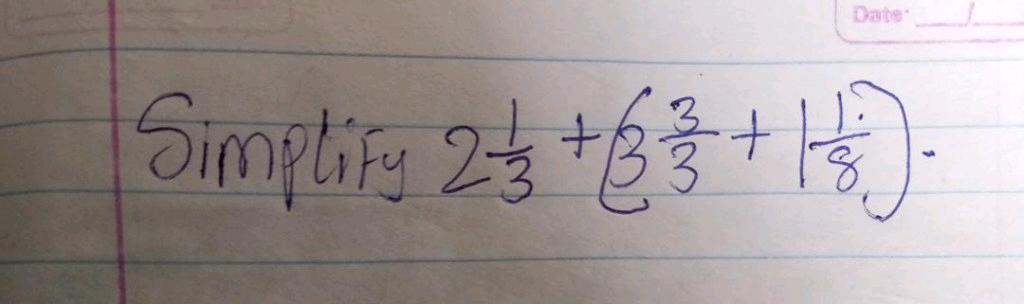
Simplifying the Expression 2\frac{1}{3} + \left(3\frac{3}{3} + 1\frac{1}{8}\right)
 RULE / FORMULA USED:
- Converting Mixed Numbers to Improper Fractions:a\frac{b}{c} = \frac{(a \times c) + b}{c}
- Order of Operations (PEMDAS): Evaluate terms inside parentheses first.
- Addition of Fractions with Unlike Denominators: Find the Least Common Denominator (\text{LCD}) to combine fractions:\frac{a}{b} + \frac{c}{d} = \frac{a \cdot d + c \cdot b}{b \cdot d}
 SOLUTION STEPS:
Step 1 — Convert each mixed number into an improper fraction
- First term:2\frac{1}{3} = \frac{(2 \times 3) + 1}{3} = \frac{7}{3}
- Second term (inside parentheses):3\frac{3}{3} = 3 + 1 = 4 = \frac{4}{1} = \frac{12}{3}
- Third term (inside parentheses):1\frac{1}{8} = \frac{(1 \times 8) + 1}{8} = \frac{9}{8}
Step 2 — Simplify the expression inside the parentheses
Find a common denominator for 4 (or \frac{4}{1}) and \frac{9}{8}, which is 8:
\left(4 + \frac{9}{8}\right) = \left(\frac{32}{8} + \frac{9}{8}\right) = \frac{41}{8}
Step 3 — Add the remaining terms together
Now, add the first fraction \frac{7}{3} to the result of the parentheses \frac{41}{8}:
\frac{7}{3} + \frac{41}{8}
The Least Common Denominator (\text{LCD}) of 3 and 8 is 24:
- Convert \frac{7}{3}:\frac{7 \times 8}{3 \times 8} = \frac{56}{24}
- Convert \frac{41}{8}:\frac{41 \times 3}{8 \times 3} = \frac{123}{24}
Step 4 — Combine the fractions and convert to a mixed number
Add the numerators over the common denominator:
\frac{56 + 123}{24} = \frac{179}{24}
Convert the improper fraction \frac{179}{24} into a mixed number:
179 \div 24 = 7 \text{ with a remainder of } 11
\frac{179}{24} = 7\frac{11}{24}
(Note: If the second term in your handwriting is intended to be 3\frac{2}{3}, the sum is 2\frac{1}{3} + 3\frac{2}{3} + 1\frac{1}{8} = 6 + 1\frac{1}{8} = 7\frac{1}{8}.)
━━━━━━━━━━━━━━━━━━━━━━━━━━━
 ANSWER: 7\frac{11}{24} (or as an improper fraction: \frac{179}{24})
━━━━━━━━━━━━━━━━━━━━━━━━━━━
 KEY CONCEPTS:
1. Mixed Numbers and Whole Numbers
- Definition: A mixed number represents the sum of a whole number and a proper fraction.
- In this problem: The term 3\frac{3}{3} contains \frac{3}{3}, which equals 1, turning the whole term into 3 + 1 = 4.
2. Least Common Denominator (LCD)
- Definition: The smallest positive integer that is a common multiple of the denominators of two or more fractions.
- In this problem: The \text{LCD} of 3 and 8 is 24, which was used to perform the final addition.
 COMMON MISTAKES:
 Adding Denominators Directly
- Wrong: \frac{7}{3} + \frac{41}{8} = \frac{7+41}{3+8} = \frac{48}{11}
- Right: \frac{7}{3} + \frac{41}{8} = \frac{56}{24} + \frac{123}{24} = \frac{179}{24}
- Why it’s wrong: Fractions cannot be added by directly combining numerators and denominators; they must share a common denominator to represent equal parts of a whole.
Would you like me to generate a similar fraction problem for you to practice?
number 2 question
Simplifying the Expression 3\frac{1}{4} + \left(2\frac{2}{3} + 1\frac{1}{6}\right)
RULE / FORMULA USED:
- Converting Mixed Numbers to Improper Fractions:a\frac{b}{c} = \frac{(a \times c) + b}{c}
- Order of Operations (PEMDAS): Simplify the terms inside the parentheses first.
- Addition of Fractions with Unlike Denominators: Find the Least Common Denominator (\text{LCD}) to combine fractions:\frac{a}{b} + \frac{c}{d} = \frac{a \cdot d + c \cdot b}{b \cdot d}
SOLUTION STEPS:
Step 1 — Convert each mixed number into an improper fraction
- First term:3\frac{1}{4} = \frac{(3 \times 4) + 1}{4} = \frac{13}{4}
- Second term (inside parentheses):2\frac{2}{3} = \frac{(2 \times 3) + 2}{3} = \frac{8}{3}
- Third term (inside parentheses):1\frac{1}{6} = \frac{(1 \times 6) + 1}{6} = \frac{7}{6}
Step 2 — Simplify the expression inside the parentheses
Find the common denominator for \frac{8}{3} and \frac{7}{6}, which is 6:
- Convert \frac{8}{3}:\frac{8 \times 2}{3 \times 2} = \frac{16}{6}
- Add the fractions:\left(\frac{16}{6} + \frac{7}{6}\right) = \frac{16 + 7}{6} = \frac{23}{6}
Step 3 — Add the remaining terms together
Now, add the first fraction \frac{13}{4} to the result from the parentheses \frac{23}{6}:
\frac{13}{4} + \frac{23}{6}
The Least Common Denominator (\text{LCD}) of 4 and 6 is 12:
- Convert \frac{13}{4}:\frac{13 \times 3}{4 \times 3} = \frac{39}{12}
- Convert \frac{23}{6}:\frac{23 \times 2}{6 \times 2} = \frac{46}{12}
Step 4 — Combine the fractions and convert to a mixed number
Add the numerators over the common denominator:
\frac{39 + 46}{12} = \frac{85}{12}
Convert the improper fraction \frac{85}{12} into a mixed number:
85 \div 12 = 7 \text{ with a remainder of } 1
\frac{85}{12} = 7\frac{1}{12}
━━━━━━━━━━━━━━━━━━━━━━━━━━━
ANSWER: 7\frac{1}{12} (or as an improper fraction: \frac{85}{12})
━━━━━━━━━━━━━━━━━━━━━━━━━━━
KEY CONCEPTS:
1. Grouping with Parentheses
- Definition: Operations enclosed in parentheses must be evaluated before operations outside them.
- In this problem: We simplified \left(2\frac{2}{3} + 1\frac{1}{6}\right) into \frac{23}{6} before adding it to 3\frac{1}{4}.
2. Least Common Denominator (LCD)
- Definition: The smallest positive multiple shared by the denominators of two or more fractions.
- In this problem: The \text{LCD} of 4 and 6 is 12, which allowed us to combine the fractions accurately.
COMMON MISTAKES:
Multiplying Denominators Instead of Finding the LCD
- Wrong: Using 4 \times 6 = 24 without simplifying, leading to larger and error-prone calculations like \frac{170}{24}.
- Right: Using the smallest common multiple, \text{LCD}(4, 6) = 12, to keep the numbers as simple as possible.
- Why it’s wrong: While using a larger common denominator gives the same mathematical value, it increases the chance of arithmetic errors and requires extra simplification steps at the end.
Would you like another practice problem involving subtraction or multiplication of mixed numbers?