the correct answer
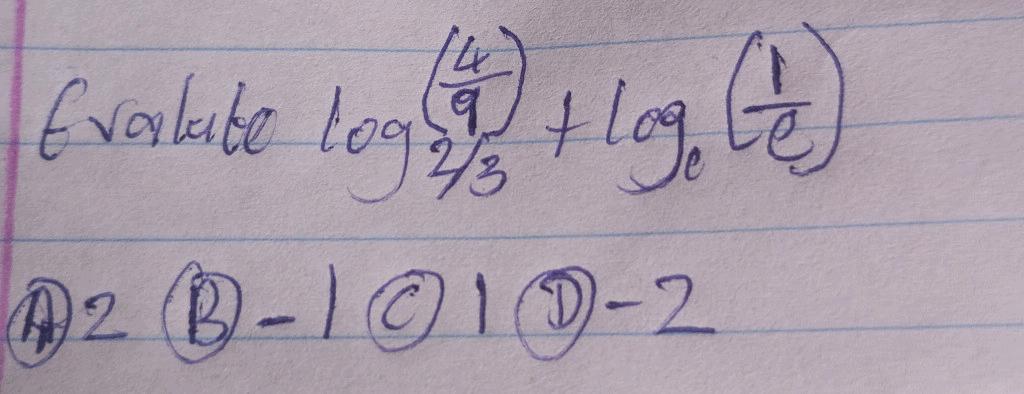
Evaluation of \log_{2/3}\left(\frac{4}{9}\right) + \log_{e}\left(\frac{1}{e}\right)
 RULE / FORMULA USED:
- Base-power logarithm identity: \log_{b}(b^k) = k
- Exponent rules for fractions and negatives: \left(\frac{a}{b}\right)^k = \frac{a^k}{b^k} and \frac{1}{b} = b^{-1}
 SOLUTION STEPS:
Step 1 — Evaluate the first logarithmic term
Express the argument \frac{4}{9} in terms of base \frac{2}{3}:
\frac{4}{9} = \left(\frac{2}{3}\right)^2
Apply the logarithmic identity \log_{b}(b^k) = k:
\log_{2/3}\left(\frac{4}{9}\right) = \log_{2/3}\left(\left(\frac{2}{3}\right)^2\right) = 2
Step 2 — Evaluate the second logarithmic term
Express the argument \frac{1}{e} in terms of base e:
\frac{1}{e} = e^{-1}
Apply the logarithmic identity \log_{e}(e^k) = k:
\log_{e}\left(\frac{1}{e}\right) = \log_{e}(e^{-1}) = -1
Step 3 — Add the evaluated values
Substitute the values back into the original expression:
\log_{2/3}\left(\frac{4}{9}\right) + \log_{e}\left(\frac{1}{e}\right) = 2 + (-1) = 2 - 1 = 1
━━━━━━━━━━━━━━━━━━━━━━━━━━━
 ANSWER: C) 1
━━━━━━━━━━━━━━━━━━━━━━━━━━━
 KEY CONCEPTS:
1. Logarithm Base Property
- Definition: The logarithm \log_b(x) asks: “To what power must base b be raised to equal x?”
- In this problem: \left(\frac{2}{3}\right)^2 = \frac{4}{9}, so \log_{2/3}\left(\frac{4}{9}\right) = 2.
2. Negative Exponent Property
- Definition: Taking the reciprocal of a base corresponds to a negative exponent (b^{-1} = \frac{1}{b}).
- In this problem: e^{-1} = \frac{1}{e}, so \log_e\left(\frac{1}{e}\right) = -1.
 COMMON MISTAKES:
 Confusing Base Powers with Reciprocals
- Wrong: Assuming \log_{2/3}\left(\frac{4}{9}\right) = -2 by misapplying negative exponents.
- Right: \left(\frac{2}{3}\right)^2 = \frac{4}{9}, which gives a positive exponent +2.
- Why it’s wrong: A negative exponent flips the fraction, but here the numerator and denominator are both squared directly without inverting.
Would you like to try another logarithm problem involving fractional or negative bases to practice?