correct answer
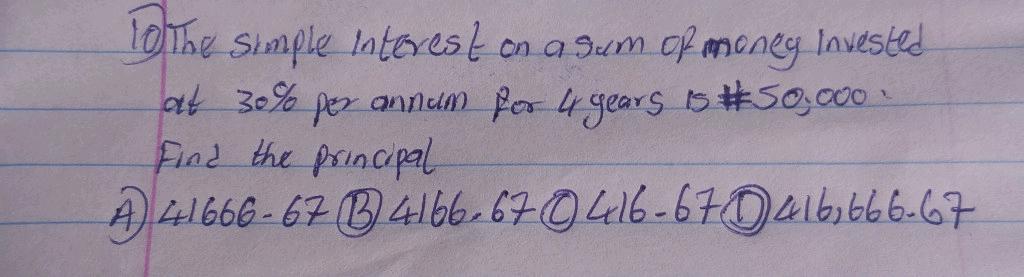
Calculating the Principal from Simple Interest
 RULE / FORMULA USED:
\text{Simple Interest } (I) = \frac{P \times R \times T}{100}
Rearranging the formula to solve for the Principal (P):
P = \frac{I \times 100}{R \times T}
Where:
- I = Simple Interest = ₦50,000
- R = Rate of interest per annum = 30\%
- T = Time period = 4\text{ years}
- P = Principal (the original sum of money)
 SOLUTION STEPS:
Step 1 — Identify Given Values
- Interest (I) = ₦50,000
- Rate (R) = 30\%
- Time (T) = 4\text{ years}
Step 2 — Substitute Values into the Principal Formula
P = \frac{50,000 \times 100}{30 \times 4}
Step 3 — Simplify the Numerator and Denominator
- Numerator: 50,000 \times 100 = 5,000,000
- Denominator: 30 \times 4 = 120
P = \frac{5,000,000}{120}
Step 4 — Calculate the Final Value
P = \frac{500,000}{12} = \frac{125,000}{3} \approx 41,666.67
━━━━━━━━━━━━━━━━━━━━━━━━━━━
 ANSWER: Option A) 41666.67 (₦41,666.67)
━━━━━━━━━━━━━━━━━━━━━━━━━━━
 KEY CONCEPTS:
1. Simple Interest
- Definition: A method to calculate the interest charge on a loan or investment where the interest is calculated only on the initial principal.
- In this problem: The total accumulated interest (₦50,000) over 4\text{ years} at 30\% per annum was used to work backwards to determine the starting capital.
 COMMON MISTAKES:
 Confusing Total Amount with Simple Interest
- Wrong: Treating ₦50,000 as the total maturity value (A = P + I) and using A = P(1 + \frac{RT}{100}).
- Right: Recognizing that ₦50,000 is solely the interest earned (I).
- Why it’s wrong: The problem explicitly states that the simple interest is ₦50,000, not the final amount.
Would you like me to generate a similar practice problem to test your skills?