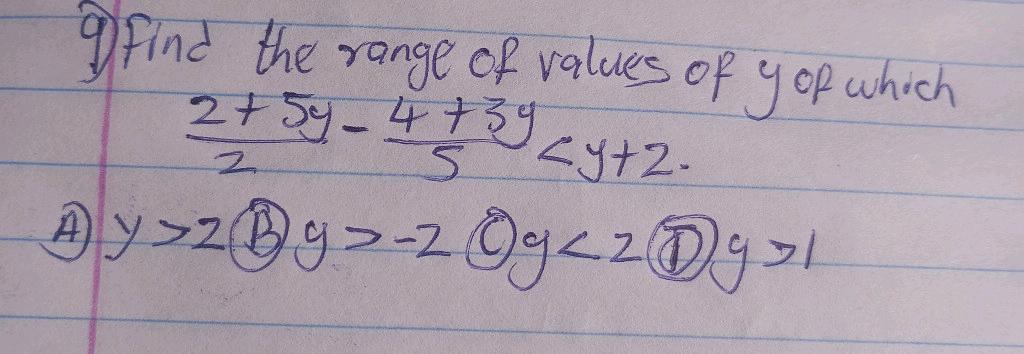
DPind the vange cf values of ycp whvch
259-4104t2-
Đy>zy20942D>I
Solving the Linear Inequality for the Range of Values of y
 RULE / FORMULA USED:
To solve a linear inequality with fractions:
- Clear the fractions by multiplying every term by the Least Common Denominator (LCD) of the denominators: \text{LCM}(2, 5) = 10.
- Distribute and expand all parentheses, ensuring negative signs are applied across the entire numerator.
- Group like terms and isolate the variable y.
\text{Given Inequality: } \frac{2+5y}{2} - \frac{4+3y}{5} < y + 2
 SOLUTION STEPS:
Step 1 — Clear the denominators
Multiply every term on both sides of the inequality by 10:
10 \cdot \left(\frac{2+5y}{2}\right) - 10 \cdot \left(\frac{4+3y}{5}\right) < 10 \cdot (y + 2)
Simplify the fractions:
5(2 + 5y) - 2(4 + 3y) < 10(y + 2)
Step 2 — Expand the expressions
Distribute the factors across the terms inside each set of parentheses:
10 + 25y - 8 - 6y < 10y + 20
Step 3 — Combine like terms on the left side
Combine the variable terms (25y - 6y) and the constant terms (10 - 8):
19y + 2 < 10y + 20
Step 4 — Rearrange to isolate the variable terms
Subtract 10y from both sides:
19y - 10y + 2 < 20
9y + 2 < 20
Subtract 2 from both sides:
9y < 20 - 2
9y < 18
Step 5 — Solve for y
Divide both sides by 9:
y < \frac{18}{9}
y < 2
━━━━━━━━━━━━━━━━━━━━━━━━━━━
 ANSWER: Option C: y < 2
━━━━━━━━━━━━━━━━━━━━━━━━━━━
 KEY CONCEPTS:
1. Clearing Fractions with the LCD
- Definition: Multiplying an inequality by a positive common denominator eliminates all fractions without changing the direction of the inequality sign.
- In this problem: Multiplying all terms by 10 converted the fractional equation into an easily solvable linear form.
2. Distributing Negative Signs Across Numerators
- Definition: A negative sign preceding a fraction acts as a negative multiplier applied to every term in the numerator: -\frac{a+b}{c} = -\frac{1}{c}(a+b) = \frac{-a-b}{c}.
- In this problem: -2(4 + 3y) correctly simplifies to -8 - 6y.
 COMMON MISTAKES:
 Sign Error in Numerator Expansion
- Wrong: -2(4 + 3y) = -8 + 6y
- Right: -2(4 + 3y) = -8 - 6y
- Why it’s wrong: The negative sign before the fraction applies to the entire numerator, changing the sign of +3y to -3y.
Forgetting to Multiply the Entire Right-Hand Side
- Wrong: Leaving the right side as y + 2 after multiplying the left side by 10.
- Right: Multiplying the entire right side by 10 to get 10(y + 2) = 10y + 20.
- Why it’s wrong: Every individual term on both sides of the inequality must be multiplied by the same value to maintain equality.
Would you like me to generate a similar practice problem on solving inequalities with fractions to test your skills?