correct answer
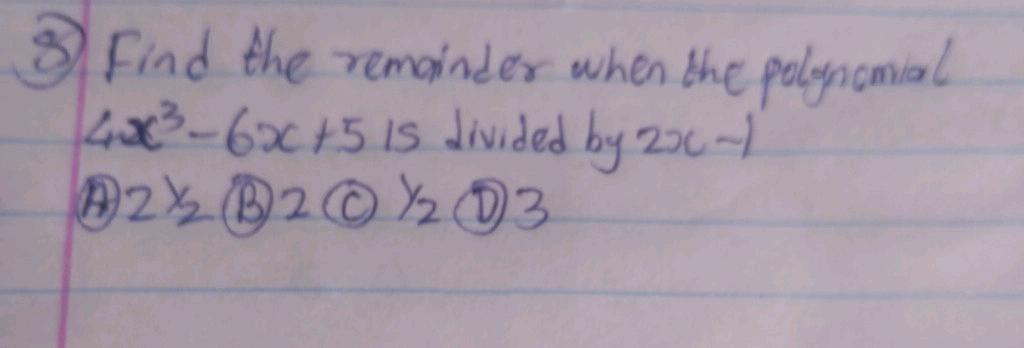
Finding the Remainder of 4x^3 - 6x + 5 Divided by 2x - 1
 RULE / FORMULA USED:
According to the Polynomial Remainder Theorem, when a polynomial P(x) is divided by a linear divisor of the form ax - b, the remainder R is equal to:
R = P\left(\frac{b}{a}\right)
where \frac{b}{a} is the root obtained by setting the divisor equal to zero (ax - b = 0).
 SOLUTION STEPS:
Step 1 — Find the zero of the divisor
Set the divisor 2x - 1 equal to 0 and solve for x:
2x - 1 = 0
2x = 1
x = \frac{1}{2}
Step 2 — Substitute x = \frac{1}{2} into the polynomial
Define the polynomial as P(x) = 4x^3 - 6x + 5 and evaluate P\left(\frac{1}{2}\right):
P\left(\frac{1}{2}\right) = 4\left(\frac{1}{2}\right)^3 - 6\left(\frac{1}{2}\right) + 5
Step 3 — Simplify each term
- First term: 4\left(\frac{1}{8}\right) = \frac{4}{8} = \frac{1}{2}
- Second term: -6\left(\frac{1}{2}\right) = -3
- Constant term: +5
Step 4 — Calculate the final sum
R = \frac{1}{2} - 3 + 5
R = \frac{1}{2} + 2
R = 2\frac{1}{2} \quad \text{or} \quad \frac{5}{2}
━━━━━━━━━━━━━━━━━━━━━━━━━━━
 ANSWER: Option A: 2\frac{1}{2}
━━━━━━━━━━━━━━━━━━━━━━━━━━━
 KEY CONCEPTS:
1. Polynomial Remainder Theorem
- Definition: A theorem stating that the remainder of the division of a polynomial f(x) by a linear polynomial (x - c) is equal to f(c).
- In this problem: Used to find the remainder directly by evaluating P\left(\frac{1}{2}\right) without needing to perform full polynomial long division.
2. Mixed Numbers and Improper Fractions
- Definition: A mixed number combines a whole number and a fraction, representing the sum of both parts.
- In this problem: The improper fraction \frac{5}{2} is expressed in mixed number form as 2\frac{1}{2}.
 COMMON MISTAKES:
 Sign Error When Finding the Divisor Root
- Wrong: Setting x = -\frac{1}{2} by mistakenly taking the sign of -1.
- Right: Setting 2x - 1 = 0 \implies x = +\frac{1}{2}.
- Why it’s wrong: Moving -1 across the equals sign changes its sign to positive, so the root is positive \frac{1}{2}.
Exponent Evaluation Error
- Wrong: Calculating \left(\frac{1}{2}\right)^3 = \frac{1}{6}.
- Right: Calculating \left(\frac{1}{2}\right)^3 = \frac{1^3}{2^3} = \frac{1}{8}.
- Why it’s wrong: Exponents apply to both the numerator and denominator independently (2 \times 2 \times 2 = 8).
Would you like to see how to solve this using polynomial long division to verify the quotient and remainder?