Aland 2(2and Albwice Dr bueiCe
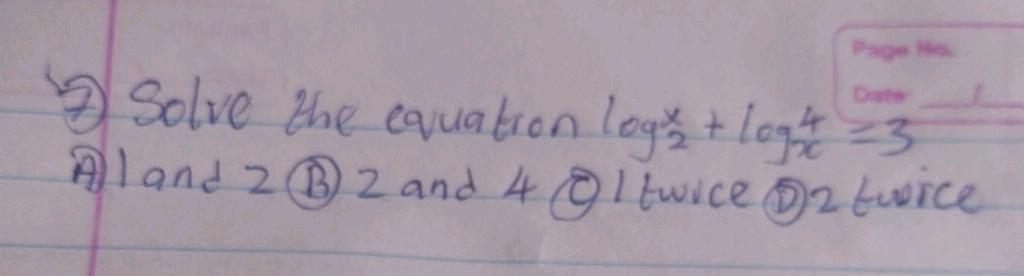
Solve the Logarithmic Equation \log_2 x + \log_x 4 = 3
 FORMULAS AND RULES USED:
- Change of Base Formula: \log_a b = \frac{\log_c b}{\log_c a}
- Base Identity: \log_b (b^k) = k
- Logarithmic Definition: \log_b x = y \iff x = b^y
 SOLUTION STEPS:
Step 1 — Identify the Domain Restrictions
For the terms \log_2 x and \log_x 4 to be defined:
- The argument of the logarithm must be strictly positive: x > 0
- The base of a logarithm must be positive and not equal to 1: x > 0 and x \neq 1
Therefore, the valid domain is x \in (0, 1) \cup (1, \infty).
Step 2 — Apply the Change of Base Formula
Express the term \log_x 4 with base 2:
\log_x 4 = \frac{\log_2 4}{\log_2 x}
Since 4 = 2^2, simplify the numerator:
\log_2 4 = \log_2 (2^2) = 2
Thus:
\log_x 4 = \frac{2}{\log_2 x}
Step 3 — Substitute and Form an Algebraic Equation
Substitute \log_x 4 = \frac{2}{\log_2 x} into the original equation:
\log_2 x + \frac{2}{\log_2 x} = 3
Let u = \log_2 x where u \neq 0:
u + \frac{2}{u} = 3
Step 4 — Solve the Quadratic Equation for u
Multiply both sides of the equation by u:
u^2 + 2 = 3u
Rearrange into standard quadratic form:
u^2 - 3u + 2 = 0
Factor the quadratic equation:
(u - 1)(u - 2) = 0
Setting each factor to zero gives:
- u_1 = 1
- u_2 = 2
Step 5 — Back-Substitute to Find x
Substitute u = \log_2 x back into each value:
-
Case 1:
\log_2 x = 1 \implies x = 2^1 = 2 -
Case 2:
\log_2 x = 2 \implies x = 2^2 = 4
Both solutions satisfy the domain restriction x > 0 and x \neq 1.
━━━━━━━━━━━━━━━━━━━━━━━━━━━
 ANSWER: B) 2 and 4
━━━━━━━━━━━━━━━━━━━━━━━━━━━
 KEY CONCEPTS:
1. Change of Base Formula
- Definition: A rule allowing a logarithm in any base to be rewritten using a common base: \log_a b = \frac{\log_c b}{\log_c a}.
- In this problem: It converted the variable base in \log_x 4 into base 2, creating an equation in terms of a single variable u = \log_2 x.
2. Substitution Method
- Definition: Replacing an algebraic or logarithmic expression with a single variable to reduce a higher-order or transcendental equation into a standard polynomial.
- In this problem: Letting u = \log_2 x turned the logarithmic equation into an easily factorable quadratic equation u^2 - 3u + 2 = 0.
 COMMON MISTAKES:
 Forgetting Base Restrictions
- Wrong: Assuming any positive real number can be a solution without checking x \neq 1.
- Right: Always check that the base of a logarithm satisfies both x > 0 and x \neq 1.
- Why it’s wrong: If a solution resulted in x = 1, \log_x 4 would be undefined because \log 1 = 0 in the denominator.
Misapplying Logarithm Addition Rules
- Wrong: Combining terms directly as \log_2 x + \log_x 4 = \log(4x).
- Right: The product rule \log_b(M) + \log_b(N) = \log_b(MN) only applies when the bases are identical.
- Why it’s wrong: Here, one term is in base 2 and the other is in base x; they cannot be combined until converted to the same base.
Would you like me to walk through another logarithmic equation with variable bases to practice this technique?