just the answer give me the correct answer when I will be taking the picture I will also had the options given to me so choose a professional one a correct one
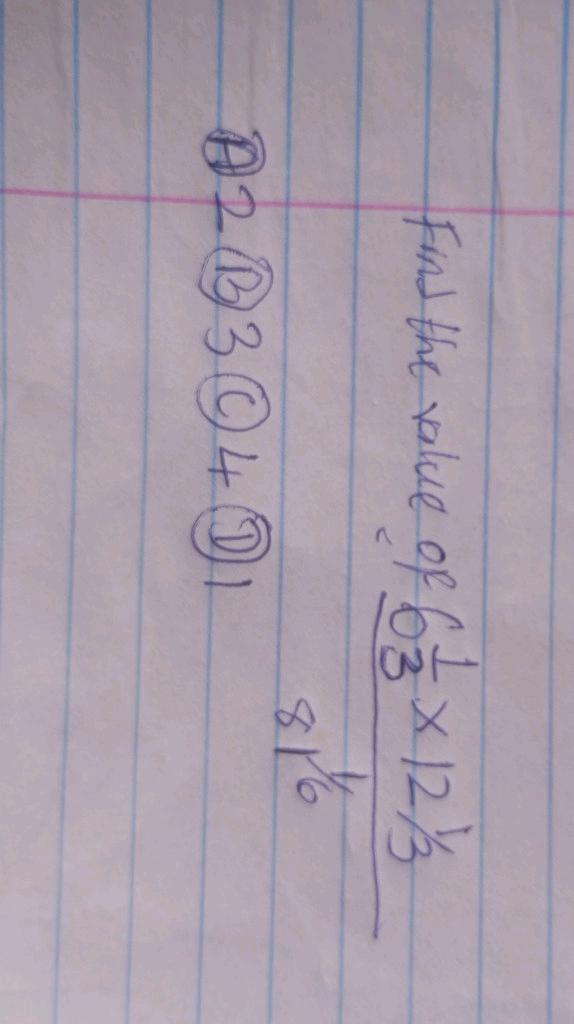
Evaluating the Exponential Expression
 RULE / FORMULA USED:
- Product of powers with the same exponent: a^n \times b^n = (a \times b)^n
- Power of a power property: (a^m)^n = a^{m \cdot n}
- Prime factorization to simplify fractional exponents: \sqrt[n]{a^m} = a^{\frac{m}{n}}
 SOLUTION STEPS:
Step 1 — Simplify the numerator using the product rule of exponents
Since both factors in the numerator have the same exponent \frac{1}{3}, combine them under a single base:
6^{\frac{1}{3}} \times 12^{\frac{1}{3}} = (6 \times 12)^{\frac{1}{3}} = 72^{\frac{1}{3}}
Step 2 — Express the numerator in prime factor form
Break 72 down into its prime factors (72 = 2^3 \times 3^2):
72^{\frac{1}{3}} = (2^3 \times 3^2)^{\frac{1}{3}} = (2^3)^{\frac{1}{3}} \times (3^2)^{\frac{1}{3}} = 2^1 \times 3^{\frac{2}{3}} = 2 \cdot 3^{\frac{2}{3}}
Step 3 — Simplify the denominator using prime factorization
Write the base 81 as a power of 3 (81 = 3^4):
81^{\frac{1}{6}} = (3^4)^{\frac{1}{6}} = 3^{\frac{4}{6}} = 3^{\frac{2}{3}}
Step 4 — Divide the numerator by the denominator
Substitute the simplified forms of the numerator and denominator back into the fraction:
\frac{6^{\frac{1}{3}} \times 12^{\frac{1}{3}}}{81^{\frac{1}{6}}} = \frac{2 \cdot 3^{\frac{2}{3}}}{3^{\frac{2}{3}}}
Cancel the common factor 3^{\frac{2}{3}} from both the numerator and denominator:
\frac{2 \cdot \cancel{3^{\frac{2}{3}}}}{\cancel{3^{\frac{2}{3}}}} = 2
━━━━━━━━━━━━━━━━━━━━━━━━━━━
 ANSWER: Option A (2)
━━━━━━━━━━━━━━━━━━━━━━━━━━━
 KEY CONCEPTS:
1. Fractional Exponents (Radicals)
- Definition: A fractional exponent a^{\frac{m}{n}} represents the n-th root of a raised to the m-th power, \sqrt[n]{a^m}.
- In this problem: We simplified 81^{\frac{1}{6}} as (3^4)^{\frac{1}{6}} = 3^{\frac{2}{3}} to find a common factor with the numerator.
2. Product Rule for Same Exponents
- Definition: When two different bases share the same power, multiply the bases and keep the exponent: a^k \times b^k = (ab)^k.
- In this problem: 6^{\frac{1}{3}} \times 12^{\frac{1}{3}} combined cleanly into (6 \times 12)^{\frac{1}{3}} = 72^{\frac{1}{3}}.
 COMMON MISTAKES:
 Treating exponents as mixed fractions
- Wrong: Reading 6^{\frac{1}{3}} as 6\frac{1}{3} = \frac{19}{3}.
- Right: Recognizing the superscript as an exponent/power (6^{\frac{1}{3}} = \sqrt[3]{6}).
- Why it’s wrong: Superscripts indicate powers, which follow index laws rather than addition of whole numbers and fractions.
Would you like me to generate a similar exponential simplification problem to test your skills?