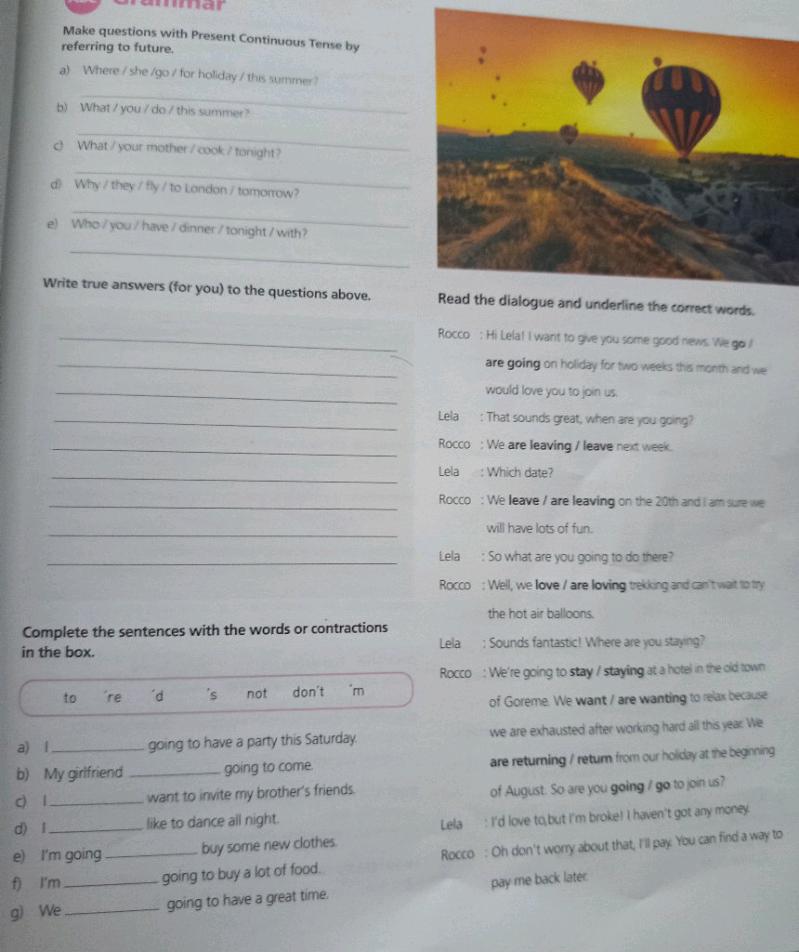
Make guestions with Present Continuous Terse by
referring to future
a Where /she Ago / for holdiy / ths Se
h) What / you / do/ ths sumeer?
c What/ your mother cook/tonight?
d Why/they/ fy/ to London /tomomow?
e Who/you /he dinner/ toniaht/with
Write true answers (for you) to the questions above.
Complete the sentences with the words or contractions
in the box.
to
a) We
b) My girfriend
e) Im going
f t’m.
re
not don’t’m
going to have a party this Saturday
going to come
want to invite my brother’s friends
lke to dance all night
buy some new dothes
-going to buy a lot of food.
going to have a great time.
Read the dialogue and underline the correct wods
Rocco
Lela That sounds great, when ane yu gog
RoccoWe are leaving / leave net week
Lela
Hi Lelal Iwant to gje you some good nes We ge
Rocco1We leave / are leaving on the 20th andi am suee
will have lots of fun
are going on holiday for to weeks ths month and e
wod love you to join
Rocco:Well, we love / are loving teing and catat toy
Which date?
So what are you going to do thene?
the hot air balloons
Sounds fantastict Where ae you staing?
We’re going to stay / staying ata hte n the oid twn
of Gorene We want/ are wanting to eias becase
we are exhausted atter working hard al this yeac Wie
are returning / retum from ou holday at the beging
of August So are you going / go to join us?
d love to but I’m broket i haven’t oot any mone
Oh don’t wory about that, rl pay You can find away to
pay me back later
Present Continuous for Future Arrangements & Future Forms
 FORMULAS & RULES USED:
- Present Continuous for Future Arrangements:\text{Subject} + \text{am / is / are} + \text{Verb(-ing)}Question form:\text{Wh- word} + \text{am / is / are} + \text{Subject} + \text{Verb(-ing)} + \dots?
- Be going to (Intentions / Plans):\text{Subject} + \text{am / is / are} + \text{going to} + \text{base verb}
- Stative Verbs (Non-continuous): Verbs of feeling, thinking, and wanting (such as love, want, like) are used in the Simple Present, not the continuous form.
 STEP-BY-STEP SOLUTION:
Exercise 1: Make questions with Present Continuous Tense referring to future
-
a) Where / she / go / for holiday / this summer?
- Subject: \text{she} \rightarrow auxiliary verb is \text{is}.
\text{Where is she going for holiday this summer?} -
b) What / you / do / this summer?
- Subject: \text{you} \rightarrow auxiliary verb is \text{are}.
\text{What are you doing this summer?} -
c) What / your mother / cook / tonight?
- Subject: \text{your mother (she)} \rightarrow auxiliary verb is \text{is}.
\text{What is your mother cooking tonight?} -
d) Why / they / fly / to London / tomorrow?
- Subject: \text{they} \rightarrow auxiliary verb is \text{are}.
\text{Why are they flying to London tomorrow?} -
e) Who / you / have / dinner / tonight / with?
- Subject: \text{you} \rightarrow auxiliary verb is \text{are}.
\text{Who are you having dinner with tonight?}
Exercise 2: Sample answers (true for you)
- a) She is going to Antalya for holiday this summer.
- b) I am relaxing and visiting my grandparents this summer.
- c) She is cooking pasta tonight.
- d) They are flying to London tomorrow for a business conference.
- e) I am having dinner with my family tonight.
Exercise 3: Complete the sentences with the words from the box
Box: to | 're | 'd | 's | not | don't | 'm
- a) I 'm going to have a party this Saturday. (contraction of I + am)
- b) My girlfriend 's going to come. (contraction of girlfriend + is)
- c) I don’t want to invite my brother’s friends. (negative simple present with want)
- d) I 'd like to dance all night. (contraction of I + would for polite desire)
- e) I’m going to buy some new clothes. (infinitive marker after going)
- f) I’m not going to buy a lot of food. (negative element after am)
- g) We 're going to have a great time. (contraction of We + are)
Exercise 4: Read the dialogue and underline the correct words
- 1. We are going (Holiday plan arranged for the future)
- 2. are leaving (Fixed arrangement next week)
- 3. are leaving (Specific planned departure date: on the 20th)
- 4. love (Love is a stative verb; it does not take -ing)
- 5. stay (The structure is be going to + base verb)
- 6. want (Want is a stative verb describing desire; non-continuous)
- 7. are returning (Arranged return date)
- 8. going (Formula: Are you going to join us?)
━━━━━━━━━━━━━━━━━━━━━━━━━━━
 FINAL ANSWER SUMMARY:
- Exercise 1:
- Where is she going for holiday this summer?
- What are you doing this summer?
- What is your mother cooking tonight?
- Why are they flying to London tomorrow?
- Who are you having dinner with tonight?
- Exercise 3: a)
'm| b)'s| c)don't| d)'d| e)to| f)not| g)'re - Exercise 4: are going \rightarrow are leaving \rightarrow are leaving \rightarrow love \rightarrow stay \rightarrow want \rightarrow are returning \rightarrow going
━━━━━━━━━━━━━━━━━━━━━━━━━━━
 KEY CONCEPTS:
- Arrangements vs. States: We use the Present Continuous for future social plans and travel arrangements, but never with stative verbs like love, like, hate, or want.
 COMMON MISTAKES:
 Incorrect Approach: “We are wanting to relax.”
- Correct Approach: “We want to relax.” (Verbs of emotion and desire stay in the simple form).
Would you like to practice creating a few more sentences comparing be going to with the Present Continuous?