- Tirn never
(havel
- My sister (studyl
- lyou/ tikel
- Why (you / not / comel
lunch at the canteen, because he (finish)
my new dress, Alice?" "Yes, I
lot these days; she (want)
school at 2.00 p.m.
to pass her exams
to the café with me? I (meet)
You [look)
great
- Mum (waterl
- Stay at home! It (rain)
the flowers right naw.
Sally there at 530 pm
12 How often (the children / playl
cats and dogs.
- Peter sometimes fwatch)
foatball?
- The newsagent’s Inot/open)
TV after dinner.
9 (Mary / ikel
at 9:30 a.m. It lopen)
pasta?
No, she
at 9:45 a.m
Hurry up. childrenl The
school bus (come)
exam this afternoon.
7Ilbel
6 Where lyou/go
afraid I lcan / not l gol
Inot/want to go to the seaside anain.
to the cinema this evening. I (revisel
tor tamceros
5. We Istartl
4 Katys father usually ldrive)
t make any noisel The baby Isleep)
school at 9:30 and the last lesson (be)
_on holiday, Sarah?"1 (not/ knowl
TY parents
t
430o.m
.
Don
her to school, but this week she (takel
2 What [Jack /dol
1.
My brother Iwashl
I
(think)
the car He always [wash)
at lhe morment
he (do)
the homewore i his bedro
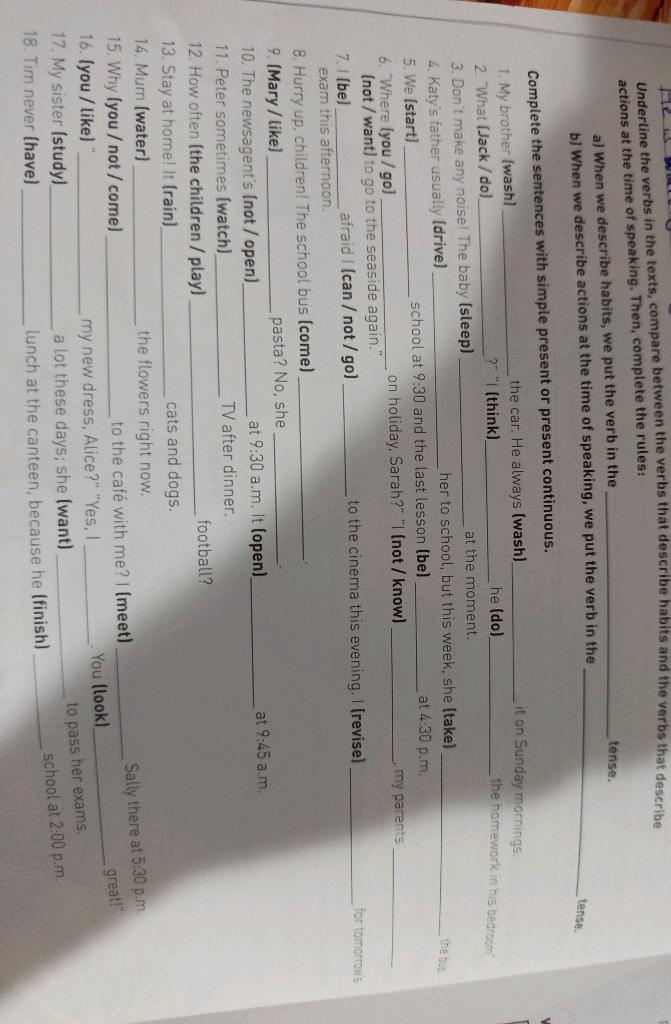
Complete the sentences with simple present or present continuous.
bl
When we describe
actions at the time of speaking, we put the verb in the
it on Sunday mornings
Tense
al When we
describe habits, we put the verb in the
actions at the time of
speaking. Then, complete the rules:
inderine the verbs in the texts, compare between the vers tnat descrioe habits and the verbs that deseik
Present Simple vs. Present Continuous Worksheet Solutions
 FORMULAS & RULES USED:
- Present Simple: Used for habits, routines, general truths, and timetables.
\text{Subject} + \text{Verb (base / -s / -es)}
\text{Do / Does} + \text{Subject} + \text{Verb (base)}
- Present Continuous: Used for actions happening right now, temporary situations, or fixed future arrangements.
\text{Subject} + \text{am / is / are} + \text{Verb-ing}
Grammar Rules Completion
- a) When we describe habits, we put the verb in the Present Simple tense.
- b) When we describe actions at the time of speaking, we put the verb in the Present Continuous tense.
 STEP-BY-STEP SOLUTION:
-
My brother is washing the car. He always washes it on Sunday mornings.
- Action happening now: \text{is washing}
- Habit / frequency adverb (“always”): \text{washes}
-
“What is Jack doing?” “I think he is doing the homework in his bedroom.”
- Question about an action in progress: \text{is Jack doing}
- Stative verb of opinion (“think”): \text{think}
- Action in progress: \text{is doing}
-
Don’t make any noise! The baby is sleeping at the moment.
- Time expression (“at the moment”) and imperative command: \text{is sleeping}
-
Katy’s father usually drives her to school, but this week, she is taking the bus.
- Habitual action (“usually”): \text{drives}
- Temporary situation (“this week”): \text{is taking}
-
We start school at 9:30 and the last lesson is at 4:30 p.m.
- Timetable / fixed schedule: \text{start}, \text{is}
-
“Where are you going on holiday, Sarah?” “I don’t know, my parents don’t want to go to the seaside again.”
- Future plan / arrangement: \text{are you going}
- Stative verbs of mental state/desire: \text{don't know}, \text{don't want}
-
I am afraid I cannot go (can’t go) to the cinema this evening. I am revising for tomorrow’s exam this afternoon.
- Present state: \text{am}
- Modal verb: \text{cannot go}
- Arrangement / plan for this afternoon: \text{am revising}
-
Hurry up, children! The school bus is coming.
- Action happening at the moment of speaking: \text{is coming}
-
Does Mary like pasta? No, she doesn’t.
- General preference (stative verb “like”): \text{Does Mary like}, \text{doesn't}
-
The newsagent’s doesn’t open at 9:30 a.m. It opens at 9:45 a.m.
- Scheduled opening hours (timetables): \text{doesn't open}, \text{opens}
-
Peter sometimes watches TV after dinner.
- Routine with frequency adverb (“sometimes”): \text{watches}
-
How often do the children play football?
- Asking about frequency (“how often”): \text{do the children play}
-
Stay at home! It is raining cats and dogs.
- Event happening right now: \text{is raining}
-
Mum is watering the flowers right now.
- Time expression (“right now”): \text{is watering}
-
Why don’t you come to the café with me? I am meeting Sally there at 5:30 p.m.
- Suggestion / invitation: \text{don't you come}
- Definite future arrangement: \text{am meeting}
-
“Do you like my new dress, Alice?” “Yes, I do. You look great!”
- Stative verbs of preference/perception (“like”, “look”): \text{Do you like}, \text{do}, \text{look}
-
My sister is studying a lot these days; she wants to pass her exams.
- Temporary action around the present time (“these days”): \text{is studying}
- Stative verb (“want”): \text{wants}
-
Tim never has lunch at the canteen, because he finishes school at 2:00 p.m.
- Habit / daily routine: \text{has}, \text{finishes}
 KEY CONCEPTS:
- Stative Verbs: Verbs that describe states, feelings, or mental processes (e.g., like, want, know, think) are generally not used in the continuous form.
- Time Markers:
- Present Simple: always, usually, sometimes, never, how often.
- Present Continuous: now, right now, at the moment, these days, this week.
 COMMON MISTAKES:
 Incorrect Approach: Writing “She is wanting to pass her exams.”
 Correct Approach: Use Present Simple (“She wants to pass”) because want is a stative verb expressing a desire.
Would you like to practice with a few extra sentences to test your understanding of stative verbs?