Expressing Likes, Dislikes, and Preferences in English
KEY FORMULA / RULE: In English, preference and degree of liking range from strongest positive to strongest negative: love () > like () > dislike / don’t like () > hate / can’t stand (). The structure “prefer X to Y” means someone likes X more than Y.
SOLUTION & OPTION ANALYSIS
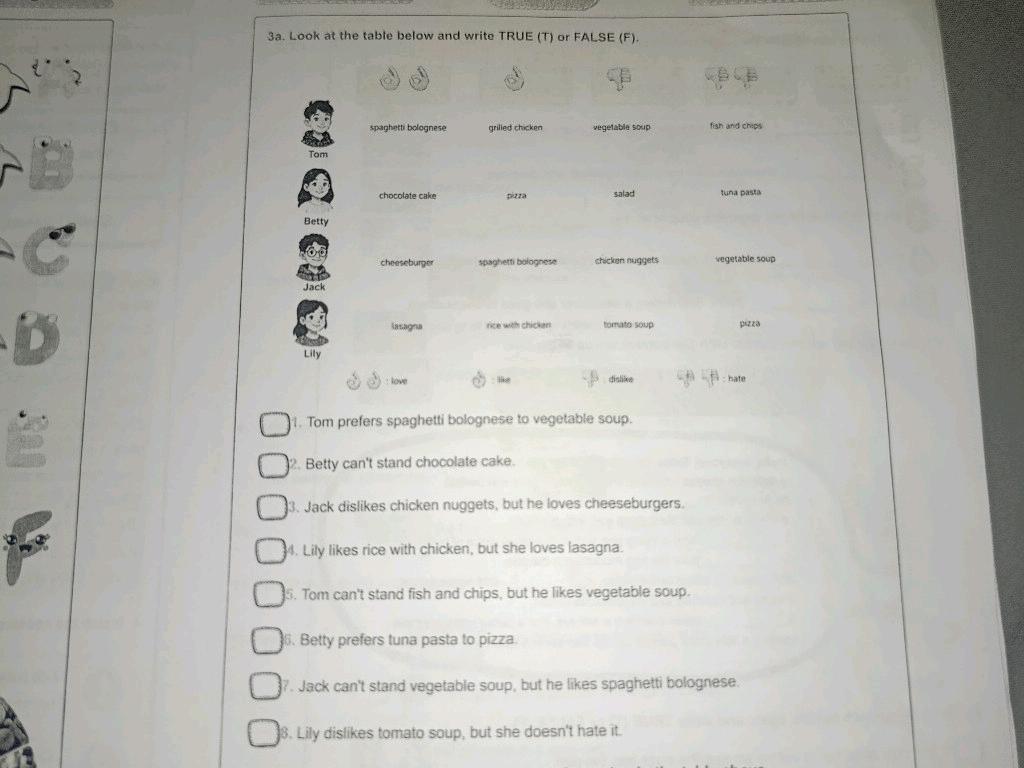
Based on the chart:
Tom: Love = spaghetti bolognese, Like = grilled chicken, Dislike = vegetable soup, Hate = fish and chips
Betty: Love = chocolate cake, Like = pizza, Dislike = salad, Hate = tuna pasta
Jack: Love = cheeseburger, Like = spaghetti bolognese, Dislike = chicken nuggets, Hate = vegetable soup
Lily: Love = lasagna, Like = rice with chicken, Dislike = tomato soup, Hate = pizza
1. Tom prefers spaghetti bolognese to vegetable soup. — TRUE (T)
Tom loves spaghetti bolognese () and dislikes vegetable soup (), so he prefers spaghetti bolognese.
2. Betty can’t stand chocolate cake. — FALSE (F)
“Can’t stand” means to hate (), but chocolate cake is in Betty’s love column ().
3. Jack dislikes chicken nuggets, but he loves cheeseburgers. — TRUE (T)
Chicken nuggets are under dislike () and cheeseburgers are under love ().
4. Lily likes rice with chicken, but she loves lasagna. — TRUE (T)
Rice with chicken is under like () and lasagna is under love ().
5. Tom can’t stand fish and chips, but he likes vegetable soup. — FALSE (F)
While Tom hates fish and chips, he dislikes vegetable soup (); he does not like it.
6. Betty prefers tuna pasta to pizza. — FALSE (F)
Betty likes pizza () and hates tuna pasta (), so she prefers pizza to tuna pasta.
7. Jack can’t stand vegetable soup, but he likes spaghetti bolognese. — TRUE (T)
Vegetable soup is under hate () and spaghetti bolognese is under like ().
8. Lily dislikes tomato soup, but she doesn’t hate it. — TRUE (T)
Tomato soup is in the dislike category (), while pizza is the only item in her hate category ().
FINAL ANSWER:
T
F
T
T
F
F
T
T
EXAM INSIGHT / PITFALL: Be careful with the phrase can’t stand; it is an idiom that means “to hate intensely” or “cannot tolerate” (), not simply “to dislike” ().
 KEY FORMULA / RULE: In English, preference and degree of liking range from strongest positive to strongest negative: love (

 ) > hate / can’t stand (
 SOLUTION & OPTION ANALYSIS
 FINAL ANSWER:
 EXAM INSIGHT / PITFALL: Be careful with the phrase can’t stand; it is an idiom that means “to hate intensely” or “cannot tolerate” (