English Greetings and Sentence Unscrambling Practice
 KEY FORMULA / RULE: In English, daily greetings correspond directly to specific times of day (morning, afternoon, evening, and night). Standard English sentence structure typically follows the Subject + Verb + Object/Complement word order, beginning with a capital letter and ending with a period.
 SOLUTION STEPS
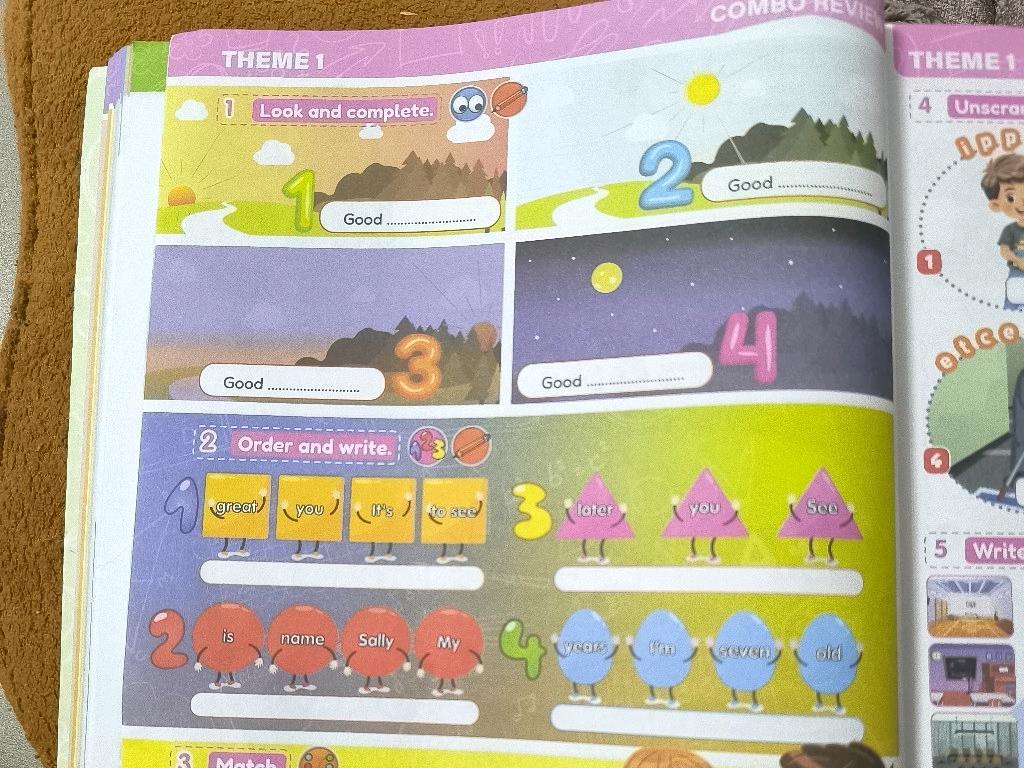
Part 1: Look and Complete
- 1. Good morning: The illustration displays the sun rising in the early hours of the day.
- 2. Good afternoon: The bright sun is positioned high in the sky during midday.
- 3. Good evening: The sun is setting behind the horizon at dusk.
- 4. Good night: The night sky contains the moon and darkness, used when parting or going to sleep.
Part 2: Order and Write
- 1. It’s great to see you. (Words:
great / you / It's / to see)
Starts with the capitalized subject and contraction “It’s”, followed by the adjective phrase “great to see you.”
- 2. My name is Sally. (Words:
is / name / Sally / My)
Starts with the capitalized possessive pronoun “My”, followed by the noun phrase “name”, the linking verb “is”, and the proper noun “Sally.”
- 3. See you later. (Words:
later / you / See)
Common conversational farewell expression beginning with the imperative verb “See.”
- 4. I’m seven years old. (Words:
years / I'm / seven / old)
Starts with the subject pronoun and verb “I’m”, followed by the age expression “seven years old.”
 FINAL ANSWER:
Activity 1 (Greetings):
- Good morning
- Good afternoon
- Good evening
- Good night
Activity 2 (Sentences):
- It’s great to see you.
- My name is Sally.
- See you later.
- I’m seven years old.
 EXAM INSIGHT / PITFALL: Always look for the capitalized word to identify the beginning of an unscrambled sentence (e.g., It’s, My, See, I’m), and ensure proper punctuation is placed at the end.