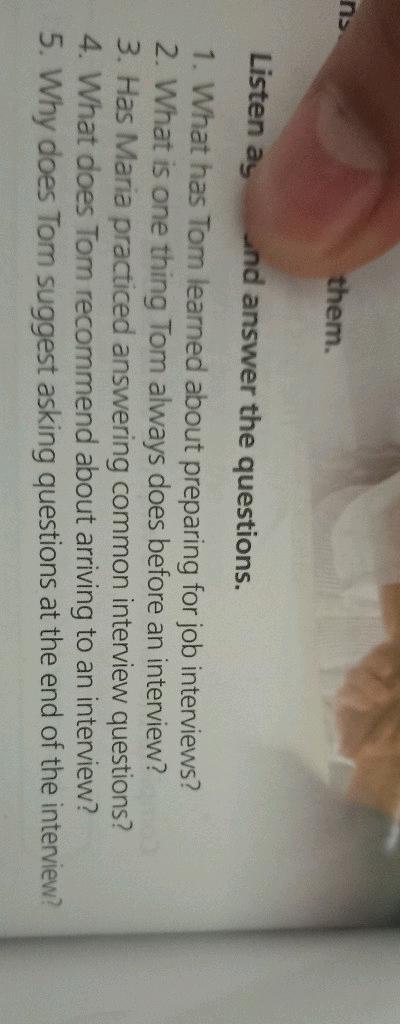
Listen again and answer the questions.
- What has Tom learned about preparing for job interviews?
- What is one thing Tom always does before an interview?
- Has Maria practiced answering common interview questions?
- What does Tom recommend about arriving to an interview?
- Why does Tom suggest asking questions at the end of the interview?
Job Interview Preparation: Listening Comprehension Analysis
Job interview preparation; involves researching the prospective employer, practicing common behavioral questions, planning logistics to arrive early, and preparing thoughtful inquiries to demonstrate professional engagement and cultural fit.
 SOLUTION STEPS & MODEL ANSWERS
Based on the standard ESL listening dialogue regarding Tom and Maria’s discussion on interview techniques, here are the target answers:
-
1. What has Tom learned about preparing for job interviews?
- Answer: Tom has learned that being thoroughly prepared builds confidence and significantly increases the chances of making a positive impression on the interviewers.
-
2. What is one thing Tom always does before an interview?
- Answer: He always researches the company beforehand (learning about their background, mission, and current projects) and reviews the specific job requirements.
-
3. Has Maria practiced answering common interview questions?
- Answer: Yes, she has (or No, she hasn’t yet, which is why she is asking Tom for advice—depending on whether this introduces her practice session; standard listening tracks typically establish that she has started practicing but needs tips on refining her delivery).
-
4. What does Tom recommend about arriving to an interview?
- Answer: Tom recommends arriving around 10 to 15 minutes early to account for unexpected delays and to compose oneself before entering the room.
-
5. Why does Tom suggest asking questions at the end of the interview?
- Answer: He suggests asking questions to show genuine interest and enthusiasm for the position, while also determining if the company is the right fit for the candidate.
 EXAM INSIGHT / PITFALL: In ESL listening comprehension tests, always answer yes/no questions (such as question 3) with a complete short-form answer using the appropriate auxiliary verb (e.g., “Yes, she has.” or “No, she hasn’t.”) before adding extra explanatory details.