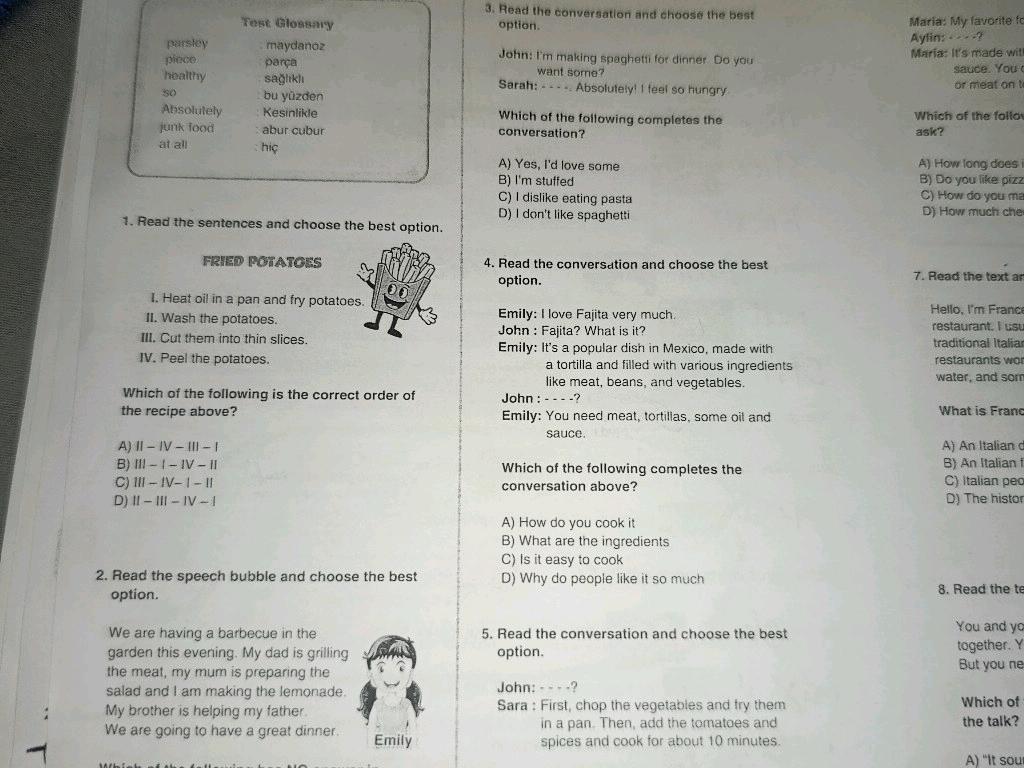
- Read the conversation and choose the best option.
John: I’m making spaghetti for dinner. Do you want some?
Sarah: - - - -1 Absolutely! I feel so hungry.
Which of the following completes the conversation?
A) Yes, I’d love some
B) I’m stuffed
C) I dislike eating pasta
D) I don’t like spaghetti - Read the conversation and choose the best option.
Emily: I love Fajita very much.
John: Fajita? What is it?
Emily: It’s a popular dish in Mexico, made with a tortilla and filled with various ingredients like meat, beans, and vegetables.
John: - - - -1
Emily: You need meat, tortillas, some oil and sauce.
A) How do you cook it
B) What are the ingredients
C) Is it easy to cook
D) Why do people like it so much - Read the conversation and choose the best option.
Sara: First, chop the vegetables and fry them in a pan. Then, add the tomatoes and spices and cook for about 10 minutes.
English: “In the Kitchen” Dialogue Completion & Cooking Vocabulary
 KEY FORMULA / RULE: In conversational English, accepting an offer requires an affirmative expression that matches positive follow-up statements (e.g., “Absolutely! I feel so hungry.”). When inquiring about food preparation, questions asking about materials/items require responses listing food components (ingredients), whereas questions asking about steps/actions require sequential cooking instructions (process).
 SOLUTION & OPTION ANALYSIS
Question 3 Analysis
Context: John offers food (“I’m making spaghetti for dinner. Do you want some?”), and Sarah replies affirmatively (“Absolutely! I feel so hungry.”). Sarah needs a phrase accepting the meal offer.
- A) Yes, I’d love some: Correct. It accepts the offer politely and perfectly matches her follow-up statement indicating hunger.
- B) I’m stuffed: Incorrect. This idiom means “I am completely full” and contradicts being hungry.
- C) I dislike eating pasta: Incorrect. Expresses refusal/dislike, which contradicts “Absolutely!”.
- D) I don’t like spaghetti: Incorrect. Direct refusal of the offered dish.
Question 4 Analysis
Context: Emily answers John’s question with a list of items: “You need meat, tortillas, some oil and sauce.” This list names the food items required to prepare the dish.
- A) How do you cook it: Incorrect. This asks for the preparation process and cooking steps, not the list of food items.
- B) What are the ingredients: Correct. Emily lists the exact ingredients necessary to make fajitas.
- C) Is it easy to cook: Incorrect. This requires a Yes/No answer rather than a list of ingredients.
- D) Why do people like it so much: Incorrect. This asks for the reason for its popularity, not what it is made of.
Question 5 Analysis (Reference)
- Context: Sara answers with sequential preparation steps (“First, chop… Then, add…”).
- Target Question: The missing question from John asks for the preparation process or recipe (e.g., “How do you make/cook it?” or “What is the recipe?”).
 FINAL ANSWER:
- Question 3: A) Yes, I’d love some
- Question 4: B) What are the ingredients
 EXAM INSIGHT / PITFALL: Be careful to distinguish between ingredients (the components/food items, e.g., meat, oil, vegetables) and the recipe/process (the sequential actions marked by transition words such as First, Second, Then, After that, Finally).