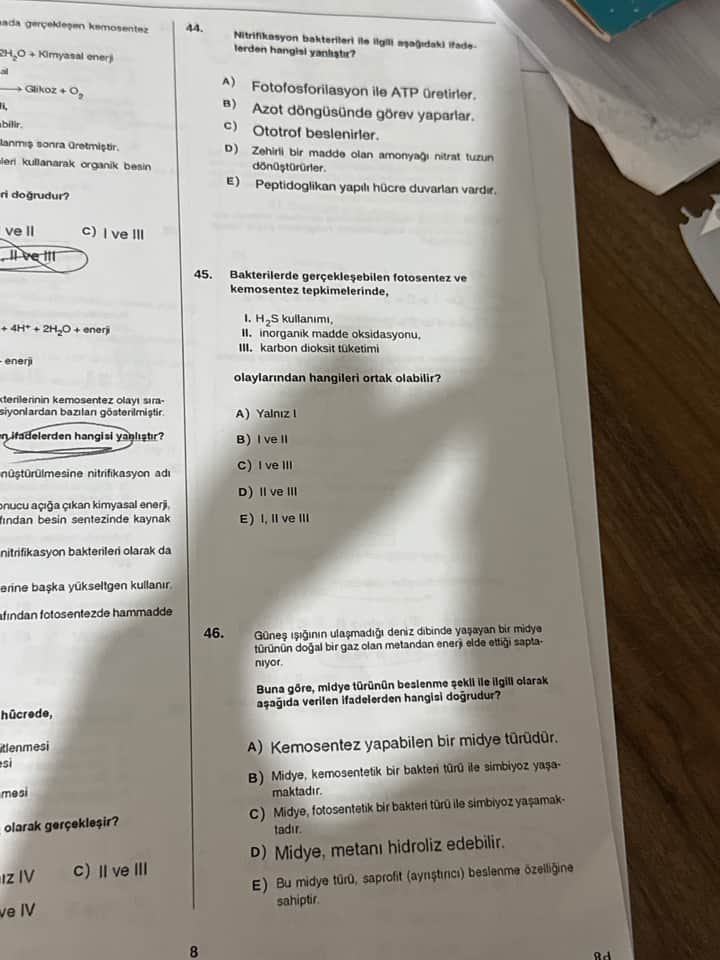
Aşağıda soruların doğru şıkları ve kısa açıklamaları yer almaktadır:
-
Soru 44: Nitrifikasyon bakterileri ile ilgili yanlış ifade
– Doğru cevap: A)
Çünkü bu bakteriler ATP’yi fotosofosforilasyon ile değil, oksidatif (kemoototrofik) fosforilasyon ile üretirler. -
Soru 45: Fotosentez ve kemosentez tepkimelerinde ortak olabilecek olaylar
– Doğru cevap: E) I, II ve III
• Hem bazı fotosentetik hem de kemosentetik bakteriler H₂S kullanabilir.
• Her iki süreç de inorganik madde oksidasyonu ve CO₂ tüketimi içerir. -
Soru 46: Derin deniz midyesinin metandan enerji elde etme şekli
– Doğru cevap: B)
Midye, metan-oksitleyici kemosentetik bir bakteri ile simbiyoz yaparak enerji sağlar.
Özet tablo:
| Soru No | Doğru Şık | Kısa Açıklama |
|---|---|---|
| 44 | A | Fotosofosforilasyon yerine oksidatif fosforilasyon yapar |
| 45 | E | H₂S kullanımı, inorganik oksidasyon ve CO₂ tüketimi ortak |
| 46 | B | Metan-oksitleyici bakteri ile simbiyoz içindedir |
Jkkkko - Biology Questions with Answers
Table of Contents
- Question 44: Nitrification bacteria - Which statement is wrong?
- Question 45: Common reactions in photosynthesis and chemosynthesis in bacteria
- Question 46: Feeding type of a mussel living without sunlight at sea bottom
1. Question 44: Nitrification bacteria - Which statement is wrong?
Question:
Which of the following statements about nitrification bacteria is incorrect?
A) They produce ATP through photophosphorylation.
B) They play a role in the nitrogen cycle.
C) They are autotrophic.
D) They convert ammonia, a toxic substance, into nitrate salt.
E) They have peptideoglycan-structured cell walls.
Answer:
The incorrect statement is A) They produce ATP through photophosphorylation.
Explanation:
- Nitrification bacteria are chemolithoautotrophic, meaning they obtain energy from the oxidation of inorganic molecules such as ammonia (NH₃) but do not perform photosynthesis or photophosphorylation.
- They convert ammonia to nitrite and then nitrate, which is a part of the nitrogen cycle (B is correct).
- They are autotrophic since they fix CO₂ using the energy obtained by oxidation (C is correct).
- They convert toxic ammonia into nitrate salts (D is correct).
- Their cell walls contain peptidoglycan, typical of bacteria (E is correct).
2. Question 45: Common reactions in photosynthesis and chemosynthesis in bacteria
Question:
Which of the following reactions can be common in photosynthesis and chemosynthesis in bacteria?
I. Use of H₂S
II. Oxidation of inorganic substances
III. Carbon dioxide consumption
A) Only I
B) I and II
C) I and III
D) II and III
E) I, II, and III
Answer:
The correct answer is E) I, II, and III.
Explanation:
- Both photosynthetic and chemosynthetic bacteria can use hydrogen sulfide (H₂S) as an electron donor (I).
- Both involve the oxidation of inorganic substances (II).
- Both consume carbon dioxide (CO₂) as a carbon source (III).
- So, all three (I, II, and III) are common reactions.
3. Question 46: Feeding type of a mussel living without sunlight on the sea floor
Question:
It is found that a mussel species living on the ocean floor where sunlight cannot reach obtains energy from methane, a natural gas.
According to this, which of the following statements about the feeding type of the mussel is correct?
A) It is a mussel species capable of chemosynthesis.
B) The mussel lives in symbiosis with a chemosynthetic bacterial species.
C) It lives in symbiosis with photosynthetic bacteria.
D) The mussel can hydrolyze methane.
E) This mussel species has saprophytic (decomposer) feeding characteristics.
Answer:
The correct answer is B) The mussel lives in symbiosis with a chemosynthetic bacterial species.
Explanation:
- The mussel itself cannot perform chemosynthesis but obtains energy by living symbiotically with chemosynthetic bacteria that oxidize methane.
- Since sunlight does not reach the ocean floor, photosynthesis is impossible (C is incorrect).
- Mussels typically do not hydrolyze methane themselves (D is incorrect).
- The feeding is not saprophytic; saprophytes feed on dead organic matter, not methane oxidation (E is incorrect).
- Therefore, B (symbiosis with chemosynthetic bacteria) is correct.
Summary Table
| Question | Topic | Correct Answer | Explanation Summary |
|---|---|---|---|
| 44 | Nitrification bacteria | A | They do not produce ATP via photophosphorylation. |
| 45 | Photosynthesis and chemosynthesis commonalities | E | All listed processes (H₂S use, oxidation, CO₂ use) are common. |
| 46 | Mussel feeding without sunlight | B | The mussel obtains energy via symbiotic chemosynthetic bacteria. |
If you want further explanation on any question or related concepts, feel free to ask!