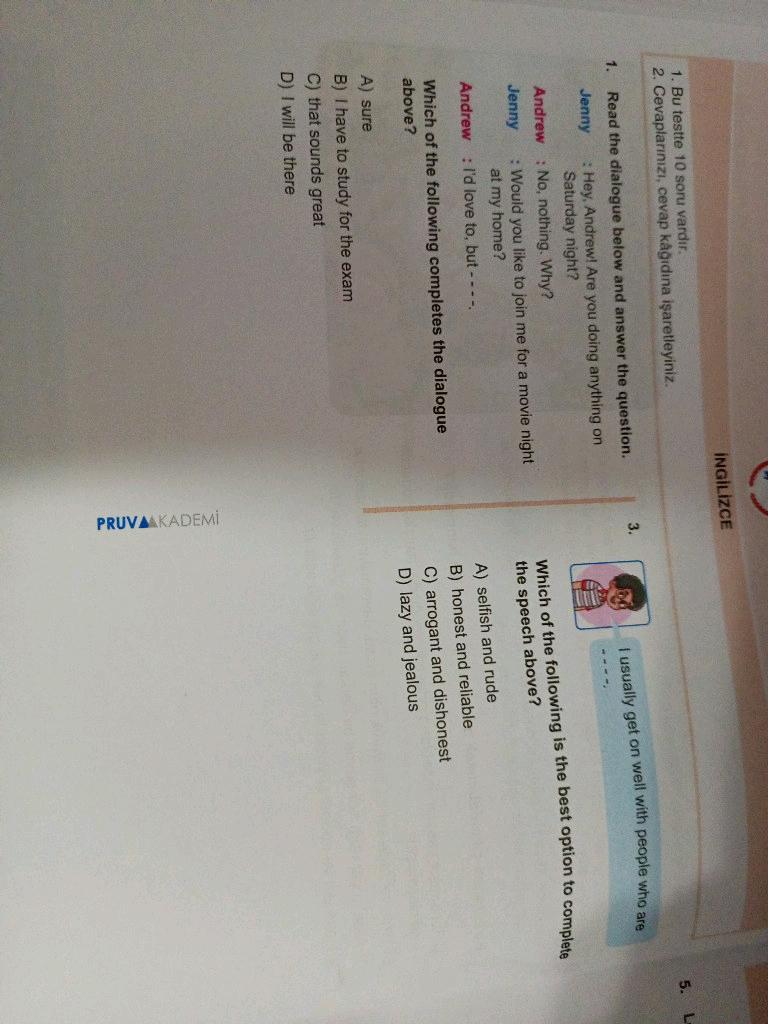
- Read the dialogue below and answer the question.
Jenny1 Hey, Andrew! Are you doing anything on Saturday night?
Andrew1 No, nothing. Why?
Jenny1 Would you like to join me for a movie night at my home?
Andrew1 I’d love to, but ----.
Which of the following completes the dialogue above?
A) sure
B) I have to study for the exam
C) that sounds great
D) I will be there
[Image of a boy saying: I usually get on well with people who are ----.]
A) selfish and rude
B) honest and reliable
C) arrogant and dishonest
D) lazy and jealous
LGS English: Friendship — Making Excuses & Personal Traits
 KEY FORMULA / RULE: In English communication, the phrase “I’d love to, but…” signals polite refusal followed by an excuse or reason. Furthermore, the phrasal verb “get on well with” means to have a friendly relationship, which requires pairing with positive personal qualities.
 SOLUTION & OPTION ANALYSIS
Question 1 Analysis (Dialogue Completion)
Jenny invites Andrew to a movie night at her home. Andrew begins his response with “I’d love to, but…”, which means he wants to come but cannot, requiring an excuse:
- A) sure: Incorrect — This expresses direct acceptance.
- B) I have to study for the exam: Correct — This provides a valid excuse explaining why he cannot attend.
- C) that sounds great: Incorrect — This is an expression used to accept an invitation.
- D) I will be there: Incorrect — This confirms attendance rather than refusing.
Question 3 Analysis (Personal Traits)
The sentence states: “I usually get on well with people who are ----.” Having a good relationship naturally connects to positive character traits:
- A) selfish and rude: Incorrect — Both are negative traits (bencil ve kaba).
- B) honest and reliable: Correct — Both are positive personal qualities (dürüst ve güvenilir) essential for good friendship.
- C) arrogant and dishonest: Incorrect — Both are negative traits (kibirli ve dürüst olmayan).
- D) lazy and jealous: Incorrect — Both are negative traits (tembel ve kıskanç).
 FINAL ANSWER:
- Question 1: B) I have to study for the exam
- Question 3: B) honest and reliable
 EXAM INSIGHT / PITFALL: When answering LGS Friendship questions, watch out for transition words like “but”. Even if a sentence starts positively (“I’d love to…”), “but” shifts the meaning into a refusal that must be followed by a reason.