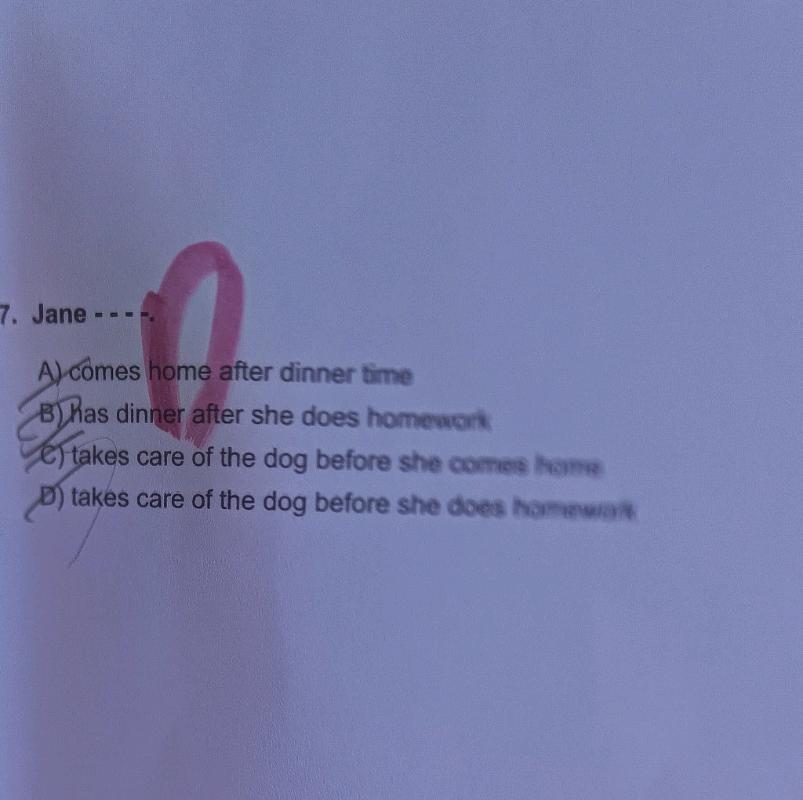
Jane - - - -1
A) comes home after dinner time
B) has dinner after she does homework
C) takes care of the dog before she comes home
D) takes care of the dog before she does homework
Sentence Completion: Jane’s Daily Routine
 STEP-BY-STEP SOLUTION & Option Analysis:
This question tests the chronological sequence of events using time conjunctions “before” (önce) and “after” (sonra):
- \text{Event } 1 \text{ \textbf{before} } \text{Event } 2 \implies \text{Event } 1 \text{ happens first, then Event } 2.
- \text{Event } 1 \text{ \textbf{after} } \text{Event } 2 \implies \text{Event } 2 \text{ happens first, then Event } 1.
Meaning of the Options:
-
A) comes home after dinner time:
- Meaning: Jane has dinner first, and returns home later.
- Condition to be true: Look at the text to see if Jane eats dinner outside or at school before returning home.
-
B) has dinner after she does homework:
- Meaning: Jane first does her homework, then she eats dinner (\text{Homework} \rightarrow \text{Dinner}).
- Condition to be true: Check if her homework time is earlier than dinner time in the reading passage.
-
C) takes care of the dog before she comes home:
- Meaning: Jane looks after the dog outside or somewhere else before arriving home.
- Condition to be true: This is generally less common unless her dog is kept outside her home.
-
D) takes care of the dog before she does homework:
- Meaning: Jane feeds/walks the dog first, and then does her homework (\text{Dog care} \rightarrow \text{Homework}).
- Condition to be true: Check if the dog-care activity is scheduled right before homework.
 How to Find the Correct Option from Your Text:
- Locate the section of the text or timetable that lists Jane’s afternoon/evening activities (e.g., coming home, homework, feeding/walking the dog, having dinner).
- Put Jane’s activities in order of occurrence (1^{\text{st}} \rightarrow 2^{\text{nd}} \rightarrow 3^{\text{rd}}).
- Match that order with the conjunctions:
- If she does homework first and eats dinner next, choose B.
- If she walks/feeds the dog first and does homework next, choose D.
(Note: In standard middle school English curricula, B or D is commonly the intended answer depending on the specific sequence given in the reading passage.)
━━━━━━━━━━━━━━━━━━━━━━━━━━━
 FINAL ANSWER:
Check the reading passage above question 7 for the sequence of actions:
- Choose B if: \text{Homework} \rightarrow \text{Dinner}
- Choose D if: \text{Taking care of the dog} \rightarrow \text{Homework}
━━━━━━━━━━━━━━━━━━━━━━━━━━━
 KEY CONCEPTS:
- Before (+ action): Indicates that the other action happens prior to this one (A \text{ before } B \implies A \text{ first}).
- After (+ action): Indicates that the other action happens following this one (A \text{ after } B \implies B \text{ first}).
Would you like to share the text or timetable above this question so we can confirm the exact option together?
@sorumatik_ai türkçe yaz
Cümle Tamamlama: Jane’in Günlük Rutini
 KULLANILAN FORMÜL / KURAL:
İngilizcede zaman bağlaçları olan “before” (-den önce) ve “after” (-den sonra) kullanımında olayların kronolojik sırası:
- \text{Eylem 1} \textbf{ before } \text{Eylem 2} \implies \text{Önce 1. eylem, sonra 2. eylem yapılır.}
- \text{Eylem 1} \textbf{ after } \text{Eylem 2} \implies \text{Önce 2. eylem, sonra 1. eylem yapılır.}
ÇÖZÜM ADIMLARI & Seçenek Analizi:
Soruda verilen seçenekler, Jane’in gün içindeki eylemlerinin gerçekleşme sırasını ifade etmektedir:
-
A) comes home after dinner time:
- Anlamı: Akşam yemeği saatinden sonra eve gelir.
- İnceleme: Jane akşam yemeğini evde yiyorsa bu ifade yanlıştır.
-
B) has dinner after she does homework:
- Anlamı: Ödevini yaptıktan sonra akşam yemeği yer.
- İnceleme: Parçada Jane önce ödevini yapıyor (\text{Homework}), ardından akşam yemeğine oturuyorsa (\text{Dinner}) bu seçenek doğrudur.
-
C) takes care of the dog before she comes home:
- Anlamı: Eve gelmeden önce köpekle ilgilenir.
- İnceleme: Köpek genellikle evde beslendiği için bu mantıksal olarak ve parça akışında genellikle elenir.
-
D) takes care of the dog before she does homework:
- Anlamı: Ödev yapmadan önce köpekle ilgilenir.
- İnceleme: Parçada Jane eve gelip önce köpeğiyle ilgileniyor/besliyor (\text{Dog care}), ardından ödevinin başına geçiyorsa (\text{Homework}) bu seçenek doğrudur.
Doğru Seçeneği Belirleme:
Sorunun üst kısmındaki okuma parçası veya saat tablosuna bakarak Jane’in eve geldikten sonraki sırasını kontrol etmelisin:
- Parçada “First, she feeds/walks the dog. Then, she does homework.” gibi bir sıra varsa cevap D seçeneğidir.
- Parçada “She finishes her homework, then has dinner with her family.” gibi bir sıra varsa cevap B seçeneğidir.
━━━━━━━━━━━━━━━━━━━━━━━━━━━
CEVAP:
Parçadaki zaman sırasına göre:
- Önce köpekle ilgilenip sonra ödev yapıyorsa: D — takes care of the dog before she does homework
- Önce ödev yapıp sonra akşam yemeği yiyorsa: B — has dinner after she does homework
━━━━━━━━━━━━━━━━━━━━━━━━━━━
TEMEL KAVRAMLAR:
- Before: Kendisinden sonra gelen eylemden önce yapılan işi anlatır.
- After: Kendisinden sonra gelen eylemden sonra yapılan işi anlatır.
 SIK YAPILAN HATALAR:
 Hatalı Yaklaşım: Bağlacı cümlenin başındaki eylemle birleştirmek (Örneğin, “has dinner after” ifadesini “akşam yemeğinden sonra” diye çevirmek).
- Doğru Yaklaşım: “After” ve “Before” kelimeleri kendilerinden sonra gelen cümleye/eyleme aittir (after she does homework = ödevini yaptıktan sonra).
Sorunun ait olduğu okuma parçasını veya saat tablosunu göndermek ister misin, birlikte kesin seçeneği netleştirelim mi?