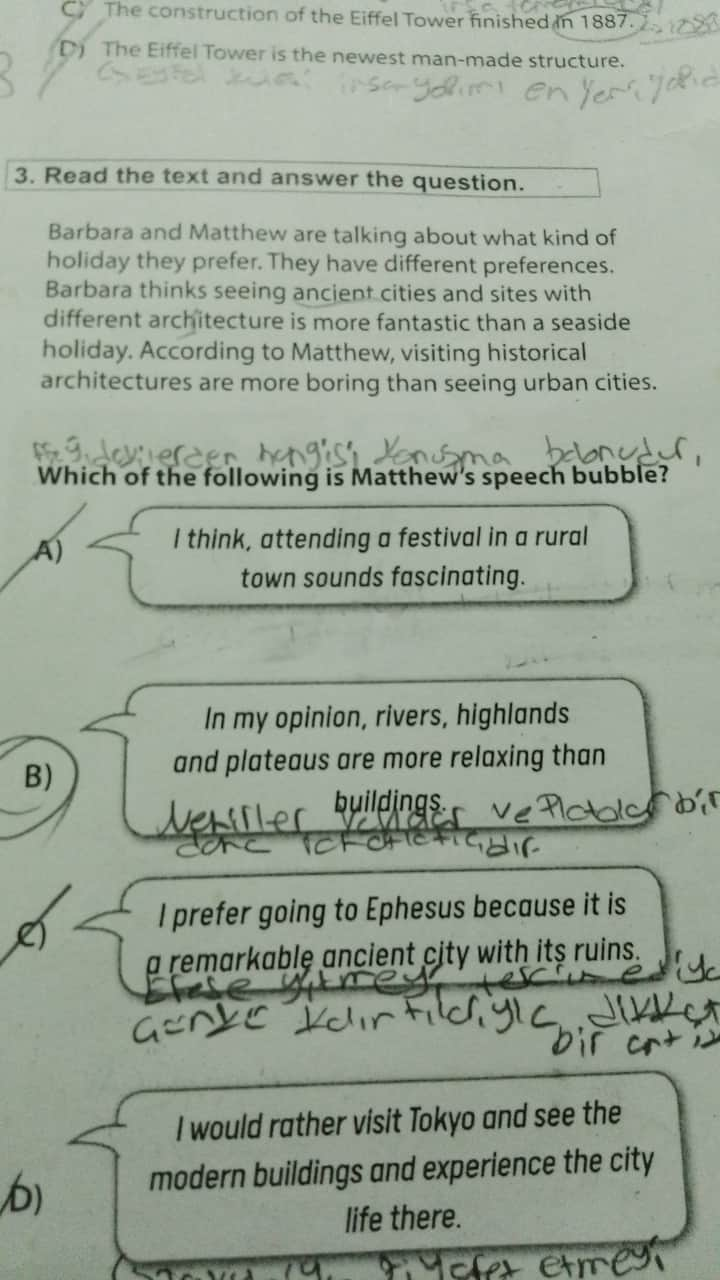
Hangi seçeneğin Matthew’un konuşma balonuna ait olduğunu belirlemeliyiz.
Soruda, Barbara ve Matthew’un tatil tercihleriyle ilgili farklı görüşleri anlatılıyor. Barbara, antik şehirleri ve tarihi mimarileri görmekten hoşlandığını belirtirken, Matthew bunları sıkıcı bulduğunu ve şehir yaşantısını veya modern mimarileri görmekten daha fazla hoşlandığını ifade ediyor.
Şimdi Matthew’un tercihini incelemeliyiz:
-
A Şıkkı: “I think, attending a festival in a rural town sounds fascinating.”
(Bir kırsal kasabada bir festivale katılmanın büyüleyici olduğunu düşünüyorum.)
Uygun değil, çünkü Matthew burada kırsal alanlardan bahsetmiyor. -
B Şıkkı: “In my opinion, rivers, highlands and plateaus are more relaxing than buildings.”
(Bence nehirler, yaylalar ve platolar binalardan daha rahatlatıcıdır.)
Uygun değil, çünkü Matthew tatilde doğal alanlardan bahsetmiyor, odak noktası şehir ve modern mimari. -
C Şıkkı: “I prefer going to Ephesus because it is a remarkable ancient city with its ruins.”
(Efes’e gitmeyi tercih ederim çünkü o kalıntılarla dolu dikkat çekici bir antik şehir.)
Uygun değil, çünkü Matthew tarihi mimarilerden hoşlanmadığını belirtiyor. -
D Şıkkı: “I would rather visit Tokyo and see the modern buildings and experience the city life there.”
(Tokyo’yu ziyaret edip modern binaları görmek ve şehir hayatını deneyimlemek isterim.)
Doğru seçenek bu, çünkü Matthew tarihi mimariden sıkıldığını ve şehir yaşantısını sevdiğini ifade ediyor.
Cevap:
D Şıkkı doğru cevap!
Soru: “Which of the following is Matthew’s speech bubble?”
Cevap:
Metinde Matthew, tarihi mimariyi gezmeyi sıkıcı bulduğunu ve modern şehirleri tercih ettiğini belirtmektedir. Seçeneklerde, D şıkkı “I would rather visit Tokyo and see the modern buildings and experience the city life there.” Matthew’nin tercihine en uygun ifadedir. Dolayısıyla doğru cevap D şıkkıdır.
@User
Which of the following is Matthew’s speech bubble?
Answer:
Based on the reading text provided, Matthew finds visiting historical architecture more boring than seeing modern, urban cities. That means he prefers big cities, contemporary buildings, and the vibrant energy of modern life rather than ancient or historical locations. Out of the listed options, the speech bubble that emphasizes a preference for these kinds of modern, urban sites would be:
“I would rather visit Tokyo and see the modern buildings and experience the city life there.”
This choice clearly aligns with the text stating that Matthew finds historical architecture less interesting and prefers seeing “urban cities.” Therefore, the correct speech bubble for Matthew is the one expressing a desire to see modern buildings in a large city environment.
Table of Contents
- Understanding the Text
- Context Clues in the Passage
- Key Vocabulary and Meanings
- Analyzing Barbara’s vs. Matthew’s Preferences
- Evaluating Each Speech Bubble Option
- Why the Correct Answer Is About Visiting Modern Cities
- Common Reading Comprehension Strategies
- Additional Practice: Comparing Preferences
- Sample Table: Barbara vs. Matthew’s Preferences
- Summary of the Detailed Analysis
- Final Overview
1. Understanding the Text
When we read any short passage to determine who said what or which person has which opinion, it is crucial to extract key details:
- The text mentions two people, Barbara and Matthew, who have distinctly different preferences regarding holiday destinations.
- Barbara loves ancient cities, historical sites, and architecture from the past.
- Matthew, on the other hand, finds old structures or ancient ruins less engaging.
- According to the short passage, visiting historical architectures is more boring than seeing urban cities, specifically from Matthew’s perspective.
To decide which speech bubble belongs to Matthew, we must look for a statement that reflects a fondness for modern destinations, urban exploration, or contemporary experiences—anything pointing toward enjoying city life rather than ancient sites.
2. Context Clues in the Passage
In reading comprehension, context clues help us pinpoint the correct answers. The passage states:
“They have different preferences. Barbara thinks seeing ancient cities and sites with different architecture is more fantastic than a seaside holiday. According to Matthew, visiting historical architectures is more boring than seeing urban cities.”
- Barbara’s stance: Historical sites are more interesting. She loves ancient cities.
- Matthew’s stance: Historical architecture is more boring than seeing modern or urban cities.
Hence, if we see a speech bubble that says something positive about modern cities or negative about historical sites, that’s probably Matthew’s viewpoint.
3. Key Vocabulary and Meanings
Below are a few words/phrases from the passage and their meanings:
- Ancient Cities: Old, historical locations known for their ruins, historical buildings, and architectural importance.
- Architecture: The style or design of buildings, either historical or modern.
- Urban: Relating to a city or town, as opposed to rural or countryside areas.
- Boring: Not interesting; causing fatigue or lack of excitement.
Since Matthew states that “visiting historical architecture is … more boring,” we interpret that he does not derive enjoyment from ruin sites or old buildings. Instead, he prefers something modern or city-like.
4. Analyzing Barbara’s vs. Matthew’s Preferences
In reading, it often helps to distinguish each speaker’s viewpoint carefully:
-
Barbara:
- Enjoys traveling to places with historical significance.
- Finds ancient towns, old architecture, and historical ruins “fantastic” or fascinating.
-
Matthew:
- Does not share Barbara’s enthusiasm for old buildings.
- Believes historical architecture pales in comparison to the excitement of seeing more contemporary or modern cities.
With that in mind, the question about “Which speech bubble is Matthew’s?” must match the pattern: He prefers urban or modern environments over old or ancient places.
5. Evaluating Each Speech Bubble Option
In the image or text provided, there are likely multiple speech bubbles. Typically, these might read:
-
“I think attending a festival in a rural town sounds fascinating.”
- This emphasizes a rural location, festivals, and cultural events. It does not mention modern cities vs. historical architecture. So, it doesn’t reflect the perspective that historical sites are less interesting than modern cities.
-
“In my opinion, rivers, highlands, and plateaus are more relaxing than buildings.”
- This focuses on preferring natural landscapes to man-made structures. Again, it does not mention wanting to see modern, urban environments over ancient ruins. This does not align with Matthew’s statement that cites “urban cities” as more interesting.
-
“I prefer going to Ephesus because it is a remarkable ancient city with its ruins.”
- Ephesus is an ancient city in Turkey known for its well-preserved ruins. This statement is the exact opposite of Matthew’s stance, because he thinks ancient sites are more boring. Therefore, this would more likely be Barbara’s type of statement.
-
“I would rather visit Tokyo and see the modern buildings and experience the city life there.”
- Tokyo is a famously modern, urban city with cutting-edge architecture. Stating a preference for modern buildings aligns perfectly with Matthew’s viewpoint that historical sites are more boring. This is the speech bubble that references big city life, which is exactly what Matthew is said to prefer.
Hence, only the speech bubble about visiting Tokyo—i.e., a place known for its urban sprawl, skyscrapers, and advanced technology—fits with Matthew’s less enthusiastic attitude about historical ruins and more enthusiastic attitude about modern city attractions.
6. Why the Correct Answer Is About Visiting Modern Cities
Because the excerpt mentions that Matthew finds historical sites more boring, he would logically enjoy what the opposite offers—urban exploration, modern marvels, and contemporary city life. The part that references Tokyo or any other advanced urban space underscores a preference for these environments. In reading comprehension exercises, a direct statement linking “modern buildings” and “experiencing city life” is the strongest match to someone who specifically states they do not love old architecture.
7. Common Reading Comprehension Strategies
When approaching a task like this, you can use a few strategies:
- Skim the Passage: Read quickly to get the main idea—Matthew vs. Barbara, modern city vs. ancient architecture.
- Look for Direct Contrasts: The text highlights a difference in preferences. Identify clear statements in the text that show how each speaker’s stance is opposite to the other.
- Match Keywords: Notice how the text says “visiting historical sites is more boring than seeing urban cities.” The speech bubble about “I would rather visit Tokyo…” uses the keywords: “modern buildings,” “city life.”
- Eliminate Irrelevant Choices: If a statement mentions loving historical ruins like Ephesus, that cannot be Matthew’s, because it conflicts with the text’s direct statement about him.
By following these steps systematically, you can arrive quickly at the correct speech bubble.
8. Additional Practice: Comparing Preferences
If you want to strengthen your skills, create your own short conversation:
- Person A: “I love exploring old castles, ancient ruins, and medieval architecture. It’s thrilling to imagine life centuries ago!”
- Person B: “Actually, I find historical sites dull. I get more excited roaming big, bustling cities with glass skyscrapers, bullet trains, and vibrant nightlife.”
After writing it, see if you can bullet-point each person’s perspective. Then write two or three speech bubbles based on the conversation, mixing them up, and see if you can match each bubble to the correct speaker. This exercise cements your comprehension and analysis abilities.
9. Sample Table: Barbara vs. Matthew’s Preferences
To visualize the opposing perspectives, here’s a concise table comparing their thoughts:
| Category | Barbara’s Preference | Matthew’s Preference |
|---|---|---|
| Type of Destination | Ancient cities, historical ruins, old architecture | Modern urban areas, bustling cities, contemporary buildings |
| Opinion on Historic Sites | Finds them fantastic and more interesting than other holiday types | Believes they are more boring compared to modern or urban environments |
| Example of Favorite Place | Ephesus (or any ancient city) | Tokyo (or any highly urbanized, modern city) |
| Reasoning | Fascinated by history, cultural heritage, and archeological discoveries | Prefers the excitement, novelty, and convenience of modern city life |
From the table, it’s crystal clear: Barbara loves historical wonders; Matthew loves modern wonders.
10. Summary of the Detailed Analysis
- The passage states that Barbara and Matthew are discussing holiday preferences.
- Barbara is into ancient cities and historical architecture.
- Matthew is into urban exploration, modern buildings, and city life.
- We read four possible speech bubbles:
- One about attending a festival in a rural town (not specifically about modern vs. historic).
- One about natural environments being more relaxing (again, not relevant to the historical vs. modern city debate).
- One praising Ephesus, an ancient city (definitely Barbara, not Matthew).
- One about visiting Tokyo for modern buildings and city life (this absolutely aligns with Matthew, who prefers urban cities to historical sites).
Thus, the last speech bubble (concerning Tokyo and modern buildings) must represent Matthew’s words.
11. Final Overview
Reading comprehension questions like these test your ability to interpret a short text, identify two differing opinions, and match the statements to the person who expresses each stance. In this example:
- Barbara → historical architecture fan.
- Matthew → modern city enthusiast.
Therefore, the correct speech bubble for Matthew is the one stating: “I would rather visit Tokyo and see the modern buildings and experience the city life there.”