in nucleophilic substitution reactions is there carbocation rearrangement
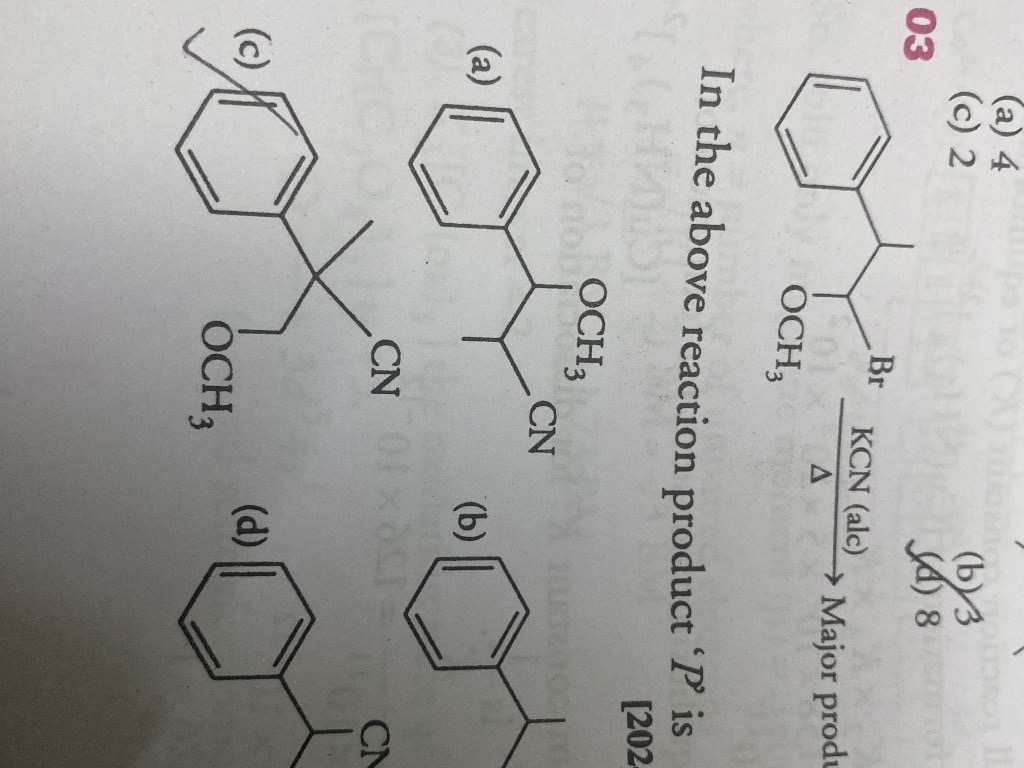
Carbocation Rearrangement in Nucleophilic Substitution Reactions
Yes, carbocation rearrangement can occur in nucleophilic substitution reactions, but ONLY in \text{S}_\text{N}1 reactions, never in \text{S}_\text{N}2 reactions.
1. Fundamental Rule: \text{S}_\text{N}1 vs. \text{S}_\text{N}2
| Mechanism | Intermediate Formed? | Carbocation Rearrangement? | Driving Force |
|---|---|---|---|
| \text{S}_\text{N}1 | Yes (True carbocation intermediate: R^+) | YES (Hydride shift, methyl shift, or ring expansion) | Formation of a thermodynamically more stable carbocation (e.g., 1^\circ \to 2^\circ \to 3^\circ or resonance-stabilized). |
| \text{S}_\text{N}2 | No (Single-step, concerted transition state) | NO (No free carbocation is ever formed) | Nucleophile attacks simultaneously as the leaving group departs with Walden inversion. |
2. Analysis of the Given Problem
 Reaction Conditions:
\text{Substrate} + \text{KCN (alcoholic)} \xrightarrow{\Delta} \text{Product } P
- Reagent: \text{CN}^- is a strong, non-bulky nucleophile, and alcoholic medium with a secondary halide typically favors an \text{S}_\text{N}2 pathway (or at elevated temperatures, substitution without extensive rearrangement unless a strongly stabilized carbocation is accessible).
- Substrate Structure:
The substrate is a secondary alkyl halide:\text{Ph}-\text{CH}(\text{OCH}_3)-\text{CH}(\text{Br})-\text{CH}_3(or benzylic/adjacent ether derivative depending on the position of the \text{Br} atom).
3. Does Rearrangement Happen Here?
-
Case 1: If the reaction proceeds via \text{S}_\text{N}2 (Direct Substitution):
- The strong nucleophile \text{CN}^- attacks the carbon bearing the leaving group (-\text{Br}) from the backside as \text{Br}^- departs.
- No carbocation intermediate is formed, hence no rearrangement occurs.
- The -\text{CN} group simply replaces -\text{Br} at the exact same carbon atom (as in Option a).
-
Case 2: If the reaction proceeds via an \text{S}_\text{N}1 pathway (Carbocation Formation):
- Ionization occurs, producing an intermediate carbocation:\text{R}-\text{CH}^+-\text{CH}_3
- A carbocation will undergo a 1,2-hydride shift or 1,2-methide shift only if the resulting carbocation is significantly more stable (for instance, gaining benzylic resonance or oxygen lone-pair resonance: -\overset{+}{\text{C}}-\ddot{\text{O}}\text{CH}_3 \longleftrightarrow -\text{C}=\overset{+}{\text{O}}\text{CH}_3).
- Nucleophilic attack by \text{CN}^- then takes place at the rearranged, more stable cationic center.
- Ionization occurs, producing an intermediate carbocation:
4. Summary & Takeaway
- Does rearrangement occur?
- In \text{S}_\text{N}1: Always check for rearrangement. Whenever a carbocation intermediate is generated, it will rearrange if a more stable carbocation (via 1,2-hydride shift, 1,2-methyl shift, or resonance stabilization) can be formed faster than the nucleophile attacks.
- In \text{S}_\text{N}2: Never. The concerted displacement leaves no time or ionic intermediate for rearrangement.
Would you like to walk through the complete step-by-step mechanism and orbital overlap for this specific question to see whether \text{S}_\text{N}1 or \text{S}_\text{N}2 dominates?