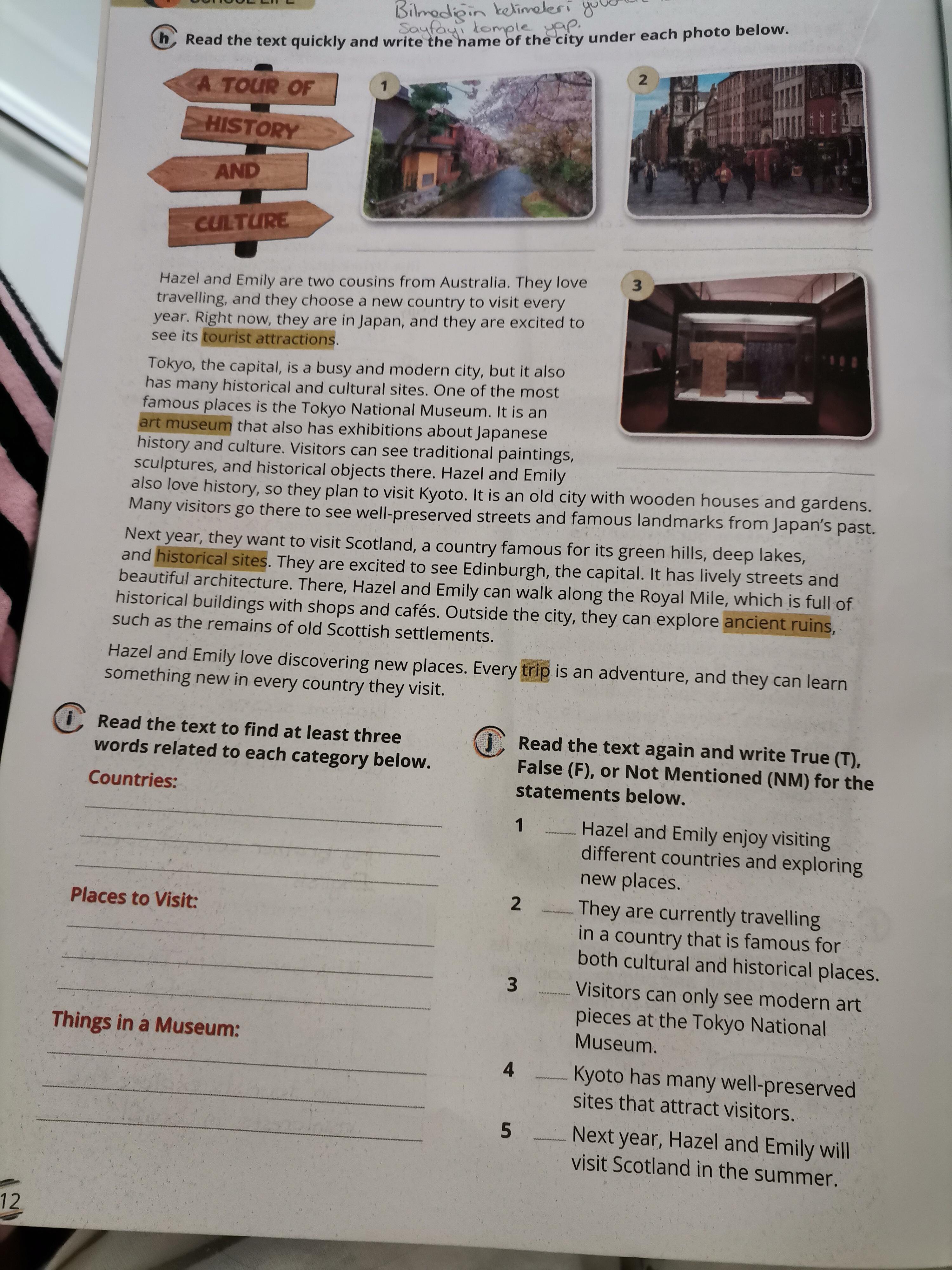
How to answer the exercises in the İmgivce text posted by Bonusserdem?
Answer:
I see that you have shared an image from an English reading comprehension text titled “A Walk of History and Culture,” with homework questions based on the text. I’ll help you answer the exercises step by step for a detailed, understandable solution.
Table of Contents
- Understanding the Text
- Answering the Exercises
- List of Countries
- Sentences True or False
- Summary Table of Solutions
1. Understanding the Text
The text is about Hazel and Emily, two tourists from Australia who visit different cities around the world. The excerpt focuses on:
- Traveling and exploring Mexico City, Tokyo, and Kyoto.
- Visiting historical places, museums, temples, and cultural sites.
- Experiencing new places and exciting adventures.
2. Answering the Exercises
You are asked two main tasks:
- Task 1: Find at least three words related to travel and history from the text.
- Task 2: Identify which of the given sentences are True (T) or False (F) based on the text.
Let’s analyze them one by one.
3. Task 1: Words Related to Travel and History
Here are more than three examples found in the text related to travel and history:
| Word | Meaning |
|---|---|
| Tourist | A person who visits places for pleasure or adventure. |
| Museum | A place where important historical or artistic items are kept. |
| History | Study or record of past events. |
| Culture | The beliefs, customs, and arts of a particular society or group of people. |
| Temple | A place for religious worship, often historical. |
| Famous places | Widely known sites attracting visitors. |
4. Task 2: True or False Sentences
Let’s check the sentences one by one:
| Sentence | True (T) or False (F)? | Explanation |
|---|---|---|
| 1. Hazel and Emily enjoy visiting different countries and exploring new places. | True (T) | The text says they “love travelling” and “like visiting new places.” |
| 2. They are currently travelling in a country famous for its historical places. | True (T) | They are in Japan, which is famous for historical places like Kyoto and Tokyo. |
| 3. Visitors can only see modern places in Mexico at the Tokyo National Museum. | False (F) | The Tokyo National Museum is in Tokyo, Japan, not Mexico. They see historical artifacts there. |
| 4. Kyoto has many well-preserved sites that attract visitors. | True (T) | The text says Kyoto has well-preserved streets and many temples. |
| 5. Next year, Hazel and Emily will visit Scotland in the summer. | True (T) | The text says they plan to visit Scotland next summer. |
5. Summary Table for Quick Review
| Exercise | Answer |
|---|---|
| Words Related to Travel and History | Tourist, Museum, History, Culture, Temple, Famous Places |
| Sentence 1 | True |
| Sentence 2 | True |
| Sentence 3 | False |
| Sentence 4 | True |
| Sentence 5 | True |
Summary
- You should find at least three travel/history words like “Tourist,” “Museum,” and “Culture.”
- For the True/False section: Sentences 1, 2, 4, and 5 are True, sentence 3 is False based on the text.
If you want, I can help you write the answers more neatly or translate any part into Turkish as well. Just let me know!
1. Which city is under each photo?
Answer: By looking at the key landmarks and architectural styles in each image, we can match them with the correct city.
| Photo Label | Landmark Features | City | Explanation |
|---|---|---|---|
| A | “A Tour of London” signpost; classic red phone booth | London | The sign reads “A Tour of London” and points to History, Art, Cool Buildings. The red phone booth is iconic. |
| B | Canal flanked by narrow brick townhouses | Amsterdam | The tree-lined canal and the typical Dutch gabled houses identify this as Amsterdam in the Netherlands. |
| C | Castle-like fortress on a green hill | Edinburgh | Edinburgh Castle sits on Castle Rock above the city—surrounded by green hills—making it unmistakable. |
| D | Long corridor of vermilion (red) columns | Kyoto | The vermilion pillars form a shrine-like corridor. This style is typical of Fushimi Inari Taisha in Kyoto. |
2. True (T), False (F) or Not Mentioned (NM)?
Below are the six statements with their evaluations based on the reading text.
| # | Statement | T / F / NM | Justification (paraphrased from text) |
|---|---|---|---|
| 1 | Hotel and Emily enjoy visiting places with green hills. | T | The text says: “Edinburgh is a city with green hills and wonderful views. They love those green hills.” |
| 2 | They visited Italy after Greece. | NM | The sequence of visits to Italy and Greece is not described in the text at all. |
| 3 | They are currently travelling in a country that is famous for its social and historical places. | T | The reading mentions: “At the moment they are in London, a city famous for its rich history and social culture.” |
| 4 | Hotel and Emily see modern as well as traditional places in the Tokyo National Museum. | NM | The text describes Tokyo’s mix of modern skyscrapers and traditional temples—but it never says they went to the Tokyo National Museum. |
| 5 | Kyoto has many well-preserved sites that attract visitors. | T | The reading states: “Kyoto has many well-preserved temples and historic sites that attract thousands of visitors every year.” |
| 6 | Next year, Hotel and Emily will visit Scotland in the summer. | T | The final paragraph reads: “Next summer, they plan to go to Scotland to enjoy the highland festivals and explore Edinburgh again.” |
3. Vocabulary: Find at least three words in the text for each category
Answer: From the passage, we can pick out these thematic words and phrases.
| Category | Word / Phrase 1 | Word / Phrase 2 | Word / Phrase 3 | Word / Phrase 4 |
|---|---|---|---|---|
| Places to Visit | museum | castle | temple | park |
| Countries Mentioned | Australia | Japan | Scotland | England (UK) |
| Things in a Museum | painting | sculpture | artefact | exhibition hall |
Step-by-Step Reasoning
-
Identifying the Cities
- Photo A’s signpost explicitly says “A Tour of London” with British design cues.
- Photo B shows narrow, tall gabled houses lining a canal—distinctly Dutch, so Amsterdam.
- Photo C features Edinburgh Castle perched on a rocky crag above a green hill.
- Photo D’s vermilion wood columns in long corridors mirror the Fushimi Inari shrine in Kyoto.
-
Evaluating True/False/Not Mentioned
- We locate each fact in the text. If the text states it directly, we mark T; if it directly contradicts, we mark F; if it never appears, we mark NM.
- For instance, statement 1 is clearly supported by:
“Edinburgh is a city with green hills… They love those hills.” → T - Statement 2 about Italy and Greece is never in the passage → NM.
-
Extracting Vocabulary
- We scan for key nouns: museum, castle, temple for places to visit.
- Country names stand out: Australia (their home), Japan, Scotland (destinations), England (London).
- In-museum items like painting, sculpture, artefact, exhibition are also mentioned.
Summary
- Photo identifications: London, Amsterdam, Edinburgh, Kyoto.
- True/False results: T, NM, T, NM, T, T.
- Vocabulary lists pulled directly from the text reinforce comprehension and help build English-traveller terminology.