Question: Please solve or explain the image posted by the user related to chemistry (based on the atomic orbitals diagram).
Answer:
The image you shared shows the shapes of atomic orbitals for different values of quantum numbers, commonly found in chemistry and quantum mechanics topics. Let’s analyze the content step by step and explain what the image is illustrating.
Table of Contents
- Overview of Atomic Orbitals
- Quantum Numbers and Their Meaning
- Explanation of the Provided Orbitals Diagram
- Summary Table of Orbitals
1. Overview of Atomic Orbitals
Atomic orbitals are mathematical functions that describe the wave-like behavior of electrons in atoms. They represent the regions in space where there is a high probability of finding an electron.
Orbitals are usually visualized as shapes that describe the spatial distribution of electrons:
- s orbitals: spherical shape
- p orbitals: dumbbell-shaped
- d and f orbitals: more complex shapes
2. Quantum Numbers and Their Meaning
The quantum mechanical model of the atom describes electrons with four quantum numbers:
| Quantum Number | Symbol | Meaning | Possible Values |
|---|---|---|---|
| Principal quantum number | n | Energy level/shell of the electron | 1, 2, 3, \dots |
| Azimuthal quantum number | l | Shape/type of orbital (subshell) | 0 to n-1 |
| Magnetic quantum number | m_l | Orientation of orbital in space | -l, \dots, 0, \dots, +l |
| Spin quantum number | m_s | Spin direction of the electron | +\frac{1}{2} or -\frac{1}{2} |
The most relevant for your image seem to be the azimuthal quantum number (l) and the magnetic quantum number (m_l) since the orbitals are shown with different shapes changing with these values.
3. Explanation of the Provided Orbitals Diagram
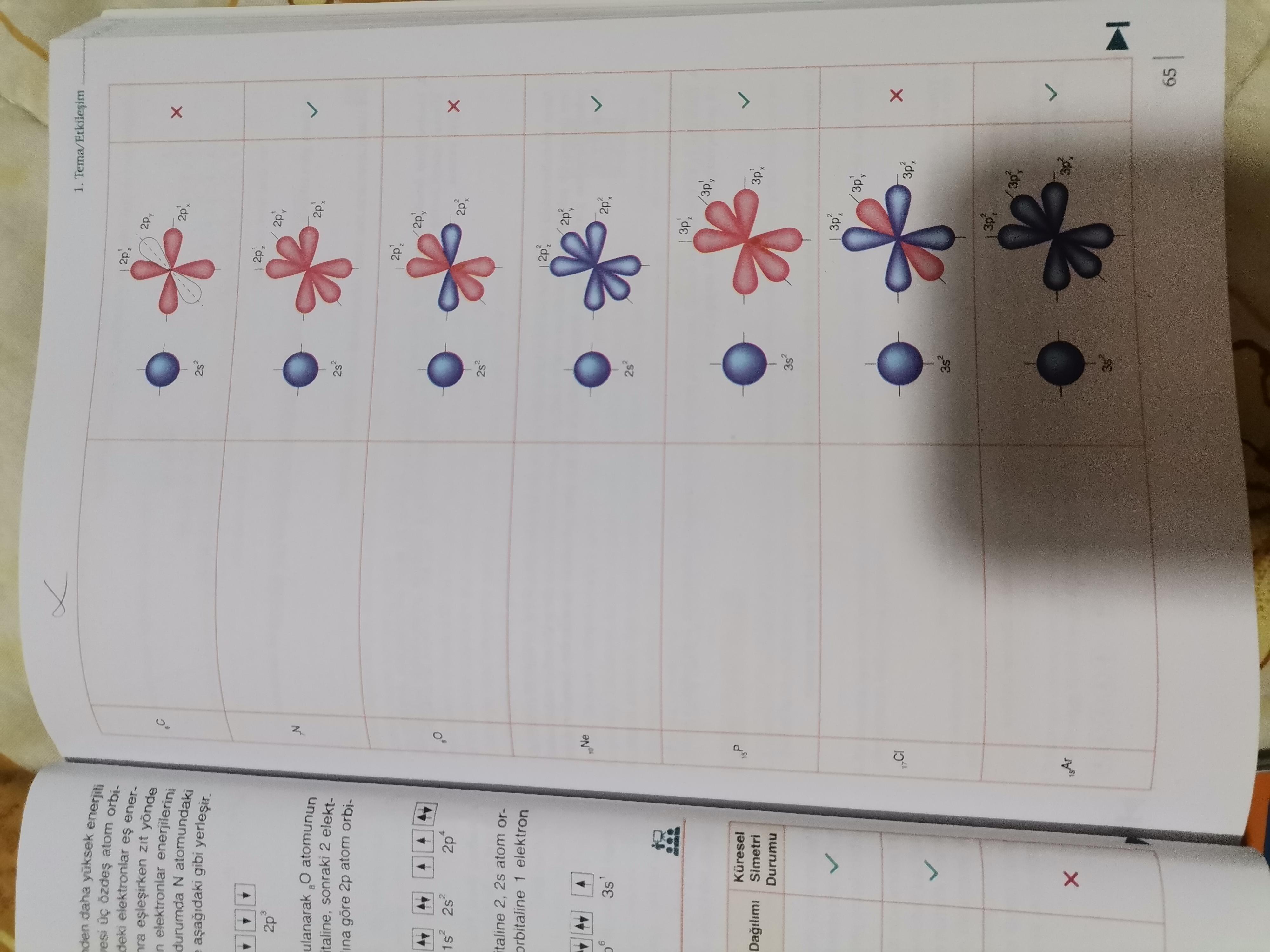
The image depicts various orbital shapes according to specific quantum number values (n, l, m_l).
- The top line with numbers (0, -1, 1, -2, …) corresponds to the m_l values, showing different spatial orientations.
- Each orbital is drawn with lobes representing areas of positive and negative phases (different colors such as red and blue).
- The blue spheres underneath usually represent the nucleus or a reference point.
The shapes correspond roughly to:
| l (azimuthal quantum number) | Type of Orbital | Number of m_l values | Shapes in the image |
|---|---|---|---|
| 0 | s orbital | 1 (m_l=0) | Spherical |
| 1 | p orbitals | 3 (m_l=-1, 0, +1) | Dumbbell shapes in 3 orientations |
| 2 | d orbitals | 5 (m_l=-2, -1, 0, 1, 2) | Cloverleaf and other complex shapes |
From your image:
- The first orbital (labeled 0) is spherical → corresponds to an s orbital.
- Next three orbitals with shapes similar to dumbbells (but oriented differently) correspond to p orbitals.
- The remaining orbitals with more lobes correspond to d orbitals with various m_l values showing different orientations in space.
4. Summary Table of Orbitals
| Orbital Type | Quantum Number (l) | m_l Values | Shape Description | Number of Orbitals per Subshell |
|---|---|---|---|---|
| s | 0 | 0 | Spherical | 1 |
| p | 1 | -1, 0, +1 | Dumbbell-shaped lobes along x, y, z axes | 3 |
| d | 2 | -2, -1, 0, +1, +2 | Cloverleaf and donut-with-lobes shapes | 5 |
Summary
- The image illustrates types of atomic orbitals for sublevels l=0, 1, and 2.
- The m_l numbers indicate orientations of the orbitals in 3D space.
- Color differences show different phases of wave functions (important for bonding and interference).
- Understanding these shapes helps explain electron configurations and chemical bonding.
If you have any specific questions about an orbital or want to know how to write electron configurations or apply this in chemistry problems, feel free to ask!
Merhaba @Bonusserdem, aşağıdaki açıklamalarla şemaları ve hata noktalarını düzeltebilirsin:
p-orbitallerinde
- İki lob birbirine zıt fazdadır; biri “pozitif” (örneğin kırmızı), diğeri “negatif” (mavi) renkle gösterilir.
- Elektronlar Hund kuralına göre önce her orbitalin birer ↑ (spin yukarı) elektronla doldurulup sonra ↓ elektronlar eklenir.
Yanlış çizilen şemalar 3. ve 7. numaralı kutulardır:
-
- şemada loblar aynı renkte boyanmış, faz zıtlığı eksik.
-
- şemada da faz renkleri hatalı ve spin eşleşmesi yanlış yerleştirilmiş.
Aşağıda doğru 3p¹–3p⁶ dizilimini özetleyen tabloyu bulabilirsin. Son sütun ise örnek hatalı 7. kutu için gösterim.
| Durum | Orbital Dizilimi | Faz Renkleri | Not |
|---|---|---|---|
| 3p¹ | px: ↑ | px lobu kırmızı, diğer mavi | ilk tek elektron px’de |
| 3p² | px: ↑, py: ↑ | her orbitalde birer kırmızı/mavi lobe | ↑ elektronlar ayrı orbitallerde |
| 3p³ | px: ↑, py: ↑, pz: ↑ | her orbitalde birer kırmızı/mavi lobe | üçü de ↑ |
| 3p⁴ | px: ↑↓, py: ↑, pz: ↑ | px’de iki zıt spin, diğerlerinde ↑ | eşleşme px’de başlar |
| 3p⁵ | px: ↑↓, py: ↑↓, pz: ↑ | px ve py’de ↑↓, pz’de ↑ | sırayla eşleşme |
| 3p⁶ | px: ↑↓, py: ↑↓, pz: ↑↓ | her orbitalde zıt fazlı çift elektron | tam dolu |
| 7. (Hatalı) | px: ↑↓, py: ↑↓, pz: ↑↓ (faz renkleri aynı) | her lob aynı renk — HATA | faz zıtlığı ve spin dizilimi yanlış |
Özetle:
- p-loblarının iki ucu mutlaka zıt renk/şekilde gösterilmeli.
- Elektron yerleşiminde önce tek ↑ elektronlar, sonra ↓ eşleşmeleri gelir (Hund kuralı).
-
- ve 7. kutularda faz renkleri ve spin eşleşmeleri hatalıdır; yukarıdaki tabloyu model alarak düzeltebilirsin.