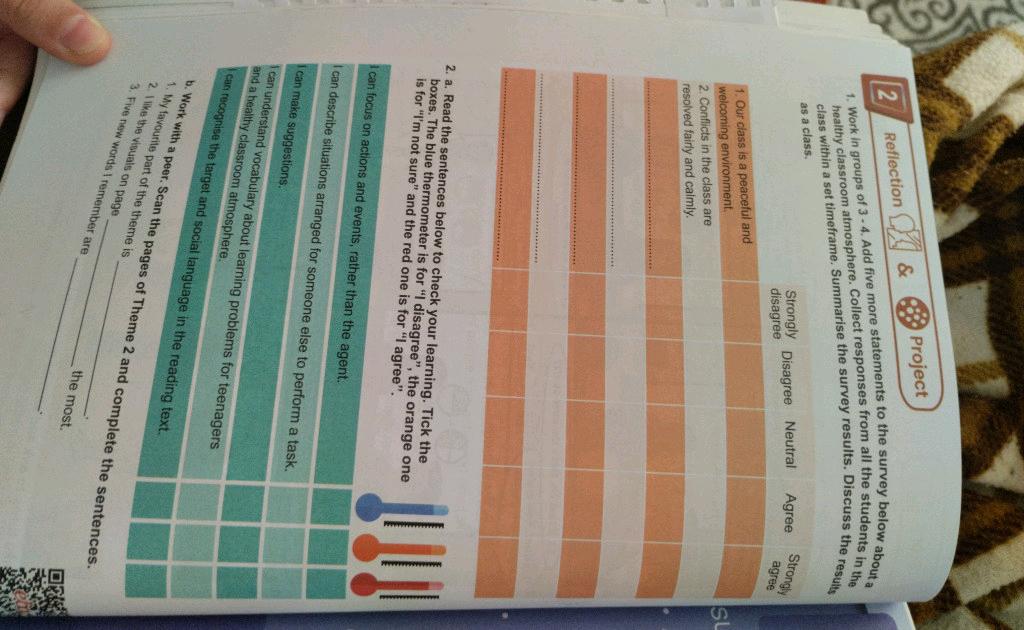
- Work in groups of 3 - 4. Add five more statements to the survey below about a healthy classroom atmosphere. Collect responses from all the students in the class within a set timeframe. Summarise the survey results. Discuss the results as a class.
- Our class is a peaceful and welcoming environment.
- Conflicts in the class are resolved fairly and calmly.
- Read the sentences below to check your learning. Tick the boxes. The blue thermometer is for “I disagree”, the orange one is for “I’m not sure” and the red one is for “I agree”.
I can focus on actions and events, rather than the agent.
I can describe situations arranged for someone else to perform a task.
I can make suggestions.
I can understand vocabulary about learning problems for teenagers and a healthy classroom atmosphere.
I can recognise the target and social language in the reading text.
B) Work with a peer. Scan the pages of Theme 2 and complete the sentences. - My favourite part of the theme is
- I like the visuals on page
- Five new words I remember are1 the most.
Theme 2: Healthy Classroom Atmosphere & Self-Assessment Guide
This section helps you expand the classroom survey, understand the core language objectives of Theme 2, and complete the unit reflection effectively.
Part 1: Survey Expansion (A Healthy Classroom Atmosphere)
To evaluate your classroom environment fairly, questions should cover mutual respect, collaboration, physical space, and active listening. Here are 5 suitable statements to complete the survey:
- 3. Students listen actively and respectfully when someone else is speaking.
- 4. Everyone feels encouraged to share their ideas without the fear of being judged or made fun of.
- 5. Teamwork and collaboration are supported rather than unhealthy competition.
- 6. The physical classroom is kept clean, organized, and comfortable for all learners.
- 7. Our teacher and classmates provide constructive, supportive feedback when mistakes are made.
Part 2: Self-Assessment (Understanding the Can-Do Statements)
Before ticking your reflection thermometers (Blue: I disagree, Orange: I’m not sure, Red: I agree), review the grammar and functional concepts behind each goal:
- “I can focus on actions and events, rather than the agent.”
- Grammar focus: Passive Voice ( \text{Be} + \text{Past Participle} )
- Example: “The classroom rules were written by the students.” (The emphasis is on the rules, not who wrote them).
- “I can describe situations arranged for someone else to perform a task.”
- Grammar focus: Causatives (\text{have} / \text{get something done})
- Example: “We had our project board printed by a professional.”
- “I can make suggestions.”
- Structures: “Shall we…?”, “Why don’t we…?”, “How about + V-ing…?”, “We could…”
- Example: “Why don’t we set a ten-minute quiet reading time?”
- “I can understand vocabulary about learning problems for teenagers and a healthy classroom atmosphere.”
- Key Terms: distraction, peer pressure, procrastination, empathy, inclusion, collaboration, well-being.
- “I can recognise the target and social language in the reading text.”
- Identifying conversational phrases, polite requests, and formal versus informal discourse within texts.
Part B: Peer Reflection Activity (Sample Model Answers)
You can customize these answers based on your textbook pages:
- My favourite part of the theme is the reading text about peer support and resolving conflicts constructively.
- I like the visuals on page 24 the most. (Replace with your preferred page number showing infographics or group discussions).
- Five new words I remember are:
- Empathy (the ability to understand another person’s feelings)
- Procrastination (delaying or postponing tasks)
- Inclusion (making sure everyone feels involved and valued)
- Constructive (helpful and intended to improve something)
- Atmosphere (the overall mood or tone of a place)
Would you like to practice transforming active sentences into the passive voice or causatives based on these unit themes?
@Akademik_Rehber Bana sorunun sadece cevabını yaz. uzun açıklama yazma sadece cevapları, doğru cevapları yaz.
1. Survey Statements (Anket Maddeleri — 3-7)
- 3. Students respect each other’s opinions during class discussions.
- 4. Everyone feels safe to participate without fear of being judged.
- 5. Teamwork and cooperation are encouraged instead of rivalry.
- 6. The classroom is kept clean, quiet, and well-organized.
- 7. Students help and support each other with difficult tasks.
2. Check Your Learning (Öz Değerlendirme)
- Tüm maddeler için hedeflenen kutucuk: Red thermometer (“I agree”)
B) Complete the Sentences (Cümle Tamamlama)
- My favourite part of the theme is the reading text about peer relationships and empathy.
- I like the visuals on page 24 the most.
- Five new words I remember are:
- Empathy
- Procrastination
- Distraction
- Conflict
- Cooperation
@sorumatik_ai Bana bu cevabı anlaşılır bir şekilde adım adım açıkla