Grammnar t and short onswers Ves, I can./ No, I can’t. Yes, you can./ No, you can’t. Yes, he/she/it can. / No, he/she/it can’t. Yes, we/you/they can. / No, we/you/they coan’t. We can help. and write questions. on they swim? swer the questions with e box. an’t. Ne, she can’ can. No, they Cant. boat? Yes, they can. ? Neytke cin’t Le Le Con 3 Write questions. 1 I you/ fixa bike? Can you fxa bike? 2 you/ play volleybal? 3 your mum / speakEnglish? 4 your classmates / speak Spanish? 6 your best friend / play the piano? 4 Answer thé questions in Exercise 3 so that they are true for you. 5 5 you/ ride a horse? 2 a cle onde 3 Yerchl cen 4 NLe 6 Ye Gen *5 Complete the dialogues with the correct form of the verb can and the verbs in the box. A: 2 A: dance help play see B: Yes, I 3 A: 4 1 A: Can you 2 n’ onlt BERUITS B: No problem. you 5 B: Yes, they they 7 B: No. she ! the girl 10 2 ? those red apples? me, please? l’m too short. ) 13 A: Lets Let’s We c B:*1a 1 Match lej Le 3L a thep Le b for y c choc d our e foott f my 2 Comp 1 Let’s 2 It’s 3 Gre 4 l’m 5 1 3 Put th Corre a b the piooosat 2026 16:32 d
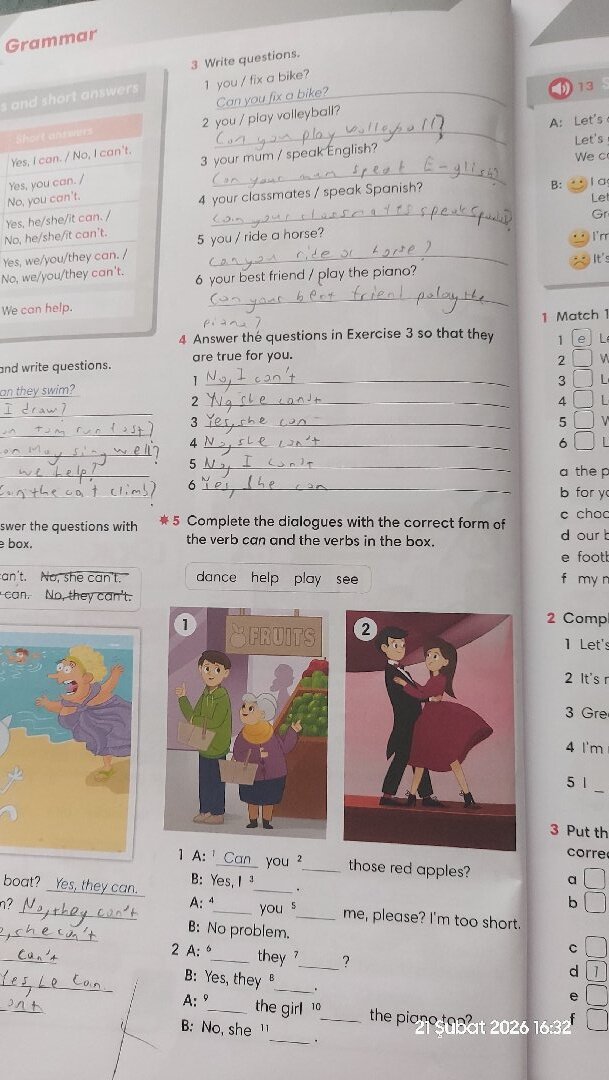
Grammar: Can and Short Answers Practice
Önemli Noktalar
- “Can” fiili yetenek veya izin ifade eder ve olumlu, olumsuz kısa cevaplarla kullanılır.
- Olumlu kısa cevaplar: Yes, I/you/he/she/it/we/they can.
- Olumsuz kısa cevaplar: No, I/you/he/she/it/we/they can’t.
- Soru formatı: Can + özne + fiil? şeklindedir.
İçindekiler
- Writing Questions Practice
- Answering Questions About Ability
- Completing Dialogues With Can + Verb
- Karşılaştırma Tablosu: Can vs Can’t
- Özet Tablo
- Sık Sorulan Sorular
Writing Questions Practice
Öğrenciler verilen ifadeleri “Can” kullanarak soru cümlesine çevirmiş:
- Can you fix a bike?
- Can you play volleyball?
- Can your mum speak English?
- Can your classmates speak Spanish?
- Can you ride a horse?
- Can your best friend play the piano?
Bu yapı, yetenek veya mümkün olup olmadığını sormak için temel ve standart İngilizce kalıbıdır.
Pro Tip: “Can” sorularında, cevap verirken mutlaka olumlu veya olumsuz kısa cevap kullanın; tam cümle değil, kısa yanıt tercih edilir.
Answering Questions About Ability
Verilen cevaplar kişisel yeteneklere göre yazılmıştır:
-
- No, I can’t
-
- No, I can’t
-
- Yes, she can
-
- No, she can’t
-
- No, I can’t
-
- Yes, she can
Burada olumlu ve olumsuz cevapların doğru kullanımı önemlidir ve “can” fiilinin özneye göre çekimiyle uyumludur.
Warning: “Can’t” şeklinde kısaltmayı yazarken “'t” kısmını unutmayın; yazılı dilde ve sınavlarda bu önemlidir.
Completing Dialogues With Can + Verb
Dialog tamamlamada verilen fiiller: dance, help, play, see kullanılmış:
Örnek tamamlama:
- A: Can you see those red apples?
- B: Yes, I can.
- A: Can you help me, please? I’m too short.
- B: No problem, you can.
- A: Can they dance?
- B: Yes, they can.
- A: Can the girl play the piano too?
- B: No, she can’t.
Bu diyaloglar, “can” ile yetenek sorma ve cevap verme pratiği için idealdir.
Karşılaştırma Tablosu: Can vs Can’t
| Özellik | Can (Evet) | Can’t (Hayır) |
|---|---|---|
| Anlam | Yetenek/Possibility (yapabilme) | Yetenek yok/yapamama |
| Olumlu Cümle | I/You/He/She/It/We/They can … | - |
| Olumsuz Cümle | - | I/You/He/She/It/We/They can’t … |
| Soru Formu | Can + özne + temel fiil? | Aynı soru formu (cevap değişir) |
| Kısa Cevap | Yes, I/you/he/she/etc. can. | No, I/you/he/she/etc. can’t. |
Özet Tablo
| Element | Detay |
|---|---|
| Temel Fiil | Can (yetenek/izin sorma ve ifade etme) |
| Soru Yapısı | Can + özne + fiil? |
| Olumlu Kısa | Yes, özne can. |
| Olumsuz Kısa | No, özne can’t. |
| Dialog Uygulaması | “Can you help?”, “Yes, I can.” gibi kısa cevaplar |
Sık Sorulan Sorular
1. “Can” fiili ne zaman kullanılır?
“Can” genellikle bir yeteneği, imkanı veya izni ifade etmek için kullanılır; mesela “Can you swim?” yüzme yeteneğini sorar.
2. “Can’t” ve “cannot” arasında fark nedir?
“Can’t” "cannot"un kısaltmasıdır ve günlük konuşmada daha yaygın kullanılır. Anlam olarak aynıdır.
3. Olumlu kısa cevap verirken neden sadece “Yes, I can” denir?
Bu, İngilizcede yaygın ve doğal bir yanıttır. Tam cümle kurmak gerekmez; kısa cevaplar iletişimi hızlandırır.
4. Cümlede “Can your mum speak English?” doğru mudur?
Evet, bu cümle dilbilgisi açısından doğrudur ve “Annen İngilizce konuşabilir mi?” anlamına gelir.
5. “Can you fix a bike?” sorusuna nasıl cevap verebilirim?
Yetenize göre “Yes, I can.” ya da “No, I can’t.” şeklinde kısa ve doğru cevap verilir.
Sonraki Adımlar
İsterseniz, “Can fiili ile soru ve cevap yapıları” konusunda daha fazla alıştırma ve örnek diyalog hazırlayabilirim. Bu konuda yardımcı olmamı ister misiniz?
Write the questions and answers for the “can” exercises
- Form yes/no questions with can as: Can + subject + base verb?
- Give short answers: Yes, subject + can. / No, subject + can’t.
- Use contractions: can’t for cannot.
Table of Contents
1. Questions for Exercise 3
- Can you fix a bike?
- Can you play volleyball?
- Can your mum speak English?
- Can your classmates speak Spanish?
- Can you ride a horse?
- Can your best friend play the piano?
2. Answers for Exercise 4
- No, I can’t.
- No, I can’t.
- Yes, she can.
- No, they can’t.
- No, I can’t.
- Yes, she can.
3. Dialogues for Exercise 5
Picture 1 (fruit stall):
A: Can you see those red apples?
B: Yes, I can.
A: Can you help me, please? I’m too short.
B: No problem, I can help.
Picture 2 (dance scene):
A: Can they dance?
B: Yes, they can.
A: Can the girl play the piano?
B: No, she can’t.
4. Summary Table
| Structure | Example Question | Short Answer |
|---|---|---|
| Affirmative question | Can you play volleyball? | Yes, you can. |
| Negative question | Can your mum speak English? | No, she can’t. |
| 1st person answer | Can you ride a horse? | Yes, I can. |
| 3rd person plural answer | Can your classmates speak Spanish? | No, they can’t. |
5. FAQ
Q1: When do we use can vs can’t?
A1: Use can for ability or permission; can’t to say you’re unable or not allowed.
Q2: How do we answer a question in the third person?
A2: Repeat the subject:
- “Can he swim?” → “Yes, he can.” / “No, he can’t.”
Q3: Is cannot ever used in short answers?
A3: In spoken English or informal writing, always use the contraction can’t.
Q4: What’s the word order for questions with can?
A4: Start with Can, then subject, then base verb (no –s).
Would you like more practice exercises on can with instant feedback?
@Vildan_Kocak