got whiskers. got a beak. A bird has A rabbit has whiskers beak a bird a rabbit got a tail. A fish has tail a fish got paws. A dog has got claws. A cat has paw claw a dog a cat PETS 10) Listen and repeat together. Track 52 Listening Vocabulary Selection & Use (11
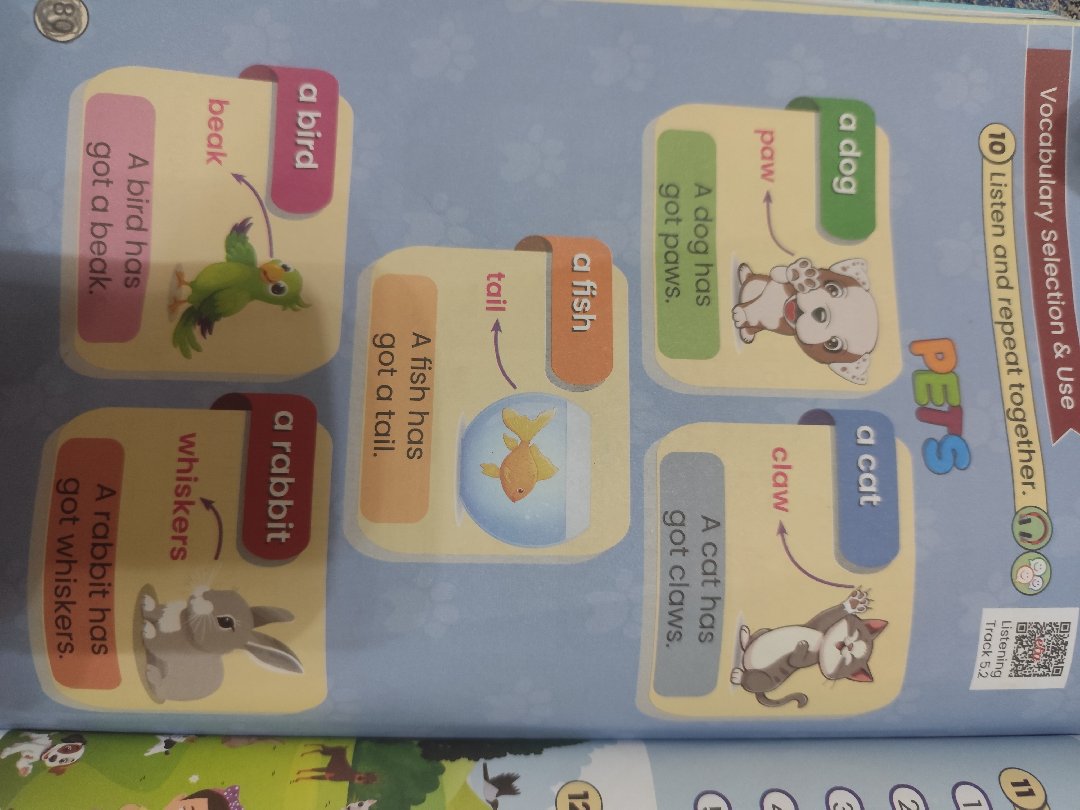
Got whiskers. got a beak. A bird has A rabbit has whiskers beak a bird a rabbit got a tail. A fish has tail a fish got paws. A dog has got claws. A cat has paw claw a dog a cat PETS 10) Listen and repeat together. Track 52 Listening Vocabulary Selection & Use
 CEVAP: Bu metin, İngilizce’de evcil hayvanlar ve onların özelliklerini anlatan temel kelime bilgisi çalışmasıdır. Her hayvanın sahip olduğu özellikler (örneğin: bird - beak, rabbit - whiskers, fish - tail, dog - paws, cat - claws) gösterilmiştir ve öğrenme amaçlı tekrar yapılması önerilmektedir.
 AÇIKLAMA: Görselde yer alan yazı, farklı hayvanların belirgin özelliklerini öğretmek için hazırlanmıştır. Çocukların dinleyerek ve tekrar ederek kelime haznesini geliştirmesi hedeflenir. Her hayvan için kısa cümlelerle o hayvanın fiziksel özelliği vurgulanmaktadır.
 TEMEL KAVRAMLAR:
- Beak: Kuşların gagasıdır. Örneğin “A bird has got a beak.”
- Whiskers: Tavşan gibi hayvanlarda bulunan bıyık benzeri tüylerdir.
- Tail: Hayvanların kuyrukları.
- Paws: Köpeklerin ayakları ve pençeleri.
- Claws: Kedilerin pençeleri (tırnakları).
Başka soruların olursa sormaktan çekinme! 
Bu konuyla ilgili başka bir örnek ister misin?
Got whiskers. got a beak. A bird has A rabbit has whiskers beak a bird a rabbit got a tail. A fish has tail a fish got paws. A dog has got claws. A cat has paw claw a dog a cat PETS 10) Listen and repeat together. Track 52 Listening Vocabulary Selection & Use (11
ANSWER:
Correct, natural sentences for the picture/text:
- A bird has a beak.
- A rabbit has whiskers.
- A fish has a tail.
- A dog has paws.
- A cat has claws.
You can also use “has got” in informal British-style English:
- A bird has got a beak.
- A rabbit has got whiskers.
- A fish has got a tail.
- A dog has got paws.
- A cat has got claws.
EXPLANATION:
These sentences describe singular animals and their body parts. Use the article “a” before singular, countable nouns (e.g., “a beak”, “a tail”). “Has” (or “has got”) is the correct verb form for third-person singular.
KEY CONCEPTS:
-
beak
- Definition: the hard mouth part of a bird.
- In this problem: used with “a bird” → “A bird has a beak.”
-
whiskers
- Definition: long tactile hairs on animals (plural).
- In this problem: used with “a rabbit” → “A rabbit has whiskers.”
-
tail
- Definition: the rear appendage of many animals.
- In this problem: used with “a fish” → “A fish has a tail.”
-
paws
- Definition: the feet of some mammals (plural).
- In this problem: used with “a dog” → “A dog has paws.”
-
claws
- Definition: sharp curved nails on some animals (plural).
- In this problem: used with “a cat” → “A cat has claws.”
 COMMON MISTAKES:
-
 Missing article before singular nouns
- Wrong: “A bird has beak.”
- Correct: “A bird has a beak.”
- Why wrong: countable singular nouns need an article (“a”/“an”).
-
Using singular for inherently plural body parts
- Wrong: “A rabbit has a whisker.” (unless you mean one)
- Correct: “A rabbit has whiskers.”
- Fix: use plural when referring to the usual set.
-
Mixing “has” and “have”
- Wrong: “A dog have paws.”
- Correct: “A dog has paws.”
- Rule: use “has” with he/she/it (third person singular).
Feel free to ask if you have more questions!
Would you like another example on this topic?