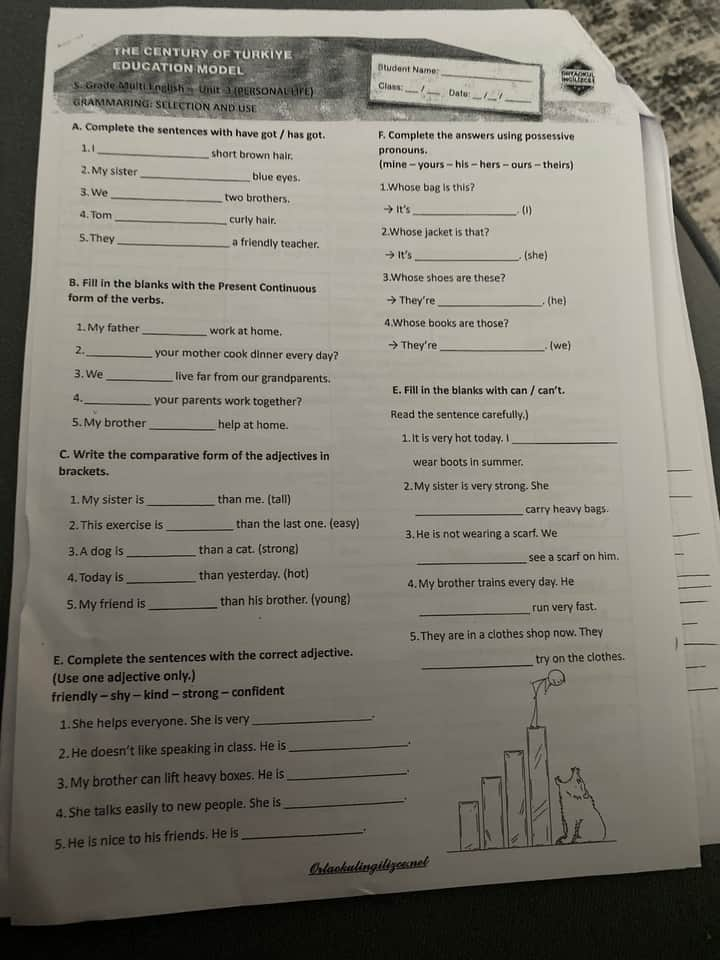
Fuşjfufuggj İngilizce Alıştırma Soruları Yanıtları
Önemli Noktalar
- Bu çalışma, have got/has got, Present Continuous tense, comparative adjectives, possessive pronouns, can/can’t kullanımı ve sıfat tamamlama konularını kapsıyor.
- Cümle tamamlama ve boşluk doldurma esaslı pratikler temel dil bilgisi kurallarını pekiştirmeye yöneliktir.
- Özellikle küçük detaylar (örneğin tekil-çoğul uyumu, doğru sıfat kullanımı) sınav başarısını artırır.
Fuşjfufuggj konulu İngilizce alıştırma sorularının aşağıda ayrıntılı çözümlerini bulabilirsiniz.
İçindekiler
- Have Got / Has Got Tamamlama
- Present Continuous Boşluk Doldurma
- Karşılaştırma Sıfatları
- Doğru Sıfat Seçimi
- Possessive Pronouns ile Tamamlama
- Can / Can’t ile Boşluk Doldurma
1. Have Got / Has Got Tamamlama
- I have got short brown hair.
- My sister has got blue eyes.
- We have got two brothers.
- Tom has got curly hair.
- They have got a friendly teacher.
Pro Tip: Tekil öznelerde (he, she, it) has got, çoğul ve I/you/we/they ile have got kullanılır.
2. Present Continuous Boşluk Doldurma
- My father is working at home.
- Is your mother cooking dinner every day?
- We are living far from our grandparents.
- Are your parents working together?
- My brother is helping at home.
Uyarı: Present continuous yapısında “to be” yardımcı fiili (am/is/are) unutulmamalı, cümlenin olumlu, olumsuz veya soru olması anlamı değiştirebilir.
3. Karşılaştırma Sıfatları
- My sister is taller than me.
- This exercise is easier than the last one.
- A dog is stronger than a cat.
- Today is hotter than yesterday.
- My friend is younger than his brother.
Anahtar Nokta: Çoğu iki heceli ve kısa sıfatlarda “er” eki eklenir; bazı istisnalar için “more” kullanılır.
4. Doğru Sıfat Seçimi
(Seçenekler: friendly, shy, kind, strong, confident)
- She helps everyone. She is very friendly.
- He doesn’t like speaking in class. He is shy.
- My brother can lift heavy boxes. He is strong.
- She talks easily to new people. She is confident.
- He is nice to his friends. He is kind.
5. Possessive Pronouns ile Tamamlama
-
Whose bag is this?
→ It’s mine. -
Whose jacket is that?
→ It’s hers. -
Whose shoes are these?
→ They’re his. -
Whose books are those?
→ They’re ours.
6. Can / Can’t ile Boşluk Doldurma
- It is very hot today. I can’t wear boots in summer.
- My sister is very strong. She can carry heavy bags.
- He is not wearing a scarf. We can’t see a scarf on him.
- My brother trains every day. He can run very fast.
- They are in a clothes shop now. They can try on the clothes.
Özet Tablo
| Bölüm | Anahtar Noktalar |
|---|---|
| Have Got / Has Got | Tekil/çoğul uyumu, possession ifadeleri |
| Present Continuous | Am/is/are + verb+ing yapısı |
| Comparative Adjectives | Sıfatların karşılaştırma biçimi (er/more) |
| Adjectives | Anlama uygun sıfat seçimi |
| Possessive Pronouns | Sahiplik zamirleri kullanımı |
| Can / Can’t | Yeteneği ifade etme |
Sık Sorulan Sorular
1. Present Continuous ile Simple Present arasındaki fark nedir?
Present Continuous, şu anda devam eden eylemleri anlatır (örn. “I am studying now”). Simple Present ise genel durumları veya alışkanlıkları ifade eder (“I study every day”).
2. “Has got” ve “have got” arasındaki fark nedir?
“Has got” üçüncü tekil şahıs (he, she, it) için, “have got” diğer şahıslar için kullanılır.
3. Possessive pronouns ile possessive adjectives aynı mıdır?
Hayır, “mine”, “yours” gibi zamirler (possessive pronouns); “my”, “your” gibi sıfatlar (possessive adjectives) farklıdır. Örnek: “This is my book” vs “This book is mine”.
Sonraki Adımlar
Bu İngilizce dil bilgisi konularında isterseniz detaylı gramer açıklamaları, pratik testler veya benzer seviyede çalışma kağıtları hazırlayabilirim. Hangisi ilginizi çeker?
Fuşjfufuggj Çalışma Sayfası Cevapları
Anahtar Çıkarımlar
- Have got/Has got sahiplik belirtir; özneye göre “have got” (I/we/you/they) veya “has got” (he/she/it) olarak çekimlenir.
- Present Continuous am/is/are + -ing ekiyle şu an devam eden eylemleri anlatır.
- Comparative Adjectives çoğunlukla “-er” eki alır (tall → taller), bazıları “more + adjective” ile yapılır.
- Can / Can’t yetenek ve izin durumunu gösterir.
- Possessive Pronouns (mine, yours, his, hers, ours, theirs) isim grubunu tek başına temsil eder.
İşte çalışma sayfasının tüm İngilizce cevapları:
İçindekiler
- Have got Kullanımı
- Present Continuous
- Comparative Adjectives
- Sıfat Tamamlama
- Possessive Pronouns
- Can / Can’t
1. Have got Kullanımı
Complete the sentences with have got / has got.
- I have got short brown hair.
- My sister has got blue eyes.
- We have got two brothers.
- Tom has got curly hair.
- They have got a friendly teacher.
2. Present Continuous
Fill in the blanks with the Present Continuous form of the verbs (am/is/are + -ing).
- My father is working at home.
- Is your mother cooking dinner every day?
- We are living far from our grandparents.
- Are your parents working together?
- My brother is helping at home.
3. Comparative Adjectives
Write the comparative form of the adjectives in brackets.
- My sister is taller than me. (tall)
- This exercise is easier than the last one. (easy)
- A dog is stronger than a cat. (strong)
- Today is hotter than yesterday. (hot)
- My friend is younger than his brother. (young)
4. Sıfat Tamamlama
Complete the sentences with the correct adjective. (Use one adjective only.)
(friendly – shy – kind – strong – confident)
- She helps everyone. She is very kind.
- He doesn’t like speaking in class. He is shy.
- My brother can lift heavy boxes. He is strong.
- She talks easily to new people. She is confident.
- He is nice to his friends. He is friendly.
5. Possessive Pronouns
Complete the answers using possessive pronouns (mine – yours – his – hers – ours – theirs).
- Whose bag is this? → It’s mine.
- Whose jacket is that? → It’s hers.
- Whose shoes are these? → They’re his.
- Whose books are those? → They’re ours.
6. Can / Can’t
Fill in the blanks with can / can’t.
- It is very hot today. I can’t wear boots in summer.
- My sister is very strong. She can carry heavy bags.
- He is not wearing a scarf. We can’t see a scarf on him.
- My brother trains every day. He can run very fast.
- They are in a clothes shop now. They can try on the clothes.
Özet Tablosu
| Bölüm | Temel Kural | Örnek Cevap |
|---|---|---|
| Have got / Has got | “have got” / “has got” | I have got… / She has got… |
| Present Continuous | am/is/are + verb-ing | is working… |
| Comparative Adjectives | adjective + -er / more + adjective | taller, easier… |
| Sıfat Tamamlama | Context’e uygun tek sıfat | kind, shy… |
| Possessive Pronouns | mine/yours/his/hers/ours/theirs | It’s mine / They’re ours |
| Can / Can’t | ability/permission vs. inability | can run / can’t wear… |
SSS
-
Have got ile has got arasındaki fark nedir?
- “Have got” I/we/you/they ile, “has got” he/she/it ile kullanılır.
-
Present Continuous hangi durumlarda tercih edilir?
- Şu an devam eden eylemler veya geçici durumlar için.
-
Comparative adjective nasıl yapılır?
- Tek heceli sıfatlara “-er”; iki heceli veya daha uzun sıfatlara “more + adjective”.
-
Possessive pronoun’lar nasıl kullanılır?
- İsim yerine geçen mine/yours/his/hers/ours/theirs şeklinde kullanılır.
Sonraki Adım: Bu konularla ilgili 3 adet ek alıştırma ister misin? @Selin_Arslanoglu