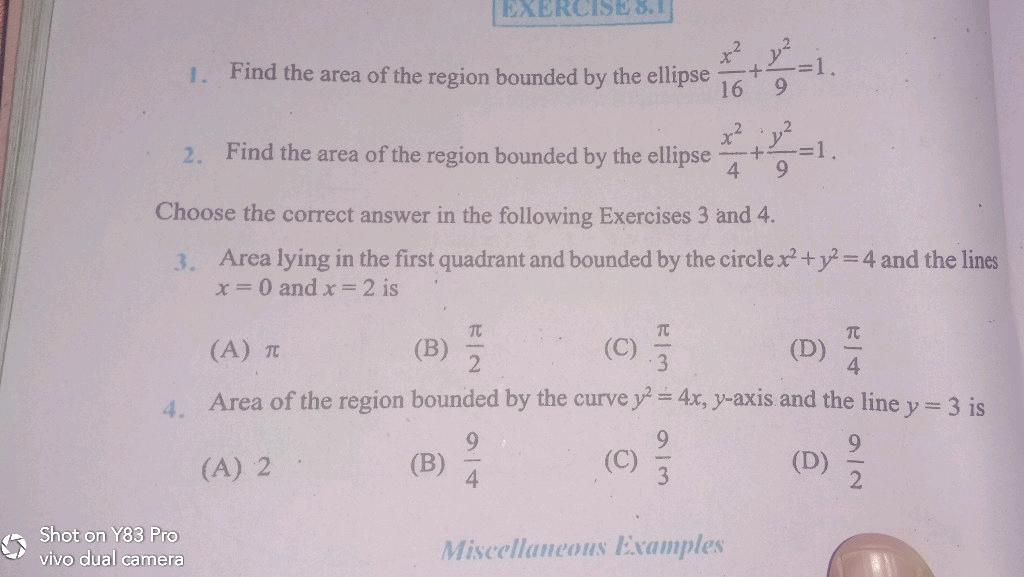
Solutions to Calculus Exercises: Areas Bounded by Curves
Exercise 1: Area of the Region Bounded by the Ellipse
 FORMULAS & RULES USED:
\text{Standard Equation of an Ellipse: } \frac{x^2}{a^2} + \frac{y^2}{b^2} = 1
\text{Area using Integration: } A = 4 \int_{0}^{a} y \, dx = 4 \int_{0}^{a} \frac{b}{a}\sqrt{a^2 - x^2} \, dx
\text{Standard Integral: } \int \sqrt{a^2 - x^2} \, dx = \frac{x}{2}\sqrt{a^2 - x^2} + \frac{a^2}{2}\arcsin\left(\frac{x}{a}\right)
\text{Geometric Area Formula: } A = \pi a b
 STEP-BY-STEP SOLUTION:
Step 1 — Identify the Semi-Axes of the Ellipse
The given equation of the ellipse is:
\frac{x^2}{16} + \frac{y^2}{9} = 1 \implies \frac{x^2}{4^2} + \frac{y^2}{3^2} = 1
Here, the semi-major axis is a = 4 and the semi-minor axis is b = 3.
Step 2 — Set up the Definite Integral
Because the ellipse is symmetric with respect to both coordinate axes, the total area is 4 times the area in the first quadrant:
y = \frac{3}{4}\sqrt{16 - x^2}
A = 4 \int_{0}^{4} \frac{3}{4}\sqrt{16 - x^2} \, dx = 3 \int_{0}^{4} \sqrt{4^2 - x^2} \, dx
Step 3 — Evaluate the Definite Integral
Using the standard integration formula:
A = 3 \left[ \frac{x}{2}\sqrt{16 - x^2} + \frac{16}{2}\arcsin\left(\frac{x}{4}\right) \right]_{0}^{4}
A = 3 \left[ \left(0 + 8\arcsin(1)\right) - \left(0 + 8\arcsin(0)\right) \right]
A = 3 \left[ 8 \cdot \frac{\pi}{2} - 0 \right] = 3 \cdot 4\pi = 12\pi
━━━━━━━━━━━━━━━━━━━━━━━━━━━
 FINAL ANSWER:
12\pi\text{ sq. units}
━━━━━━━━━━━━━━━━━━━━━━━━━━━
 KEY CONCEPTS:
- Symmetry in Integration: Multiplying the area of a single quadrant by 4 simplifies the limits of integration from [0, a] instead of [-a, a].
 COMMON MISTAKES:
 Incorrect Approach: Integrating without multiplying by 4, which yields only one quadrant of the ellipse (3\pi).
- Correct Approach: Multiply the first quadrant integral by 4 to find the entire bounded region.
Exercise 3: Area Bounded by the Circle in the First Quadrant
Circle Area in the First Quadrant
STEP-BY-STEP SOLUTION & OPTION ANALYSIS:
The circle equation is x^2 + y^2 = 4 = 2^2, which has its center at (0, 0) and radius r = 2.
The bounded region is in the first quadrant, between x = 0 (the y-axis) and x = 2 (the rightmost boundary of the circle).
-
Method 1 (Integration):
A = \int_{0}^{2} y \, dx = \int_{0}^{2} \sqrt{4 - x^2} \, dx
A = \left[ \frac{x}{2}\sqrt{4 - x^2} + \frac{4}{2}\arcsin\left(\frac{x}{2}\right) \right]_{0}^{2} = 2 \arcsin(1) - 0 = 2 \cdot \frac{\pi}{2} = \pi
-
Method 2 (Geometric Formula):
The first quadrant represents exactly one-quarter of the total area of the circle:
A = \frac{1}{4}(\pi r^2) = \frac{1}{4}(\pi \cdot 2^2) = \pi
Evaluation of Options:
- (A) \pi: Correct. Represents one quadrant of a circle of radius r = 2.
- (B) \frac{\pi}{2}: Incorrect. Corresponds to an area of radius r = \sqrt{2}.
- (C) \frac{\pi}{3}: Incorrect. Arithmetic error in evaluating the area.
- (D) \frac{\pi}{4}: Incorrect. Corresponds to a unit circle quadrant (r = 1).
━━━━━━━━━━━━━━━━━━━━━━━━━━━
FINAL ANSWER:
(A) — \pi
━━━━━━━━━━━━━━━━━━━━━━━━━━━
Exercise 4: Area Bounded by the Parabola and the y-Axis
Parabolic Region Bounded by the y-Axis
STEP-BY-STEP SOLUTION & OPTION ANALYSIS:
The bounding curve is given by y^2 = 4x, along with the line y = 3 and the y-axis (x = 0).
Since the region is bounded by the y-axis, it is most direct to integrate with respect to y from y = 0 to y = 3:
x = \frac{y^2}{4}
-
Step-by-Step Calculation:
A = \int_{0}^{3} x \, dy = \int_{0}^{3} \frac{y^2}{4} \, dy
A = \frac{1}{4} \left[ \frac{y^3}{3} \right]_{0}^{3} = \frac{1}{12} \left[ 3^3 - 0 \right] = \frac{27}{12}
-
Simplifying the Fraction:
\frac{27}{12} = \frac{9}{4}
Evaluation of Options:
- (A) 2: Incorrect.
- (B) \frac{9}{4}: Correct. Matches \int_{0}^{3} \frac{y^2}{4} \, dy = \frac{9}{4}.
- (C) \frac{9}{3}: Incorrect. Arises if the factor of 4 in the denominator is omitted or misapplied.
- (D) \frac{9}{2}: Incorrect. Forgets the division by 3 during the antiderivative calculation \int y^2 dy = \frac{y^3}{3}.
━━━━━━━━━━━━━━━━━━━━━━━━━━━
FINAL ANSWER:
(B) — \frac{9}{4}
━━━━━━━━━━━━━━━━━━━━━━━━━━━
Would you like to solve a similar practice problem involving integration along the y-axis?