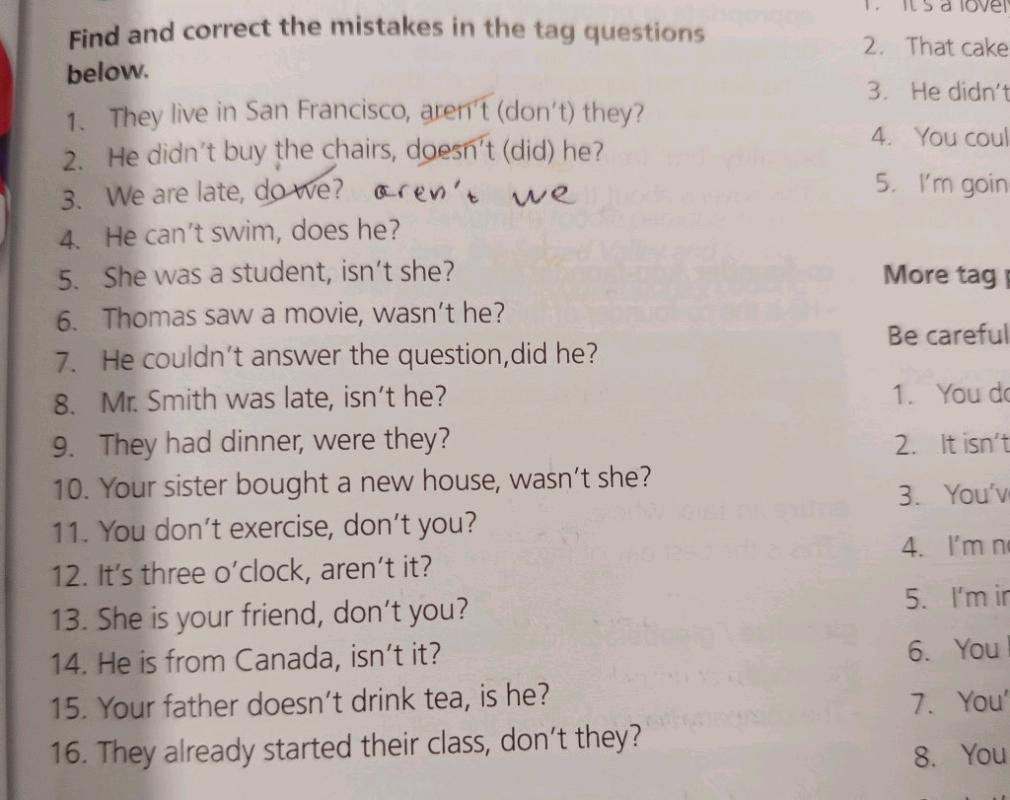
Find and correct the mistakes in the tag questions below.
- They live in San Francisco, aren’t (don’t) they?
- He didn’t buy the chairs, doesn’t (did) he?
- We are late, do we?
- He can’t swim, does he?
- She was a student, isn’t she?
- Thomas saw a movie, wasn’t he?
- He couldn’t answer the question, did he?
- Mr. Smith was late, isn’t he?
- They had dinner, were they?
- Your sister bought a new house, wasn’t she?
- You don’t exercise, don’t you?
- It’s three o’clock, aren’t it?
- She is your friend, don’t you?
- He is from Canada, isn’t it?
- Your father doesn’t drink tea, is he?
- They already started their class, don’t they?
Tag Questions: Identifying and Correcting Auxiliary and Pronoun Errors
 KEY FORMULA / RULE: A tag question mirrors the tense and auxiliary/modal verb of the main clause, matches the subject pronoun, and reverses the polarity: an affirmative statement takes a negative tag, whereas a negative statement takes an affirmative tag.
 SOLUTION & CORRECTIONS
-
1. They live in San Francisco, aren’t they?
- Correction: don’t they?
- Reason: The statement is affirmative Present Simple with an action verb, requiring the auxiliary do \rightarrow negative tag don’t.
-
2. He didn’t buy the chairs, doesn’t he?
- Correction: did he?
- Reason: The statement is negative Past Simple (didn’t), so the tag must be affirmative Past Simple (did).
-
3. We are late, do we?
- Correction: aren’t we?
- Reason: The main verb is the affirmative present form of be (are), requiring the negative tag aren’t.
-
4. He can’t swim, does he?
- Correction: can he?
- Reason: The modal verb can’t is negative, requiring the affirmative modal tag can.
-
5. She was a student, isn’t she?
- Correction: wasn’t she?
- Reason: The verb is Past Simple was, so the tag must match the tense in the negative (wasn’t).
-
6. Thomas saw a movie, wasn’t he?
- Correction: didn’t he?
- Reason: Saw is a Past Simple action verb, which requires the past auxiliary did \rightarrow didn’t.
-
7. He couldn’t answer the question, did he?
- Correction: could he?
- Reason: The modal verb is couldn’t (negative), so the tag must use the affirmative modal could.
-
8. Mr. Smith was late, isn’t he?
- Correction: wasn’t he?
- Reason: The main clause uses Past Simple was, requiring the corresponding negative tag wasn’t.
-
9. They had dinner, were they?
- Correction: didn’t they?
- Reason: Had functions here as a Past Simple main verb (to have dinner), requiring the auxiliary did \rightarrow didn’t.
-
10. Your sister bought a new house, wasn’t she?
- Correction: didn’t she?
- Reason: Bought is a Past Simple main verb, requiring the auxiliary did \rightarrow didn’t.
-
11. You don’t exercise, don’t you?
- Correction: do you?
- Reason: The main clause is negative (don’t), so the tag must be affirmative (do).
-
12. It’s three o’clock, aren’t it?
- Correction: isn’t it?
- Reason: The singular contraction it’s (it is) requires the singular negative tag isn’t.
-
13. She is your friend, don’t you?
- Correction: isn’t she?
- Reason: The subject is she and the verb is is, requiring the matching tag isn’t she.
-
14. He is from Canada, isn’t it?
- Correction: isn’t he?
- Reason: The pronoun in the tag must match the subject of the clause (he).
-
15. Your father doesn’t drink tea, is he?
- Correction: does he?
- Reason: The main clause uses the auxiliary doesn’t, so the tag must be the affirmative auxiliary does.
-
16. They already started their class, don’t they?
- Correction: didn’t they?
- Reason: Started is in the Past Simple, requiring the past auxiliary did \rightarrow didn’t.
 EXAM INSIGHT / PITFALL: Always verify that the tag uses the exact same grammatical subject pronoun (he/she/it/they) and matches the auxiliary of the main clause rather than introducing an unrelated verb (e.g., using wasn’t instead of didn’t for action verbs in the past tense).